Showing posts with label Houston Ballet. Show all posts

10.17.2016

Acting Professionally in a Rehearsal Studio

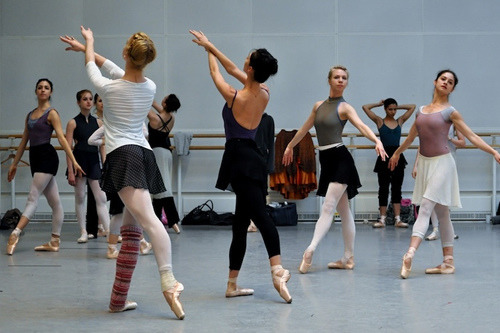
The Royal Ballet in rehearsal (Photo: Unknown)
Rehearsal etiquette is one of the many unspoken areas of our silent art form. There is no particular way that each and every rehearsal studio is run. But at the same time, there are general no-no's (and yes-yes') that are taught within the culture of a company as they create, fine-tune, and prepare a work for the stage.

Back a handful of years ago I was working with a pickup company that employed enough dancers to fill a small rehearsal room. In other words, our athletic group of 8 had to get along considering our company's size. A few of us were more seasoned than the others. But one dancer was enjoying the raw, empowering, and often shocking experience of their first job as a professional. Previously, I talked about my experience at my first full-time job with Houston Ballet and how I stepped on dancer's toes without even realizing it. After watching this type of situation from the other side, as a senior dancer, I was taught a lesson in kindness, patience, and humility.

Dancing for a big company is very different than dancing for a small ensemble. In a bigger company, dancers often feel more comfortable being up front (if not, sometimes, mean) when trying to streamline a young dancer into their place in the unique culture of a professional company. If any interaction becomes tense, dancers can retreat into their clique for comfort or hide behind other dancers who are more willing to stand their ground. But in a small company, there is nowhere to hide, very little hierarchy, and everybody has to interact frequently with one another in the studio.

Smuin Ballet in rehearsal (Photo: Chris Hardy)
Back to the occasion of watching this new dancer enter a rehearsal studio without the assimilation that the rest of us dancers had. It was a generally difficult situation to endure. The leadership wasn't very good at running a rehearsal studio and they let the dancers have a bit too much control over what happened. This new dancer became a stressor for other dancers as they were acting in ways that went way beyond the etiquette of most professional environments. Things like actively telling other dancers how to fix their dancing, counting over the choreographer, and regularly interrupting the process to crack jokes became the norm. And while the other dancers with more experience didn't approve of this behavior, the director and ballet mistress chose to allow it to continue.

Now, it is perfectly healthy to run a studio where dancers feel that they are a valuable part of the process, where the environment is light and friendly, and where a dancer feels that they can speak up when they feel that something isn't working properly. But this dancer started to become a distraction and affected the ability of others to work to the best of their abilities. Due to the size of the company, where another more experienced dancer may have talked to their freshly minted colleague, this dancer was left continually breaking "rehearsal-code" for the extent of the gig. This was most likely due to the fact that, in such a small group, everybody knew that a small amount of tension between two dancers would be felt by all.

In this company, many of the dancers looked up to me and respected my work. And for that reason, it was suggested by some that I speak to this dancer to give them an idea of professional rehearsal etiquette. But, as I stated before, I felt it would cause too much tension and that it was actually the responsibility of those in the front of the studio to hone this character in. Looking back, I'm glad I maintained this position. But this is the advice that I would offer that dancer today if I were the person at the front of the studio.

First things first, the way you act in a rehearsal studio as a student is completely different than when you are a professional. Most students who become professionals have reached the top of the hierarchy of a school. Essentially, if the school had a ranking, these dancers are the Principals of the school. In a professional company, a top-level student most often enters at the lowest rank and seniority. In most professional rehearsal setting, Principals have more leeway and freedom in their choices, actions, and vocal interaction than others. Not to say that a new professional can't have a voice or input. But it is the job of an apprentice or first year dancer to sit back and absorb what is happening around them. They don't have equal cultural standing to those higher ranked or more senior dancers. Just like in medieval times, the apprentice to the blacksmith didn't walk in on day one and start working with the iron. It may have taken a long time before the mentor allowed the apprentice to even touch any equipment, let alone lead the creation of a work of art.

My next bit of advice is to keep an open mind about your idea of what a rehearsal should look like. School rehearsals are often much slower paced with more time to retain choreography, fine-tune, and engage in conversation. Many professional environments are much faster-paced and don't open up the room to ask questions or discuss particular material until all of the material is already out. This is to help streamline the process and may even be an effective money-saver. In school, most of the students are paying to dance. In a professional environment, time is money. The longer dancers are in rehearsal, the more they get paid and the more time spent paying for rehearsal space (esp. in freelance or project based gigs that don't have a home studio). There are reasons for professional rehearsal culture that go beyond personalities and people getting along.
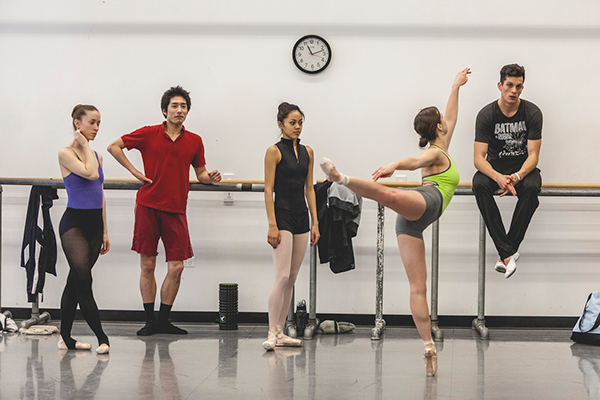
Joffrey Ballet in rehearsal (Photo: Lenny Gilmore)
The final idea I'd like to share about rehearsal etiquette is a grey area that is fluid from company to company, but generally recognized in some way or another. I'd like to bring up seniority and respect for dancers with more experience. One of the big issues with this fresh, new dancer was that they felt their presence in the studio was absolutely equal in contribution to the more experienced dancers around them. I'd love to say that this is the perfect ideal, but it was actually one of the most challenging aspects of working with this person. The difficulty laid in looking at them as a person versus their job and position as a dancer. As a person, we all enjoyed this dancer very much and wanted to give them a chance to find their place. But as a dancer, many of us felt disrespected by this person's actions. For instance, a young dancer should never think it is acceptable to offer unwarranted corrections to a more senior dancer. Additionally, taking over a rehearsal space and telling dancers how to count or how your exploration of the process is more correct can be horribly disrespectful and doesn't acknowledge a dancer's wisdom gained from time put in. Whether a young dancer is more naturally talented than a senior dancer doesn't play into the fact that dancers with seniority have spent years fine-tuning their technique, movement, and rehearsal practice. The value in hiring more senior dancers is that they have existed in a professional dance studio much longer than younger dancers. They are brought back to dance for an organization because they have a very keen sense of how to work effectively and professionally in a variety of work environments. Even a dancer with immense talent can not innately understand this. And for this reason, it is extremely important that they take a step back and absorb the culture that experienced dancers project. Because in the end, these senior dancers are not projecting their own idea of the culture. They are projecting the culture that came before them and taught them that culture and so on. You are essentially being taught the cultural history of the company by learning from those who came before you, absorbing it, and then will hopefully pass it on when you aren't the young or new one any more.

As you can see, I shied away from sharing too many specific items about how to act in a studio. This is mostly because each and every studio functions differently and most effectively per the needs of an organization. I don't want any dancer to ever feel completely stifled by trying to fit in to the culture of a dance company's rehearsal process. But if you approach a professional rehearsal studio with respect for those around you and respect for what came before, it will be much easier to acclimate to dancing for a company. And, if you are lucky enough, perhaps, you will have the staying power to become one of those dancers that helps the next generation learn a company's culture from your fine example.

10.15.2015

Giving Everything for Your Art (or not)

Performing Mary Anthony's Threnody (Photo: Bill Hebert)
When I was a young, freshly professional 19 year old near-child moving thousands of miles away from home to join Houston Ballet, I was a bit of a bunhead. Actually, let's be honest here. I'm still a complete and total bunhead. During my short year with the company, I became great friends with my fellow Apprentice and (now) new Houston Ballet faculty member Alex Pandiscio (proud shoutout). We in our bunheaded glory would sit at his apartment sipping beer, watching ballet DVDs (or VHS :-o), and debate about everything from technique to artistry to production quality. When I left to join Pacific Northwest Ballet, I really missed having a friend that was equally, if not more passionate about our art form.

Once I got into the swing of things at PNB, more often than not, I found dancers trying to fill the gap between living your life as a dancer and living your life and dancing for a living. If I suggested a ballet viewing night, people would tease me. If I wanted to sit down for drinks after work and talk about technique, people would quickly ask to change the subject. Here I was, in one of the most inspiring companies in the country seeking greater inspiration than an 8-hour workday. I found that many of my colleagues didn't want to make dance their lifestyle, which is perfectly fine. But I preferred the opposite. So, when I finally took the plunge and left PNB, it was easy for me to use this as one of the excuses for me to leave. I told myself that I needed to be surrounded by people who would give anything and everything for their art.

After making my way to Philadelphia, my 22-week seasonal contract meant that I would need to seek gigs in between work periods with the contemporary company I was dancing for. My first (and only) foray into the Philadelphia freelance scene was performing for a small modern company that is based on the technique of niche choreographer Mary Anthony. To be completely honest, it wasn't really my thing. But I went into life after PNB with an open mind as to where things would lead me. And for the first time in a long time, I felt like I was surrounded by people who would do anything for our art. Anything!

At PNB, I was used to rehearsing for productions anywhere from a few weeks to a few days before getting onstage to perform. Preparing for this Philly Fringe Festival show, we spent nearly 8 weeks rehearsing (granted it was only 6-8 hours per week) mostly after the sun had gone down. Dancers came into rehearsals late, and it was acceptable, because they had regular day jobs. It wasn't uncommon for heated discussions to happen as the work was restaged. Some dancers were much more vocal than any dancer would be in a ballet studio, while others were so happy to be dancing that they would do anything and everything necessary to be a part of the company. The contrast between strength and submission was great and utterly shocking to my ballet world expectations. Beyond all of this, pay was only guaranteed to most dancers after tickets were sold or grants came through. This meant that some dancers didn't see any compensation for months after the work had been performed.

Some weeks before we performed, our group took a trip up to New York City to work with Mary Anthony herself. She was still kicking (barely) at the ripe old age of 94 years old. We were to have rehearsal with this woman, who cultivated an intensely respectful cult following, at her studios. This rehearsal would be followed by us sharing the work in a fundraising open rehearsal. While a few dancers had dropped hints, nobody prepared me for what I was about to see or experience.

After taking an elevator to the 8th floor of a building between St. Marks and NYU that housed the Mary Anthony Dance Studios (where she was still teaching class twice a week), we were dropped off on her floor and immediately turned right into the dressing rooms. We had been sitting on a Bolt Bus for a few hours, so I had been holding my bladder for a long time. I turned to one of my fellow modern dancers and asked where the bathroom was located. He simply responded, "Walk through the lobby, past Mary's bedroom, and it will be on the left." The comment didn't really add up to me. My first thought, "Oh, Mary lives here? I guess the studio is bigger than I expected." Nope! I walked out of the dressing room and laying right behind the front desk was Mary Anthony resting on her bed. YES, right behind a desk in the lobby.

Mary Anthony lived in her studio. The lobby consisted of a front desk, a bed, a dining room table, and a door to the bathroom. The dressing rooms tripled as a place to put your clothes on, the food pantry, and a litter box area for her cat that roamed the 8th floor. Between the lobby and studio was a small cove for a kitchen. The sacred dance studio was just a dance studio. The place wasn't in disarray, but it wasn't very clean, there were nails sticking out of the nearly plywood dance floor, and there were cans of roach spray in every room.

In my culture shock, I walked through the bedroom, past the kitchen, and into the dance studio for warm-up. As I felt a nail poke my foot through the foot-blackening wooden floor, my chest tightened and another dancer must have seen the panic in my heart. She looked at me and said, "No nail here. I'll switch spots." After getting our sweat on while Mary Anthony was awakened and prepped for rehearsal, a quietly stoic figure walked with assistance into her proud home one inch at a time. She sat in rehearsal without changing expressions. When a correction needed to be made, she whispered into her adoring former dancer's ear. And then, suddenly, out of nowhere, this woman raised her voice into a boom. She stared at me with eyes dilating, "you are a SAILOR! you've had a HARD LIFE! YOU'RE...TOO...PRETTY!" That was the most she said that day. But it was said that she was most her former self in that one moment.

Performing Mary Anthony's Threnody - Me on the right (Photo: Bill Hebert)
Our open rehearsal had a minimal showing of support. We enjoyed wine and hors d'ouevres in the lobby immediately after performing Ms. Anthony's work. Living to the frail age of 94 must be exhausting, so Mary's assistant put her to sleep. To paint the clearest picture possible, Ms. Anthony lay on her back asleep in her bed, eyes covered with a floral sleep mask as dancers multiple generations past Mary's prime sipped wine and chatted around her frail sleeping form. As I stood over Mary, sipping my dry wine, and appearing to listen to another dancer talk about their next gig, I had an utterly deep realization. Maybe there is such a thing as giving too much to your art.

On the bus ride back to Philly over a smuggled bottle of Sauvignon Blanc, the dancers who had shared this experience previously told me about their first venture to the Mary Anthony Dance Studios. I think the thing about most shock is that you can only be shocked by the same thing once. These dancers now saw this experience as commonplace to learning a Mary Anthony work. As stories continued to flow, I learned that many in the dance community considered her a legend in the same realm as Graham and Limon. Mary started her own company, and since many of the dancers whom she hired had difficulty finding work in the prime time of the classical modern dance era, her dancers not only adored the woman but saw her as a motherly idol. Mary was not so nice in her less frail days. But she was passionate and had a very clear vision. She also performed well into her 70's. At one point, as her studio was struggling to survive, Mary was offered a tenured position to teach at New York University. But Mary felt that she would have sold out by taking that position. So, she chose to continue living the life she did. One where the line blurred between studio and home, work and life.

Performing Mary Anthony's Gloria (Photo: Bill Hebert)
Near the end (Mary had impressively lived over 2 years after this experience), it became clear that Mary had completely and utterly devoted her life to her art form. And I have such an incredible respect that she was able to remain so honest to her values as an artist. But meeting and working directly with somebody who had such great dedication and longevity that her life and art fused into one entity without care for quality of life taught me a very valuable lesson.

We all devote ourselves to this beautifully painful art form to one degree or another. Some people leave dance at work, others bring it home with them. And for others, dance is literally their home. I used to be more judgmental about how people that call dance a career chose to make it a part of their lives. But after this experience, I view things quite differently. I'd give most everything in my life to be a part of this art form. And while I don't look down on people who do give absolutely everything to this art form regardless of their well-being, I find that it is best to find a middle ground that makes one feel fulfilled and equally alive as a human being. As we are not dancers living as people. We are people living as dancers.

11.02.2014

How Failure and Risk Helps Me Succeed

A few months ago, when I walked into the advanced ballet class at Alaska Dance Theatre on a warm summer afternoon, I am pretty positive that I caught a few of the kids off guard. I am far from an easy instructor. In fact, I can initially come off a bit harsh in my teaching methods. I'm no bullshit and I will tell a student exactly what I saw. If I truly think they did well or if I have seen marked improvement, I will tell them. But I don't really care to coddle students, patting their backs with comfort, or telling them that it is OK and maybe they'll get it next time. At the time, there wasn't much room for nonsense, anyway, because I wasn't even sure how long these kids would get to have me as their instructor. After what was probably a shockingly difficult barre that required exact precision or a restart to the beginning, I stood in front of the class and told them this. "I want you to fail in my class. Ballet class isn't about succeeding. It's about trying the same step incorrectly multiple ways until you find what works for you. Trip, fall, hold your leg until it is shaking with exhaustion. The studio isn't a place to constantly succeed. It is a place to fail, so that you can ultimately become successful." I don't remember if an instructor ever put it to me this way, but perhaps I feel this way because this is how I live my life outside of the studio.

Attempting to get a good shot as the sunrises over Masada & the Dead Sea in Israel
I've been dancing my whole life, but I didn't fall in love with ballet until I was 15 years old. I was a jazz competition kid who just happened to get bit by the ballet bug while working with choreographer and former New York City Ballet and American Ballet Theatre principal Robert Lafosse. Once I fell in love with ballet, there was no stopping me from achieving a career. With that said, there were countless times that I was told to give up my ballet dreams and head in the direction where I excelled, jazz and musical theatre. Each time I was given that talk, sometimes from the people I most respected, it pushed me to work harder. After finally succeeding at getting into Houston Ballet's year-round program, I probably took the first major risk of my career. After accepting my offer to attend and an August summer intensive with ABT, I came home with three days to pack and head to Texas. As I tried to mentally prepare for a move that I had been waiting over a year to do (I was accepted the year prior, but my mom wouldn't let me go), I slowly began to feel that I shouldn't isolate myself in the middle of the country during the last year or two of my training. I begged my mom to let me risk this opportunity and we drove to New York City to audition for the School of American Ballet year-round program. We drove to Lincoln Center, I auditioned, and the next day I got my results directly from the horses mouth. "No. The notes say, generally poor technique and extremely large quadriceps. Goodbye." I was beside myself!

After this crushing failure, I could have easily jumped on that flight and began training. But I just couldn't bring myself to leave. One day later, we drove three hours south to the Kirov Academy of Ballet. After a private audition, the late director stated in broken English, "Very slow year for boys. One third scholarship." This was far from my full ride to the Houston Ballet Academy and way out of the financial abilities of my family, but we were able to get a sponsor for my first month in the academy. As I headed down to the Kirov, I knew that I had to get greater sponsorship to continue my training at the school, but I felt hopeful that I was still close enough to New York City to feel connected to the center of the dance world. Then, two days later, September 11th happened, my sponsor froze their assets and I was left with an impossibility to continue my training. After the school graciously allowed me to remain for the first two months, they eventually decided to put me on full scholarship and I finished out my year of training.

At the end of my time at the Kirov, I had obtained a corps de ballet contract with Colorado Ballet. While I was ecstatic to begin my career as a professional. I had also been accepted to the School of American Ballet on full scholarship for their summer intensive. SAB was my dream and it had eluded me until this point. Seeing four students who trained at SAB perform in the Nutcracker that Robert Lafosse had choreographed was the defining inspiration that changed the trajectory of my career. I knew that I had to take this summer opportunity to see if a year-round option opened up. If this happened, I was willing to delay my career to live my dream. I called SAB and asked if they were considering me for the year-round program. They told me to take the job with Colorado Ballet because they couldn't promise me anything. So, I excitedly, yet reluctantly, signed my contract and started looking for a place to live in Denver.

A few months later, I arrived in Lincoln Center to finally realize a 5-week version of my dream. After three amazing days working with teachers I had only read about in Dance Magazine, I was pulled into a conference room along with one other classmate. There I was with one of my peers being the first two dancers asked to stay for this world-famous year-round program. I was committed to Denver, but my dream had just arrived. There was no way I could turn down this opportunity, even though it meant I had to train for another year, as well as destroy a very positive connection in the dance world. I promptly called up the director of Colorado Ballet and profusely apologized as I explained that I had to follow my dream. That next year at SAB changed my life as a dancer.

SAB workshops 2003 (Photo: Paul Kolnik)
One ironic part of my path is that turning down Houston Ballet Academy to train at two other schools only led me to get a job dancing with Houston Ballet. I had an interesting year working as one of Stanton Welch's first hires as an Artistic Director. At contract time, Stanton doesn't typically offer re-engagement to any apprentice across the board. AGMA states that dancers can only spend one year with the company as an apprentice, so they either need to be promoted to corps or let go. Typically, the director waits to see amongst the corps who will stay or leave and, only then, starts to promote the apprentices into the corps. When we all were"let go," I didn't feel comfortable waiting around to find out if I would get hired or not. I quickly obtained a contract with Pacific Northwest Ballet and Boston Ballet and signed with PNB. I still wonder to this day if I would have been offered a corps contract, but I was ready to move on to a more positive environment in a more metropolitan city.

My time at PNB has been well-documented in this blog. It had it's mix of highs and lows. While I was secure in my position and well-respected as a union delegate, I was itching to experience something new. I risked all of this security and seniority to try my hand at working with a fledgling, start-up company. After a great first few months, I injured myself and the company didn't support me. I was eventually fired by that company, which I consider one of my greatest failures. It wasn't so great only because I had moved my life to Philadelphia, but more so because I had given up so much to take such a huge risk.

Taking risks daily
While I gave up all of my security and lifestyle to expand my reach and possibilities as an artist, I was now stuck in Philadelphia, burgeoning on poverty, and injured. In these dark circumstances, I had to find a way to survive. This brought me into freelancing, choreographing, writing, teaching, and traveling. If I hadn't experienced the failure that I did, I don't know if I would ever have traveled the country to dance, written articles that have been published in periodicals, been featured in dance publications, or directed an organization 4,000 miles away from home. If I had stayed at PNB, I would probably be stuck in similar circumstances that I was in nearly four years ago.

As I begin to close the chapter on my most recent risk-taking failure, I am curious where life will lead me next. I took a chance to do something that I wasn't sure if it would be a great or poor decision. While I could look at the whole experience as an utter failure, what I am realizing is that my life is much like a dance studio. I spend each day of my life exploring different ways of experiencing this wild career and testing out ways of achieving my best through trial-and-error, or failure. Some things have worked out perfectly on the first try and some things have failed immediately. But in the end, the knowledge that I have gained and the growth I have had will only make my future experiences more successful. Failure can have such a negative connotation in our culture. But I just don't really see it that way. It takes practicing a pirouette ten-thousand times to finally achieve the perfect one. And, sometimes, right after that perfect pirouette, you fall hard on your ass, get back up, and try to make it perfect again.

My greatest success at Alaska Dance Theatre

4.24.2014

Performing for No Reviews

The Seattle Times - one of PNB's regular reviewing publications
It was Black Friday, November 23, 2007, and it was opening night of Pacific Northwest Ballet's The Nutcracker. I was cast in one of my favorite roles, the Sword Doll. And this was one of the first shows of the holiday season, so I hadn't moved into my seasonal Nutcr-apathy yet. I was really hoping to impress the audience in what was one of the few featured roles I had danced at that point in my career. Shortly after this performance, a regular reviewer for CriticalDance, Dean Speer, wrote a review assessing the upkeep of this oft performed production. Towards the top of the piece he stated that the "phrasing is slightly different than in years past – more push and pull; attacking something then letting it resonate. I first noticed this with Barry Kerollis’ Sword-Dancer Doll – punching a sauté développé à la seconde, for example, and then letting it ‘sit’ for a moment before pushing on to the next step. I really liked this, as it allows each thing to read." This was one of my first public mentions. The notice instantly hooked me on getting my name written in any and all publications that came to review our shows.

As a student, the only time you really get a chance to perform publicly are in school shows, lecture demonstrations, and youth competitions. Unless a dancer is in their final years of training, they are unlikely to be involved in any production that get much press beyond small local newspapers and proud parent's Facebook posts. Other than the largest, most prestigious academy graduation performances, reviews are generally non-existent. Once you enter a professional company, it is much more common and appropriate to be publicly scrutinized.

I started dancing with PNB in July of 2004 after spending a year with Houston Ballet. By the time the above review was written, I was already in my fourth season as a professional. It is almost impossible for a Corps member to be called out unless they perform a role that steps out of the group. Could you imagine a dance critic writing, "The 4th flower from the right, Dancey McDancerson, showed great emotion in her developpes." For obvious reasons, it can take awhile for a dancer to get noticed and for critical mention to be publicly addressed. Speer's posting was probably just another Nutcracker article for him, but for me it meant much more. Beyond the fact that I got mentioned positively in a featured role, the interpretation that he was talking about was my own signature. Every year, anywhere from 5 to 10 dancers performed this role. Due to the lack of rehearsal leading into these performances, dancers often had a bit more wiggle room for interpretation. My musicality was uniquely my own and Mr. Speer showed appreciation for that.

After receiving a positive review, many dancers start looking forward to moments that could bring them to the attention of the public and, potentially, the director. The thought in my head was, "If the public notices me, the director must surely see that." And while this may not have been the best way to approach my performances, it definitely offered some great motivation.

As I started to get better roles, more critics in the Seattle area started to take notice of me. I became hungrier for attention. There is a great online forum that is both loved and hated by professional dancers, Ballet Alert. This site is a moderated forum for balletomanes across the world. On the site's message boards, ballet lovers, reviewers, professionals, parents, and more can discuss and debate anything relating to this untouchable profession. PNB had a large base of local fans that were very vocal about dancers and productions (albeit through a computer screen) on this website. Beyond the critiques written in professional publications, Ballet Alert followers often wrote their own reviews and perspectives to discuss and speculate. More often, their words are positive and pensive. But at other times, writings can descend into gossip, speculation, and bullying. As much as company members liked or disliked this forum, many of us kept close tabs on what people were writing.

My next four years passed at PNB and I started to find myself more tied to the reviews I received. I was starting to feel stagnant in the company and assumed that receiving glowing reviews would change my boss' mind. I remember debuting as Mercutio in Romeo et Juliette and waking up each morning to see if anybody had written anything about my performance. The reviews came out and they were quite positive. As the season continued, I added more roles to my resume and received greater reviews. Then, contract time came. I wasn't promoted. And to make matters worse, dancers in the company started coming up to me asking if I had been promoted (most dancers find out that they are getting promoted when they receive their letter of re-engagement). While this was a great compliment, it also left me quite confused. I had performed well all season. Critics and dancers alike had seen my progression. But when it came to the one opinion that mattered, it seemed that I had made no progress.

Studio showing of Maan Singh - Photo: Philip Gardner
After spending one more frustrating year in the same position, I decided to leave my big company roots to try something new. As I started to freelance in medium-sized companies, small organizations, and a variety of projects, I found that I was still eagerly seeking reviews at the end of our production weeks. But now I was performing in less popular venues. At one gig, I performed in a small studio in New York City. And the next was at a performing arts center in Anchorage, Alaska. People were coming to see me perform, but few people were posting about it in print or online.

I remember the first time I danced with Houston Ballet and realized that I didn't have any family or friends in the audience. I felt that I had no cheering section for whom to dance. I learned then to dance for myself and not for the accolades I would be showered with after shows. Once I moved to Seattle, I slowly started to create a presence that was recognizable by critics and regular audience members alike. And while I didn't always get press, I had motivation to impress. All of a sudden, I found myself back at square one onstage at the Wortham Theater with no support system in the audience. It was almost as if the reviews had become my support system.

I had a bit of an epiphany back in March when I performed Romeo and Juliet for Fort Wayne Ballet. My performances with the company marked the first time I was brought in as a Principal Guest Artist to lead a full-length ballet for a company. I have been brought in to dance leading roles many places, but never to carry the entire production. After all of my hard work, I spent a couple of days googling my name, Fort Wayne Ballet, and Romeo and Juliet. But nothing showed up. Initially, I was quite disappointed that nobody had been around to record the occasion. The company didn't film any of the shows I did, so I figured the best way to preserve the feeling that I had during and after the performance was to get an amazing review. You can only imagine the let down of putting that much pressure on getting public recognition in a town of 250,000 that is more interested in sports than arts.

A few weeks ago, I did my final search for a review of the performance. It took one last disappointing look for me to finally get it. What I was seeking was a physical memory of my performance because I so enjoyed it and didn't want to forget the experience. But in my efforts to hold on to the memory, instead of relishing the performance, I was seeking validation that it was a good memory. If this performance is as special to me as it was, I won't forget it. I won't forget the first time that I stared into Lucia Roger's eyes and felt that I saw my love for the first time. Or when we danced the MacMillan version of the Balcony pas, a duet that I had idolized as a teenager. Or how I legitimately cried onstage for the first time over the dead body of Mercutio. Or how the audience instantly rose to their feet after we had experienced a wildly realistic rollercoaster of emotions.

What it comes down to is that we have very few records of our careers as dancers. Photographs, footage, and reviews are the few records we will have of our careers when they are over. As a result of this difficult detail, I was relying too heavily on physical record to validate my experience. What really matters in dance, as in life, is how we felt while we were doing the things that we love. And those memories will be with us forever. A review might remind us of how others perceived us, but only we dancers can remember how it truly felt standing in the glow of the spotlight putting everything we have on the line.

Elizel Long and me from an unreviewed performance in Alaska - Photo: Shalem Photography

4.15.2014

The Frightful First Day of Work

During my first few weeks at PNB
Your first day at a new workplace is often a blur. New faces, new practices, and putting your best foot forward are three of many components that overwhelm most people after joining a new company. While there is a great amount of stress to show that an employer was right to choose you for the job, your first 8 hours on the job are rarely representative of what it will be like to work for a company or what you will be like working for that company. There is a lot to expect on the first day and a lot you want to project into your new environment.

I would call myself the king of the first day. Maybe that is reaching a bit far, but I have experienced more first days of work in the past 3 years than most people will experience in a lifetime. Looking back to my very first day with my first full-time company, I really can't tell you much. I joined Houston Ballet in July of 2003. I had spent a few weeks in the city getting my apartment together and adjusting to an adult lifestyle at the ripe age of 19 years old. I had met a few dancers in the company while getting in shape at the school's annual summer program, but didn't really know what to expect once our actual contract had commenced. I had a little taste of first day jitters when I guested with American Ballet Theatre in their Romeo and Juliet tour to the Kennedy Center while I was still training at SAB (fun side note: I was David Hallberg's 2nd cast when he had to go into the role of Benvolio. He was still in the corps.) But the beginning of your time with a company that could become your home is very stressful.

I had imagined day one of my career like this. The night before the start of my dream career finally arrived. I was really excited and a little bit nervous. My ideal night of sleep included about 8 hours of sleep. I showed up to the studio early. I needed to arrive in time to dress in the perfect outfit that I picked out the night before. I warmed up the best that I ever have. I made sure that I respectfully found the best place at barre that was still available. I didn't forget to smile at every dancer that walked by. People like happy beings, right? Class started and I knew I was going to have the best class of my life. You know, that class where even the long-time principal say, "Wow! That guy is incredibly talented!" After class, I was basking in the excitement that surrounded me. The director hired his new star, the company wanted to talk to the new talent, and my ultimate dream had been realized. Then I realized, that my dream day at my dream job is only a dream. A dream I had been building up for the last 2 years of my training.

Just another day on the job at PNB
None of these things happened on my first day, except for these things; I was nervous and excited that night before, but slept poorly. I must have been experiencing way too many adrenal emotions to actually get a good night of sleep. And I did smile at every person that I encountered. Many did not smile back. The reality of my first day at work was that for most of the people in the company, it was only their mundane return from vacation. It was nothing new or exceptional. And for me, now that I have been dancing professionally for 11 years, I don't even remember what happened on that day.

Luckily, at least for my readers, I have had many first days over the past 3 years to remind me what it feels like to leave your first impression on a boss and coworkers. As a freelancer, you will likely have many first days. And while, I am not completely numb to the prospect of showing a new group of people why I am the best person for the job, I am not as concerned about making an absolutely wholesome, perfect impression on day one.

Last week, I flew to San Francisco to begin working with Oakland Ballet. As with most of my freelancing work, I don't audition for the jobs that I am offered. My friend, Amy Seiwert, suggested that the director, Graham Lustig, take me into consideration to work with the project-based company for 6 weeks. Graham had never met me before and had likely never even heard my name. So, not only did I need to represent myself as a dancer, I needed to show for the person that trusted me enough to put their reputation on the line to get me a job. Since I am such a regular at this first day business, I wasn't too worried the night before.

I've been stuck in a bit of a pickle since I arrived in the bay area and I am still in the process of, hopefully, working things out. Housing isn't provided for this gig (the first time and last time I will accept work this way) and the place that I was supposed to stay fell through. A friend with a loft 1-bedroom condo very graciously offered me a place to crash until I resolved my situation. And while an apartment with no separating walls and a 40-minute commute to work wasn't ideal, I didn't really have any other options.

Oakland Ballet's rehearsal space - Malonga Casquelourd Center
On our first day of rehearsals, I woke up early to take the bus downtown to start my first day of work. After checking Googlemaps, I found that a specific bus would get me to the rehearsal space with 15 minutes to spare before class. I arrived at the bus stop five minutes early and went on to wait a half hour for the bus to arrive. Yes, my bus never showed up and I had to wait until the next one arrived. I tried to hail passing cabs and I seriously considered walking the additional 2 1/2 miles to work. While this was, perhaps, my 10th first day of work this season, I still felt awful and embarrassed when I had to text the artistic director that I probably wouldn't make it to class. Luckily, Graham was understanding of my situation. But if this had been one of my first jobs, I may have had a panic attack.

I arrived for class about 5 minutes late, but made it in time to join in two combinations late. My first thought upon running in to continue barre was, "my coworkers probably think horrible things of me right now." But then, I took a step back and thought back to watching others have a first day in companies that I have danced for. I barely noticed anything about those people on the first day. After class, we started rehearsing a new piece by Sonya Delwaide. Her choreography was fun and quirky and after a short hour-long audition, I was selected to be in her piece. Lunch passed and small talk ensued among us dancers. Half of the dancers work together seasonally and remained in a tightly knit group, but the others quietly sat around trying to connect without showing too many of their true colors. Everybody acts overly tentative on days like this. It makes sense. Nobody wants to be overly excited and everybody wants to be liked by everybody. For this reason, people play it safe on day one.

These dancer from Axis Dance Company will be joining Oakland Ballet in Sonya's piece
After lunch, we began rehearsing with Robert Moses. He briefly and briskly taught 32 counts of choreography. Then he told us to change the order of the steps. Following this, we paired up with another dancer, took our newly crafted solos, and turned them into duets. The only thing, for me, was that one of the dancers was missing because she was driving from Colorado after a weekend performing in Denver. I was partnerless. I couldn't learn the choreography of the duet by myself. And because of this handicap, once Robert started creating his piece, I was left out in the cold.

By the end of the day I was emotionally exhausted and a little unhappy. I was in a new time zone, I was sleeping on a couch, and I was commuting nearly an hour to work on a transit system that was unreliable. The first impression of me was being late. I wasn't immediately loved by every dancer in the studio. And one of the choreographers, the one that I was most excited to work with, didn't even seem to know that I existed. This was my first day and it was shitty. I failed in all of the places I had hoped to succeed on my first day with Oakland Ballet. All of this while being the most seasoned at entering a new workplace.

The reason that I share this story is because it really speaks volumes about what to expect on your first day of work and how much it really means in the long run. Yes, you want to do your best. Yes, you want to make your mark. But the first day is usually a whirlwind and it is rarely a representation of what work will be like, how you will get along with people, and what your true growth potential with that organization will be.

It is only one week later and so much has already changed since arriving to dance with Oakland Ballet. While I may still be figuring out my housing situation, I have figured much out and other things have evolved. My commute is no longer an issue. When I was still at my friend's house, I walked an extra 5 minutes to the BART, a much more reliable mode of transportation. I haven't been late since. Many of the dancers have opened up to me. And while I may have bonded to a degree with one or two people on the first day, the people that took longer to break through to seem to be getting closer with me than those who were more immediately. I am still enjoying Sonya's rehearsals and I have become a much more integral part of Robert's piece.

Many other factors have changed in the short week that I have been dancing with this company. If I had a first day like I did last week towards the beginning of my career, I may have had an absolute meltdown trying to cope with the stress of trying to prove myself worthy of the contract offered to me. But after my recent bad first day, I called my husband and shook it off. With the knowledge and experience I have, I knew that the rest of my experience with this company was not going to be based on all of the first impressions I had and made that day. This is because a first day of work is like a first date. Everybody is on their best behavior. Everybody is trying to look and do their best. Once everybody gets comfortable and things start to evolve, things fall into place and you get to see what the experience will truly be like. So, go into your first day as we all do. But don't go home thinking the best or the worst. Be happy that you had this day in the first place and take your first day attitude into everyday from there on.

Don't feel like this after your first day (Clarion Alley in the Mission District)

How have you felt on your first day of work?

7.29.2013

Clearing up the fear of going to classy events

Attending a gala fundraising event for Alaska Dance Theatre w/fellow ADT dancer Sarah Grundwaldt
One of the most interesting things about being a dancer is that you, at times, get to experience the life of luxury. While most dancers can barely afford a modest 1-bedroom apartment, a car, an acceptable computer, and a few dinners out a week, they are expected to dip their toes into the lives of the wealthy and act accordingly. I remember my first event at a donor's house when I was an apprentice with Houston Ballet. Everybody was dressed to the nines, holding a glass of wine in one hand, and grabbing hors d'oeuvres with the other. As I tried to find that balance between figuring out how to act and pretending like I had attended hundreds of these special events, I began my journey into adulthood and the life of a professional dancer.

Most of these events are greatly important to organizations that employ you and pay your salary. At these fancy venues, companies inspire interest and develop relationships that may eventually or already have funded programs, seasons, and artists like myself. While many artists prefer to sit in the corner talking to their friends and colleagues, it is greatly important as a dancer and person that we learn how to reach out and properly conduct ourselves in these situations. For this reason, I have compiled a list of proper etiquette, behavior, and the best ways to approach multiple angles of these events.

- Always read the invite to make sure that you understand the time, location, and type of event.

- Different types of attire:

Casual - Wear something comfortable, but avoid t-shirts and inexpensive jeans that look worn, torn, or old.  Men - maybe a collared shirt or something that isn't a t-shirt. Women - A relaxed dress or nice slacks.

Cocktail - Wear something classy, but nothing like you would wear at a wedding. Men - no jeans, definitely a collared shirt or classy top. Women - same as men with jeans. Wear a cute dress that you
Baby version of me in cocktail attire.
might wear if you were going out with your friends. Add some nice jewelry for flare.

Gala/Black-tie - Men - Wear a suit and tie, blazer, or, if you really want to show off, a tux. Women - A very classy and nice dress or a fancy suit. More refined than something you would wear out on a Saturday night. 

- Arrival - I always love when the first person who shows up to a party is exactly on time. Unfortunately, having been to and thrown many events, I have seen the discomfort on that person's face when they realize they are the first and only person/couple there. If you aren't privy to break the ice with the host or have a conversation with more strangers than friends, being the first to arrive is probably not for you. I would suggest showing up about 30 minutes late if you feel this way. Within an hour to an hour and a half of the party starting, there is usually a speech or something important happening. Try to arrive by the end of the first hour at the latest. As long as you show up by a reasonable time, though, nobody will bat an eyelash at you. Just have an, "I had another amazing event to go to first," excuse.

- How To Act - One thing that most people are worried about is that they have to be on their best behavior. Yes, you have to be respectful to the host, come off as interested and knowledgeable about your field, and remain social. But you shouldn't change your personality, completely avoid disagreeing with a view/opinion, or worry about doing the wrong thing. Don't pretend to talk about something that you don't understand. If you don't understand, ask for more information on the topic. This will show you are engaged and eager to get to know somebody. In the end, while people at these events may feel elite, they are still human beings with concerns, faults, and eccentricities.

- Don't get wasted. If you accidentally go a little overboard, though, it is not the end of the world. Unfortunately, you will find that there are a few people at every major event that get a little too toasty. If this happens at each and every event, you may start to get looks and become the avoided one (maybe consider checking into AA). But nearly everybody at these events has had a moment. Just don't knock over any million dollar vases. And, of course, make sure that you have somebody to drive you home safely.

- While this isn't a requirement, most people feel most comfortable with a drink in their hands. If you want to slow down or don't drink, get something non-alcoholic. If you don't want to feel pressure from people, lie to them and tell them that your water is a vodka soda. Nobody will ever know.

- One thing that drives me nuts is how people get embarrassed about eating at parties, especially with a drink in their hand. If you are hungry, eat. Alcohol is often flowing at these parties to liquor up donors and convince them to donate money/relax and enjoy themselves more. If you don't eat, you may have one of those moments I was talking about above. There is nothing wrong with finding a corner where you can put your drink down to use your hands to eat. It can be difficult to eat at a stand-up party. If somebody asks you a question while your mouth is full, hold a finger up, laugh it off, and joke about it. There is no reason to be uncomfortable eating, as everybody is in the same position and it is not easy to eat with one hand free.

- Make sure that you don't venture into a part of the house that may be off-limits. Many donors have expensive items that they want to protect or they want to keep the party compact. You don't want to be the reason that a donor stops holding events at their place.

- While it is perfectly acceptable to spend some time talking to friends/colleagues, don't stand in a closed circle the entire time. Potential donors come to these events because it is their chance to feel like they are an integral part of an organization. If you aren't comfortable meeting donors on your own, grab a friend and walk around with them.

- To start a conversation, ask somebody how long they have been involved in an organization. My favorite go-to ice breaker when an event is directly after a performance would be, "What was your favorite part of the program?" While you may know nothing about each other, you at least have one common interest, dance.

- Don't talk about yourself the entire time. Donors are usually interested in hearing what a dancer has to say. But they usually connect with dancers that also express interest in what they do. Mutual interest is much more engaging than egotistical self-promotion.

- To exit a conversation, you can say that you want to mix and mingle more. If the conversation has become increasingly difficult to exit, it is easiest to excuse yourself to use the restroom.

- If there isn't a clearly marked end time, feel when the crowd is starting to dwindle. Try not to be the last person at the event, unless you know the person throwing the party or if they have engaged you in conversation. Keep an eye on social cues from people who are trying to be nice, but really want you to leave.

The only ways to truly embarrass yourself at a classy event is to become way too intoxicated or to completely isolate yourself with your friends and stay closed off in a corner while ignoring donors. Everybody has broken a wine glass, been approached with a mouthful of food, stumbled here or there, or made an off-the-wall comment. If you follow these guidelines while attending a high-level event, you should be fine. But if you read all of this information really closely, you'll find that most things are acceptable and that accidents do happen and are most often acceptable. Go prepared to be social and to enjoy yourself. Don't avoid these events. Not only can they be the most memorable events in the most amazing venues, but they can also form relationships with donors that may lead to friendship, promote your career, and support future work inside and outside a company.

Two close friends & donors, Ray Hoekstra & Dan Drummey, at Pacific Northwest Ballet's gala event in 2006

7.11.2013

New York Calling

Thank you for your patience over the last few weeks as I have taken a break from writing regular blogs. For over a year, I have been writing continuous posts without a break and after throwing a successful CONTACT event (stay tuned for an upcoming blog), I took a vacation to LA and gave myself a true break. With that said, I am proud to say that Life of a Freelance Dancer was recently published in Dance/USA's online E-journal. This honor is a true testament to the content that is posted in this blog and I couldn't be happier with that. Thank you to my viewers and I can't wait to see what is to come. Now on to this weeks topic!

Bowing as "Puss & Boots" at SAB workshop 2003
At the age of 19, I danced in my final workshop performance as a student with the School of American Ballet, packed up all of my belongings, and hopped in my mom's car to drive home for the last time before joining a big company. It was a very emotional period for me. Not only was I saying goodbye to a group of friends that had become family. I was embarking on a journey that marked the end of my career as a student. All I had known was being a student. Not only did this performance note the finishing of my training, it also put a period on the end of my childhood. On the drive back to Pennsylvania, I began to cry within moments of entering Lincoln Tunnel. My mom asked me why I was crying. I replied that other than missing my real-life friends, I felt like I was leaving behind one of my best friends. New York City. I knew then that the city that never sleeps would always have a place in my heart and that I would one day return.

I moved to Texas to join the Houston Ballet less than a month after my exit from SAB. Being thrown into a new environment, hours and hours of rehearsal, and figuring out how to live on my own, I quickly forgot how much I really missed New York City. As the year passed, I came to realize that having come straight from the country's largest metropolis made it difficult for me to enjoy my transition into Texas-living. I missed walkable streets, good public transport, and having thousands of people breeze by me on their own path. I quickly realized that I needed to find another company in a city where I could live happily. Thus, my journey to Seattle began.

View of the Joyce Theater from the stage
Although I never really fell in love with the city of Seattle, I did find the city a relief from the heat and sprawl of Houston. Again, I had to adjust to my new home and company, but this time I had 7 long years to live, learn, and grow into an adult. By my sixth year in the company, I remember thinking about New York quite often. After joining a small group of PNB dancers on tour to perform at The Joyce Theater, I realized how isolated we really were in the Pacific Northwest. Just stepping foot into Steps on Broadway gave me a great idea of what I had been missing. I consider Steps the Cheers of the ballet world. Nearly every professional I know either takes class regularly or drops into this landmark dance studio when they are in town. There were dancers in class that I hadn't seen in years. Although I realized that these former classmates, colleagues, and friends hadn't forgotten who I was, I felt like I had been missing out on something really important.

I don't know what seed had been planted in me that eventually grew into my yearning to jump ship. But when it happened, I was set. I wanted to live in New York, but I didn't want to join the vast ranks of New York City Ballet or American Ballet Theatre (if they would even take me). So, my partner and I agreed that I would only audition for companies in cities where we wanted to live. The list was San Francisco, Los Angeles, Chicago, Montreal, Boston, Philadelphia, DC, and Miami. If all else failed, we would move to New York and I would freelance. Although this idea mortified me, it felt like the perfect backup plan. Alas, I was offered a job in Philadelphia and we moved to the Mid-Atlantic.

Although I was very excited to move back home (even though I am really from the burbs), I was even more excited to be close to New York again. I was already on a Bolt bus heading to an open rehearsal with a summer gig before I had even really settled into my new apartment. I got off the bus, looked around, and smiled very widely to myself. I was home. But, after spending three weeks in the city performing in the Guggenheim's Works and Process series a few months later, I had a realization. As an adult, I really didn't want to live in the city unless I could enjoy living there. When I was training at SAB, I was on full scholarship, which included classes, housing, meals, and a few more perks. My childhood in New York was a facade. I didn't have to worry about anything financially. It's a very different story as an adult and I wasn't privy to living in my favorite city and scrounging by. I have friends who live in the tiniest apartments at the highest prices. They often skip out on the finer things the city has to offer due to financial restraints. At the same time, I was happy with my transition into a new style of dancing in Philly. Why would I want to leave.

Well, as I have alluded to in the past, after nearly 8 months in our new home city, everything came collapsing down on top of me. I became injured and couldn't afford what I needed to recover. I could barely pay my rent with the greatly reduced salary I had accepted to try something new.  And now that I was injured, fear was really starting to set in as I continued dancing through the pain just to scrounge by. Finally, when I decided to take time off to heal, everything imploded into me. The company had been hiding workers comp from me for months. I found out and the company responded with anger, threats, and lies. All other details aside, it nearly destroyed me, my career, and being. Not only did I fear that I would lose my home and career, I feared walking the streets of my city because I didn't want to run into any part of the close-knit dance scene that only knew a very skewed version of what actually happened. It only felt natural that I run away from the pain and fear and start anew.

After this very challenging experience, it crossed my mind many times that I should pick up and run to New York. Aside from being a great escape, there were freelancing opportunities galore. But money, my partner, and a handful of other life-items kept me from escaping all of this turmoil. Lucky for me, I had all of these things tying me down to Philadelphia. If it weren't for that, I likely would have been reacting, instead of making a conscious, thought-out decision. For this reason, we stayed in Philly and I started living the life of a freelance dancer.

It has been 16 months since these events happened and I am still happily a resident of Philadelphia. Although I find myself traveling more than half the year, I am always excited to return back home. At times, work has brought me to New York. And trying to connect with the greater part of the New York freelance community has kept me coming back. After last week's CONTACT event, I was asked to attend an audition to workshop a piece that could eventually be developed into a much larger show. I found out recently that I had landed the gig and will be spending two weeks in New York at the beginning of August.

What I have come to realize is that although I am not currently a resident of New York, being that it is the center of the dance world, I will always return. Whether as a student, professional, teacher, choreographer, entrepreneur or more. But what I have also realized is that while New York holds a large place in my heart, for the time being it is not my home. And I am perfectly happy with that. In fact, I love Philadelphia. Part of that is due to its' close proximity to New York City.

Quintessential New York City shot - Columbus Circle
Now that I call Philly my home and don't see that changing at any point in the foreseeable future, I am not yearning to be a New Yorker anytime soon. I see myself picking up work in the city and spending large chunks of time in this important hub of dance. But Philly will remain my home-base. New York continues to call and I will continue to answer. I feel any dance-professional, whether a New Yorker or not, feels this way to a degree. And you know what, when it does call. Answer!

6.19.2013

Emotional Health - Cultivating things you enjoy

I have recently begun practicing yoga again. While dancing with Pacific Northwest Ballet, I felt extremely lucky that one of the local yoga studios, Urban Yoga Spa, had such an appreciation and care for us dancers that they offered discounts on their yoga packages. Having such accessibility to study in great classes made it easy to fall in love with this ancient physical, emotional, and spiritual practice. After moving to Philly, I tried a few yoga studios. But none kept. Due to my constant travels and my generally high expectations of classes, it took me nearly two years to find a place that inspired me to return and practice regularly. A month ago, I found Yoga Garden only three blocks from my apartment. This studio is literally steps outside of my home. Beyond that, the classes are physically challenging and emotionally stimulating. For me, the emotional part is just as important as the physical.

The life of a professional dancer comes with an array of challenges. Whether you are in a company or have set out on your own, this career is about 20 percent reward and 80 percent challenge. Of course, the rewards, although less frequent, can be so extremely exciting that they usually outweigh the hardships and disappointments. Nonetheless, we dancers tend to take in the stress of challenges without any great processing beyond feeling upset or let down. Dancers ingest a great deal of bad in hope that with hard work and good timing things will turn around and they will be put on the cover of Pointe Magazine, be promoted to principal, and/or get asked to guest in galas around the world. Unfortunately, this is the trajectory of less than 1% of the professional dance population. The build up and quiet burying of these feelings can really wear on a dancer's emotional state. Without taking steps to ensure fulfillment and happiness beyond the worth placed on a dancer in their current situation, dancers can easily become depressed, jaded, and bitter towards something they are actually quite passionate about.

Living in the "PNB Bubble" - Costume archive photo for Jerome Robbins' The Concert
Being out of what a friend and I called the "PNB bubble," it is easy to look back at my time with this large company and analyze how things worked. We call it a bubble because the outside world mostly ceases to exist when you work 40 weeks a year with a handful of people in a wildly competitive atmosphere. It can be easy to lose sight of how incredibly talented each individual dancer is, how far everybody in the company has come since childhood, how much everybody gave up to refine their art, and much more. Each person's value is based upon what they are dancing at that moment and where they are ranked in the literal and social hierarchy of the company. Due to this "bubble" effect, people's self-worth can practically disappear and their passion can disintegrate.

In the freelance world, things can work in a similar fashion to that of a "bubble." But for the most part, it is completely different. Because freelancers don't often work within the same community from job to job, their emotional state can be greatly affected by whether they are working or not, the quality of their dance work, and what they are doing to make ends meet beyond rehearsals and performances. Sometimes, dancers will take on work that they feel is sub-par or uninspiring just to get a paycheck. At other times, dancers will take on multiple jobs, from waiting tables to office work, in order to make ends meet. If a dancer doesn't have current rewards from their dance jobs, it can make much of what one is doing, inside and outside of dance, feel wasteful and demoralizing since it isn't helping push the artist to the next level.

On tour at the Joyce Theater
Last summer, I wasn't planning on freelancing and my situation caused me to miss the general cut-off to look for summer dance and teaching opportunities. I found myself dancing work that I may have taken before I entered my professional finishing programs and teaching whatever, wherever. I even sought out jobs that had nothing to do with dance. At the age of 28, I was doing everything that I had feared I would do before I landed a job with Houston Ballet a decade earlier. My self-worth went through the floor and I found myself floundering emotionally. An acquaintance I had met at a party after I premiered with PNB at the Joyce Theater had noticed that my updates on Facebook had begun to take a turn from cheerful to withdrawn. Lynne Goldberg (her site will be available on 6/22) is a life/career coach that has a passion for dance artists. She reached out and offered me a one-on-one session to see what was going on in my head. A great piece of advice that she gave me was to make four lists; things I'm good at, things I need, things I enjoy, and things I don't enjoy. After looking at these lists, Lynne instructed me to look at the things I'm good at, enjoy, and need, and try to cultivate more of those things into my life. She also suggested I look at the things I don't enjoy and try to take those things out of my life, as they will be the least fulfilling and probably make me unhappy. Although there is no easy fix to things, I try to take this advice in everything that I do. One thing I learned was that even if I may be good at something or it may gain me great financial reward, if I don't enjoy it I will probably not be happy.

Going back to the discussion of my yoga practice, I took a challenging class this evening with the studio owner, Mark Nelson. One quality that determines the difference between a good yoga teacher and a great one is their ability to inspire emotional well-being while also providing a well-structured practice. At the end of each class, Mark offers a quote or statement to make his yogis think and grow as human beings. Today, we were gifted this little gem at the culmination of our practice."Take what you love and take what you need. And do it." That statement is a short way of stating the exercise that Lynne had given me nearly a year prior. This perfect advice seems to keep thrusting itself into the forefront of my awareness. For dancers, this seems so appropriate because at one point in our training, we did exactly that and it made us happy. It can be easy to forget. Once we become professionals, we have the added stress of achievement, survival, and expectation (personal and social). There is an emotional transition of attitude once dance goes from hobby to job. If a dancer finds that work is becoming overly stressful or unfulfilling, it is important to find things that crossover on both the "things I enjoy" and "things I'm good at" lists and start to cultivate those interests. I have seen more dancers quit/retire far too early due to what I call "emotional injuries." Emotional survival is actually the key to having a long and successful dance career. Namaste!

3.27.2013

Staying in the loop

Once you stake a claim on your own little part of the dance world by becoming a freelancer, you will come to realize that, at times, you will feel more connected to the dance world than ever. On the flip-side, you will find that there are times when you feel more disconnected from dance-happenings than ever. I pass from extreme to extreme. Throwing my Contact event back in October gave me an opportunity to feel closely connected to many artists. But spending three months in Alaska, for instance, watching friend's Facebook and Twitter feeds filled with performance photos and merde wishes can make me feel that all of the excitement of the dance world is flying by thousands of miles from the epicenter of my career. I don't want to fall behind the mark. I don't want to walk into a conversation without an understanding of what is current. I don't want to stop expanding my experience as a dancer. So, I find ways to stay up-to-date on happenings in the dance world.

The art of dance is always evolving. Even when companies are putting masterful classics on their stages, the dancers who dance these works have different training, personalities, and styles that keep even the oldest of works fresh and exciting. One important aspect of the work a freelance dancer must commit to is keeping up with current happenings in their art. The dance world is wildly interconnected and people are more compelled to develop a relationship with you if they can relate to you through common bonds and interests. Dance is already a common bond, so it just needs to be cultivated. The other reason to stay up-to-date is because it improves your ability to market yourself and to search for work.

Important pieces of information to seek in your research include companies and their current programming, who is dancing where, and how companies are being perceived by the public. I find that I spend much of the summer scanning company websites to see which works they have chosen to put on during their coming season. It is always interesting to see trends and to analyze why they are happening. For instance, my first season as a professional with Houston Ballet, everybody was performing Balanchine works. If you weren't in the know, you could easily deduce that there was a reason that so many companies were performing his choreography. The reasoning? If Balanchine were still alive, it would have been his 100th birthday. This was the perfect reason to celebrate the choreographer and put his work on nearly every major and minor ballet company's stage. This season I have been quite intrigued by the multitude of companies that have restaged or premiered a new version of Stravinsky's Rite of Spring (one of my favorite pieces of music EVER!). I am not
Freshly painted for Tetley's "Rite of Spring" with PNB
aware of the reasoning behind this trend and maybe it will show its' face in the years to come. But it is likely that one company performed this work last season and the company had great ticket sales. Perhaps, a combination of one director's love for this work and the hype of one company's good fortune in the past year or so caught the attention of directors across the country. Or in the case of current up-and-coming New York City Ballet choreographer and newly-promoted soloist, Justin Peck, who recently created a piece for NYCB to rave reviews. He had one successful piece with a handful of promising write-ups and now everybody wants a piece of the pie. Miami City Ballet has already tagged their name onto his fresh success and mentioned that he was working with the company on social media. A few days after posting, they mentioned that he was working on a collaboration with only two dancers from the company. Nonetheless, they wanted to ride on this young choreographer's coat tails. But this is the beginning of a trend and I would put money down that he will be working with multiple companies over the next few years.

My reasoning for constantly checking rosters of dancers hired by companies is three-quarters professional and one-quarter personal. As I mentioned earlier, the dance world is quite small. It is easy to lose touch with friends and former peers. It is not uncommon for dancers to transition between a handful of companies as their careers evolve. I like to keep up with the whereabouts of my friends and to see how successful they have become. But on the professional side of things, it is interesting and helpful to see what kind of dancers directors are looking to hire. Rosters are usually updated somewhere between August and October prior to season opening performances. Scouting out information on dancers, their training, and their experience can help me gauge where I am in my career, where I want to go, where I should seek out work, where I shouldn't waste energy, and much more. You can also see whether a company is entering a transitional period, which may mean that they are more likely to hire freelancers as they regroup. Aside from company websites, I feel it is important to check out features in Pointe Magazine, Dance Magazine, Dance International, and Dance Spirit to see which dancers are being pushed into the spotlight. It is not uncommon for me to perform a Youtube search on these dancers to see how they dance. If I am isolated for a handful of months on a freelancing gig, this is the perfect way to inspire myself. I can look for qualities that I appreciate and take them on as corrections or goals in my everyday class and rehearsals. As dancers, I feel that we are most inspired by other dancers. I don't know one professional that began dancing because they saw a choreographer working. They were inspired by a dancer, who happened to be compelling dancing the work of a choreographer.

Performing my own work - Philly Fringe Fest(Photo:Bill Hebert)
One of the biggest challenges for me throughout my career has been to put less focus on a review/opinion and worry more about how I felt during a performance. This can be a challenge because most dancers want to see their name with stars around it. This is also harder because I have become good friends with a few reviewers for major dance publications with whom I love having lively discussions about performances we have seen. All of that aside, I find it extremely important to see how an educated audience is perceiving the growth or decline of companies. Of course, any review I read is viewed with a grain of salt and with the understanding that it is one individual's (or their small circle's) opinion. But reading multiple reviews of companies and their dancers can give me important information pertaining to what is intriguing, current, off-kilter, compelling, and beyond. Also, the more interest there is in a rising company, the more likely they are to have a multitude of reviews. I know that a performance is being given great weight if New York reviewers are sent away from their hometown to review a company's performance.

Now that I have explained all of the reasons one should stay up-to-date on all things dance, what are the best ways to stay current. First and foremost, staying in touch with your dancing friends. I find a ton of information through phone calls, Facebook/Twitter feeds, and messaging back and forth. If you don't have many friends that are involved in the professional dance world, you can follow dancers that you look up to on Twitter. Beyond that, I regularly check company websites. As I stated above, dancer rosters are typically updated between August and October. Most companies make announcements for their upcoming seasons between March and May. Many also have a press section on their website, where recent reviews and press releases are listed. I frequent the links section of Ballettalk. Each day, this site's administrators post links to reviews and stories in publications about companies large and small. Reviews and features are also posted in Pointe magazine, Dance Magazine, Dance International, Dance Spirit, and other respectable publications. If you know exactly what you are looking for, go to Google and type directly into the search box.

It is easy to fall out of touch with happenings in the dance world. If you don't put in the work to stay up-to-date, you may get behind and fall out of the loop. I always tell people that freelancing is a lot of work. Aside from dancing, teaching, marketing myself, and writing this blog, I put forth great effort in keeping up with current events. Although I am genuinely curious about what is happening out there, the time spent researching these items is work. I consider it a part of my job to put in a great deal of time doing this research. And to be completely honest, it really pays off.