Showing posts with label Royal Ballet. Show all posts

10.17.2016

Acting Professionally in a Rehearsal Studio

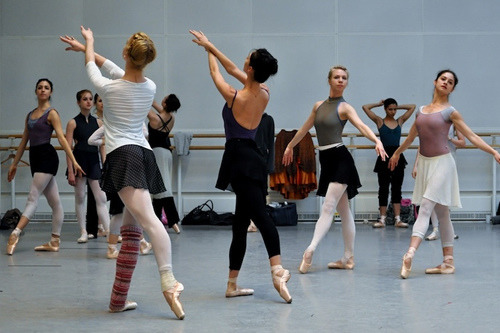
The Royal Ballet in rehearsal (Photo: Unknown)
Rehearsal etiquette is one of the many unspoken areas of our silent art form. There is no particular way that each and every rehearsal studio is run. But at the same time, there are general no-no's (and yes-yes') that are taught within the culture of a company as they create, fine-tune, and prepare a work for the stage.

Back a handful of years ago I was working with a pickup company that employed enough dancers to fill a small rehearsal room. In other words, our athletic group of 8 had to get along considering our company's size. A few of us were more seasoned than the others. But one dancer was enjoying the raw, empowering, and often shocking experience of their first job as a professional. Previously, I talked about my experience at my first full-time job with Houston Ballet and how I stepped on dancer's toes without even realizing it. After watching this type of situation from the other side, as a senior dancer, I was taught a lesson in kindness, patience, and humility.

Dancing for a big company is very different than dancing for a small ensemble. In a bigger company, dancers often feel more comfortable being up front (if not, sometimes, mean) when trying to streamline a young dancer into their place in the unique culture of a professional company. If any interaction becomes tense, dancers can retreat into their clique for comfort or hide behind other dancers who are more willing to stand their ground. But in a small company, there is nowhere to hide, very little hierarchy, and everybody has to interact frequently with one another in the studio.

Smuin Ballet in rehearsal (Photo: Chris Hardy)
Back to the occasion of watching this new dancer enter a rehearsal studio without the assimilation that the rest of us dancers had. It was a generally difficult situation to endure. The leadership wasn't very good at running a rehearsal studio and they let the dancers have a bit too much control over what happened. This new dancer became a stressor for other dancers as they were acting in ways that went way beyond the etiquette of most professional environments. Things like actively telling other dancers how to fix their dancing, counting over the choreographer, and regularly interrupting the process to crack jokes became the norm. And while the other dancers with more experience didn't approve of this behavior, the director and ballet mistress chose to allow it to continue.

Now, it is perfectly healthy to run a studio where dancers feel that they are a valuable part of the process, where the environment is light and friendly, and where a dancer feels that they can speak up when they feel that something isn't working properly. But this dancer started to become a distraction and affected the ability of others to work to the best of their abilities. Due to the size of the company, where another more experienced dancer may have talked to their freshly minted colleague, this dancer was left continually breaking "rehearsal-code" for the extent of the gig. This was most likely due to the fact that, in such a small group, everybody knew that a small amount of tension between two dancers would be felt by all.

In this company, many of the dancers looked up to me and respected my work. And for that reason, it was suggested by some that I speak to this dancer to give them an idea of professional rehearsal etiquette. But, as I stated before, I felt it would cause too much tension and that it was actually the responsibility of those in the front of the studio to hone this character in. Looking back, I'm glad I maintained this position. But this is the advice that I would offer that dancer today if I were the person at the front of the studio.

First things first, the way you act in a rehearsal studio as a student is completely different than when you are a professional. Most students who become professionals have reached the top of the hierarchy of a school. Essentially, if the school had a ranking, these dancers are the Principals of the school. In a professional company, a top-level student most often enters at the lowest rank and seniority. In most professional rehearsal setting, Principals have more leeway and freedom in their choices, actions, and vocal interaction than others. Not to say that a new professional can't have a voice or input. But it is the job of an apprentice or first year dancer to sit back and absorb what is happening around them. They don't have equal cultural standing to those higher ranked or more senior dancers. Just like in medieval times, the apprentice to the blacksmith didn't walk in on day one and start working with the iron. It may have taken a long time before the mentor allowed the apprentice to even touch any equipment, let alone lead the creation of a work of art.

My next bit of advice is to keep an open mind about your idea of what a rehearsal should look like. School rehearsals are often much slower paced with more time to retain choreography, fine-tune, and engage in conversation. Many professional environments are much faster-paced and don't open up the room to ask questions or discuss particular material until all of the material is already out. This is to help streamline the process and may even be an effective money-saver. In school, most of the students are paying to dance. In a professional environment, time is money. The longer dancers are in rehearsal, the more they get paid and the more time spent paying for rehearsal space (esp. in freelance or project based gigs that don't have a home studio). There are reasons for professional rehearsal culture that go beyond personalities and people getting along.
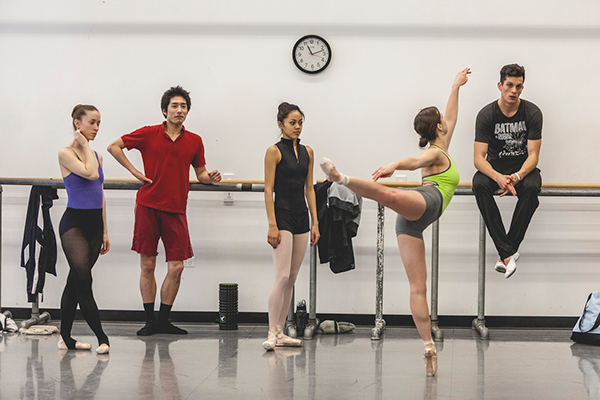
Joffrey Ballet in rehearsal (Photo: Lenny Gilmore)
The final idea I'd like to share about rehearsal etiquette is a grey area that is fluid from company to company, but generally recognized in some way or another. I'd like to bring up seniority and respect for dancers with more experience. One of the big issues with this fresh, new dancer was that they felt their presence in the studio was absolutely equal in contribution to the more experienced dancers around them. I'd love to say that this is the perfect ideal, but it was actually one of the most challenging aspects of working with this person. The difficulty laid in looking at them as a person versus their job and position as a dancer. As a person, we all enjoyed this dancer very much and wanted to give them a chance to find their place. But as a dancer, many of us felt disrespected by this person's actions. For instance, a young dancer should never think it is acceptable to offer unwarranted corrections to a more senior dancer. Additionally, taking over a rehearsal space and telling dancers how to count or how your exploration of the process is more correct can be horribly disrespectful and doesn't acknowledge a dancer's wisdom gained from time put in. Whether a young dancer is more naturally talented than a senior dancer doesn't play into the fact that dancers with seniority have spent years fine-tuning their technique, movement, and rehearsal practice. The value in hiring more senior dancers is that they have existed in a professional dance studio much longer than younger dancers. They are brought back to dance for an organization because they have a very keen sense of how to work effectively and professionally in a variety of work environments. Even a dancer with immense talent can not innately understand this. And for this reason, it is extremely important that they take a step back and absorb the culture that experienced dancers project. Because in the end, these senior dancers are not projecting their own idea of the culture. They are projecting the culture that came before them and taught them that culture and so on. You are essentially being taught the cultural history of the company by learning from those who came before you, absorbing it, and then will hopefully pass it on when you aren't the young or new one any more.

As you can see, I shied away from sharing too many specific items about how to act in a studio. This is mostly because each and every studio functions differently and most effectively per the needs of an organization. I don't want any dancer to ever feel completely stifled by trying to fit in to the culture of a dance company's rehearsal process. But if you approach a professional rehearsal studio with respect for those around you and respect for what came before, it will be much easier to acclimate to dancing for a company. And, if you are lucky enough, perhaps, you will have the staying power to become one of those dancers that helps the next generation learn a company's culture from your fine example.

1.23.2014

The Glory and Challenge of Young Success

Bowing 2nd from the left (cat outfit) w/many other successful teenagers - School of American Ballet workshop '03
Every one of us has heard these stories. 16 year old dancer is discovered by Peter Martins and named Principal dancer with New York City Ballet before she even turns 20. Preteen posts video on Youtube of himself singing and gets signed for a record deal. In fact, most of us were inspired to begin training in our art or began to pull more focus into our studies after hearing similar glory stories. While we may not all strive to be these people, who doesn't want to be showered with accolades under the premise that they are a youthful prodigy? As a culture, we glorify these kids and emulate their gifts. But more often than not, we indirectly engage in what is the downward spiral of these prodigious artists. Why is it so common for young, talented artists to struggle with their art, their decisions, and their lifestyle choices as they grow into adulthood?

While I wouldn't consider myself to be one of these prodigies, I have experienced the pressures of being very successful at a young age, as have many of my colleagues. Many professional ballet dancers are hired before they are legally adults and even more are considered seasoned before they can purchase a drink at a bar. By the time a dancer enters their 30's, if one even makes it that far, they are considered over the hill. Due to the spotlight and short span of time our careers cover, successes are usually great, lauded publicly, and die out fast. Just making it into such a cut-throat profession is a great success. And since this all happens at such a young age, nearly all dancers are used to the feeling of success and the impression it makes upon non-dancers around them.

Abby & me motivating for a performance of Swan Lake
I was speaking to one of my dearest friends, former Pacific Northwest Ballet dancer Abby Relic, via text the other day. She left the company a year after I did to pursue a broader perspective in the world of dance and acting. We have both endured struggles since we left the comfort of a big company. Some simply being life-related and others relating to our struggle to find our new place in the dance world. In the process of being each other's support system, I had responded with what was just a thoughtful response to a comment. Her response was, "So insightful!" That thought is what inspired this post and I would like to share it with you. "Being super successful young is a lot of pressure as you get older. Maintenance of those feelings becomes exponentially harder to maintain." As professional dancers, we are all super successful just for achieving a position in a world that offers few job opportunities.

It is human nature to keep pushing forward and growing. People want cities to become bigger with taller buildings. People seek to find the most cutting edge science and technology. And people want their salary to continue growing. We are innately wired to push forward and want more. If a teacher makes $50,000 a year and decides to leave the profession, they probably don't feel very good about taking a job that only pays $30,000 a year.

Feeling Puck-ish backstage w/my friend Joerg
I experienced this struggle after leaving my job at PNB. Not only was my salary one-third of what it had been, our productions didn't have a live orchestra, Pointe magazine wasn't writing about us, and our audiences were, at most, 400 people (compared to the nearly 3,000 I was accustomed to). As I began freelancing, even my successes started to feel like failures. The first time I got hired for a job, which I made happen on my own, I felt elation. By the tenth time, I wasn't happy with the quality of jobs I was being offered. At another point, I danced one of the most accomplished performances of my career. But there were only 60 people in the audience, making me feel it was less valid. Everything started becoming a comparison game. Well, this success wasn't as big as my thrilling debut (or so I was told) as Puck in Balanchine's A Midsummer Night's Dream, so it must have been a failure.

This can be the biggest challenge of being successful. Comparison of successes. Is a success a success? Or is a lesser success a failure because it is not a step up on the success ladder? Today yields a great example of this thought. Justin Bieber, love him or hate him, is an incredibly talented guy. He was discovered on Youtube, at a ripe young age, singing and playing the guitar. Being discovered was his first great success. Next, he dropped his first album. Further ahead, he had his first tour. He has won awards for his music, crossed over into a more adult fan-base, and garnered millions of dollars. But today he was arrested for a D.U.I in Miami. Over the past year, we have watched this talented young artist become the male Lindsay Lohan of the tabloids. He's considered out of control, hanging out with bad people, doing drugs, having a god-complex, etc. But if we take a step back and see what is going on, he is a victim of his own success. His successes have been so great, that it is becoming hard to live up to his own record. To the public eye, anything that he is achieving which is not perceived to be greater than what has happened before is a failure. The stress of success is great. How does one cope with that?

Bieber's story is not the first, nor will it be the last. On the dance side of things, we can look at Gelsey Kirkland's rise to stardom, drug addiction, and fall from grace. This story is documented in her book, Dancing on my Grave. Gelsey was lucky that she was able to survive the demons of her own success. Not only did her career end way too early, she fell off the face of the Earth in regards to the dance world, only to reemerge many years later to open her own school, the Gelsey Kirkland Academy of Classical Ballet. Probably enough time for her to stop comparing her former successes to her current successes. Recently, Darcey Bussel, famous former Royal Ballet ballerina, stated, "At least I'm not being compared to everything I've done in the past," in a recent article that spoke about a deep depression that she went into after retiring from the stage. Inevitably, the pressure of other's expectation of her ever-growing success became too much to bear. And I get it.

The biggest challenge of being successful is the way that people view you. At first, gaining praise for a success feels good. This motivates us to push harder to continue the flow of positive feedback that received praise. If one continues to achieve on a linear level, praise will disappear as the achievement loses it's excitement and becomes old news. As one's accomplishments grow larger and more exciting, there is less room to grow and greater expectation to continue that growth pattern. By the time an artist reaches the pinnacle of their achievements, there must be a fall. Success is fleeting because a singular success is not sustainable over a long period of time. Public pressure, whether national or local, can put so much stress on a person that they may begin to collapse. This leads to depression, burn-out, and/or self-destructive behavior.

How does one avoid the pitfalls of young success? It is challenging. First and foremost, we successful artists need to surround ourselves with people that love us for who we are, and not what we are. At times, artists may come off as cool and awkward upon meeting them. This is usually their way of assessing whether somebody wants to get to know them or get to know what they can do for them. Assessing friendships and finding people that one can trust are pertinent to keeping a level head. The next step is to stop comparing successes. This is most challenging for me. When you start comparing successes to one another, the excitement of big successes doesn't last as long and the smaller successes don't hold you up to keep you on a straight path to the exciting, big successes. One of the last things that helps keep oneself on track is to find a third party to speak to that has no stake in your success. I have recently started seeing a counselor to help me cope with the stresses of working as a traveling freelancer. My counselor doesn't just listen to what I may not be able to share with most people, they offer support, insight, and exercises to help me cope with my successes and failures.

While our culture looks at young success with wide smiles and high praise, it also relishes watching the downfall of the adult version of these young, successful artists. Many of us strive to become those artists that are at the top of their game at the earliest age possible, but steady success as we grow older seems to be underrated. Glory is good, but stressful. Surround yourself with trust and love and stop comparing yourself to yourself. You are who you are today, not yesterday. The biggest lesson I have learned in the past 3 years has been that my big successes are my trophies and my failures are, most often, actually successes that I didn't give enough value to when comparing them to my bigger achievements. Be kind to yourself and enjoy all of the success that you have had!