Showing posts with label Apprentice. Show all posts

10.17.2016

Acting Professionally in a Rehearsal Studio

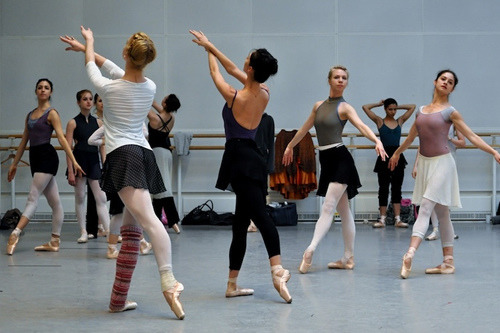
The Royal Ballet in rehearsal (Photo: Unknown)
Rehearsal etiquette is one of the many unspoken areas of our silent art form. There is no particular way that each and every rehearsal studio is run. But at the same time, there are general no-no's (and yes-yes') that are taught within the culture of a company as they create, fine-tune, and prepare a work for the stage.

Back a handful of years ago I was working with a pickup company that employed enough dancers to fill a small rehearsal room. In other words, our athletic group of 8 had to get along considering our company's size. A few of us were more seasoned than the others. But one dancer was enjoying the raw, empowering, and often shocking experience of their first job as a professional. Previously, I talked about my experience at my first full-time job with Houston Ballet and how I stepped on dancer's toes without even realizing it. After watching this type of situation from the other side, as a senior dancer, I was taught a lesson in kindness, patience, and humility.

Dancing for a big company is very different than dancing for a small ensemble. In a bigger company, dancers often feel more comfortable being up front (if not, sometimes, mean) when trying to streamline a young dancer into their place in the unique culture of a professional company. If any interaction becomes tense, dancers can retreat into their clique for comfort or hide behind other dancers who are more willing to stand their ground. But in a small company, there is nowhere to hide, very little hierarchy, and everybody has to interact frequently with one another in the studio.

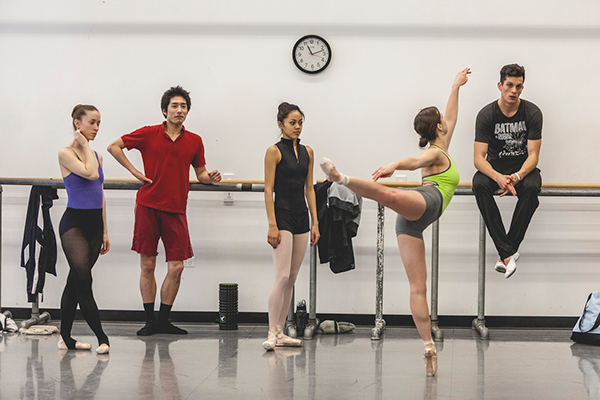
Smuin Ballet in rehearsal (Photo: Chris Hardy)
Back to the occasion of watching this new dancer enter a rehearsal studio without the assimilation that the rest of us dancers had. It was a generally difficult situation to endure. The leadership wasn't very good at running a rehearsal studio and they let the dancers have a bit too much control over what happened. This new dancer became a stressor for other dancers as they were acting in ways that went way beyond the etiquette of most professional environments. Things like actively telling other dancers how to fix their dancing, counting over the choreographer, and regularly interrupting the process to crack jokes became the norm. And while the other dancers with more experience didn't approve of this behavior, the director and ballet mistress chose to allow it to continue.

Now, it is perfectly healthy to run a studio where dancers feel that they are a valuable part of the process, where the environment is light and friendly, and where a dancer feels that they can speak up when they feel that something isn't working properly. But this dancer started to become a distraction and affected the ability of others to work to the best of their abilities. Due to the size of the company, where another more experienced dancer may have talked to their freshly minted colleague, this dancer was left continually breaking "rehearsal-code" for the extent of the gig. This was most likely due to the fact that, in such a small group, everybody knew that a small amount of tension between two dancers would be felt by all.

In this company, many of the dancers looked up to me and respected my work. And for that reason, it was suggested by some that I speak to this dancer to give them an idea of professional rehearsal etiquette. But, as I stated before, I felt it would cause too much tension and that it was actually the responsibility of those in the front of the studio to hone this character in. Looking back, I'm glad I maintained this position. But this is the advice that I would offer that dancer today if I were the person at the front of the studio.

First things first, the way you act in a rehearsal studio as a student is completely different than when you are a professional. Most students who become professionals have reached the top of the hierarchy of a school. Essentially, if the school had a ranking, these dancers are the Principals of the school. In a professional company, a top-level student most often enters at the lowest rank and seniority. In most professional rehearsal setting, Principals have more leeway and freedom in their choices, actions, and vocal interaction than others. Not to say that a new professional can't have a voice or input. But it is the job of an apprentice or first year dancer to sit back and absorb what is happening around them. They don't have equal cultural standing to those higher ranked or more senior dancers. Just like in medieval times, the apprentice to the blacksmith didn't walk in on day one and start working with the iron. It may have taken a long time before the mentor allowed the apprentice to even touch any equipment, let alone lead the creation of a work of art.

My next bit of advice is to keep an open mind about your idea of what a rehearsal should look like. School rehearsals are often much slower paced with more time to retain choreography, fine-tune, and engage in conversation. Many professional environments are much faster-paced and don't open up the room to ask questions or discuss particular material until all of the material is already out. This is to help streamline the process and may even be an effective money-saver. In school, most of the students are paying to dance. In a professional environment, time is money. The longer dancers are in rehearsal, the more they get paid and the more time spent paying for rehearsal space (esp. in freelance or project based gigs that don't have a home studio). There are reasons for professional rehearsal culture that go beyond personalities and people getting along.

Joffrey Ballet in rehearsal (Photo: Lenny Gilmore)
The final idea I'd like to share about rehearsal etiquette is a grey area that is fluid from company to company, but generally recognized in some way or another. I'd like to bring up seniority and respect for dancers with more experience. One of the big issues with this fresh, new dancer was that they felt their presence in the studio was absolutely equal in contribution to the more experienced dancers around them. I'd love to say that this is the perfect ideal, but it was actually one of the most challenging aspects of working with this person. The difficulty laid in looking at them as a person versus their job and position as a dancer. As a person, we all enjoyed this dancer very much and wanted to give them a chance to find their place. But as a dancer, many of us felt disrespected by this person's actions. For instance, a young dancer should never think it is acceptable to offer unwarranted corrections to a more senior dancer. Additionally, taking over a rehearsal space and telling dancers how to count or how your exploration of the process is more correct can be horribly disrespectful and doesn't acknowledge a dancer's wisdom gained from time put in. Whether a young dancer is more naturally talented than a senior dancer doesn't play into the fact that dancers with seniority have spent years fine-tuning their technique, movement, and rehearsal practice. The value in hiring more senior dancers is that they have existed in a professional dance studio much longer than younger dancers. They are brought back to dance for an organization because they have a very keen sense of how to work effectively and professionally in a variety of work environments. Even a dancer with immense talent can not innately understand this. And for this reason, it is extremely important that they take a step back and absorb the culture that experienced dancers project. Because in the end, these senior dancers are not projecting their own idea of the culture. They are projecting the culture that came before them and taught them that culture and so on. You are essentially being taught the cultural history of the company by learning from those who came before you, absorbing it, and then will hopefully pass it on when you aren't the young or new one any more.

As you can see, I shied away from sharing too many specific items about how to act in a studio. This is mostly because each and every studio functions differently and most effectively per the needs of an organization. I don't want any dancer to ever feel completely stifled by trying to fit in to the culture of a dance company's rehearsal process. But if you approach a professional rehearsal studio with respect for those around you and respect for what came before, it will be much easier to acclimate to dancing for a company. And, if you are lucky enough, perhaps, you will have the staying power to become one of those dancers that helps the next generation learn a company's culture from your fine example.

10.13.2014

The Rules of Company Class

I started writing this post back in July while creating at the National Choreographers Initiative, but quickly got distracted by the intensity of the choreographic process. It has been awhile since I posted, as I have been swamped while working the past few weeks in Anchorage, Alaska. While it is a few months since I started writing this blog, I feel that this topic is very relevant and hasn't been addressed much. So, I'd like to share. Enjoy!


National Choreographers Initiative dancers taking company class onstage
Back in October, I posted the rules of taking open class while prepping to dance with Barak Ballet in Los Angeles. Nine months later, I am back in the LA area having a completely different experience working as a choreographer for the National Choreographers Initiative. Each of us four choreographers have been offered the opportunity to teach company class for the professionals that have been brought in for this 3-week choreographic laboratory. I love teaching, so I happily took the director up on her offer. Having spent my first hour and a half on the other side of company class and digesting my vast experience taking class in an array of company cultures through freelancing has inspired me to gather a list of general rules for company class from both the teacher's side and the professional's side.

- Company class is a time for dancers to warmup their bodies and to improve their technique. This should generally be on their own terms. Some days a dancer is exhausted and just needs to wake their body up. Other days, a dancer may not have much rehearsal or may be understudying much of the day. During these periods, a pro may use class to push their technique to the next level. Company class is not an equal effort day to day.

- Company class instructors should approach class from an external perspective. Warmup should be approached very differently than classes that would be given to academy students. Yes, professionals need to be pushed, corrected, and kept on task. But company class should be nothing about the instructor and all about the dancers.

- It can be really effective for an instructor to offer combinations that relate to the work that is being prepared for performance. This offers the dancers an opportunity to perfect challenging sequences in choreography.

- Expectations of a dancer in company class should be very individual. If there is not a developed relationship with a group of dancers, it can be rude to make assumptions about why a dancer is acting a certain way in class. If a dancer changes my combination, I am assuming that they are making an important decision for themselves. Back to the first rule in this post, some dancers may be tired or hurting. Company class is a vehicle for the rest of the rehearsal day. Their is often an assumption that dancers must take class like they are students until they retire. Do every combination 100%, even if it doesn't feel good on your body. Of course, it is the dancer's responsibility to remain reasonable about their choices. For instance, if my back is sore from my recent injury, I may not perform arabesques or attitudes derriere in adagio or grand battements at barre. I am not being lazy. I am being smart about my body and extending the length of my career by making an educated decision to leave a combination out.

          (My mom sneaked video taking company class at PNB circa 2008)

- Apprentices and less experienced professionals should approach company class like they approached school class. It takes time to develop an understanding of what your body needs. I didn't start altering my approach to company class until I had my first injury three years into my career. At that point, I recognized that overworking any position in arabesque may be more detrimental to my dancing than beneficial.

- Instructors should try their own combinations with the music to make sure that the tempo is comfortable, doable, and what they imagined the exercise to be. To speak and hear a combination versus executing a combination is a very different experience.

- If a dancer is entering class with an established company, they should ask other dancers if they can stand in any specific barre spot before claiming space. If there aren't many spots available and you are waiting for dancers to show up and claim their regular spot, wait away from the barre until the instructor walks in. Typically, somebody will point you in the right direction of a dancer's place that isn't in attendance.

- I strongly believe that those who teach class should still be taking class. I find that I teach much better when I am checking in with my body and reminding myself what it feels like to dance. 

- If you are going to leave class early, you should always give the teacher a wave as you leave. To walk up and thank the teacher directly, as you would at the end of class, interrupts the flow for those who are continuing with class. Quietly grab your stuff, walk to the door, and wait for the teacher to acknowledge your exit.

- Generally, new or auditioning dancers should pay attention to the hierarchy of individuals in a class. If a dancer has been with the company for many years or is a Principal dancer, let them dance where they want to dance in center. Some dancers could care less about hierarchy, but some are very particular about this order.

- It is the instructors job to be sensitive about when to push dancers in class. I am a dancer that always appreciates corrections. As I stated before, some dancers just want to warm up and focus on their technique in rehearsals. If an instructor feels that a dancer is being lazy, then they can bring that up outside of class and try to push a dancer to work harder. One common error I see is that instructors make judgements about dancers that they barely know. A dancer that is altering a combination or skipping a combination is not necessarily a lazy dancer. Only when their is a developed relationship between a teacher and a professional is it fair to make a judgement.

- Teachers that don't teach to their ego are generally the most respected teachers.

- Do offer corrections to technique, but be careful when offering corrections in style. Once a dancer becomes a professional, for instance, they are very unlikely to change certain parts of their dancing. For instance, if a dancer takes their pirouette preparation from a straight back leg, they may not be willing to execute this from a bent back leg. If they have figured out how to execute a beautiful pirouette from one position, why force them to change it unless it is for choreography that requires unison.

- This is a pet peeve of mine, not necessarily a definitive rule. It is merely a suggestion. Professionals generally don't need to be given specific combinations for plies and stretching. Plies should be about telling the body that class is beginning and stretching should be about limbering your own individual needs. If a dancer doesn't know how to execute these on their own, they probably shouldn't be professionals. I tend to shut down if I am given an extravagant plie combination.

- In most companies that I have danced, it is generally acceptable to wear what you wish for class. When dancers are forced to wear a dress code or to take off their warmups, I have found that dancers are generally treated with a lower level of respect in those workplaces. 

- Instructors should learn to trust the dancers that they are teaching in their decisions. There is not often enough trust in dancers to make their own decisions.

- This is kind of a given. It is more common for dancers to talk in company class, whether catching up with a friend or discussing choreography for a later rehearsal. While it is ok to chat here and there, don't be disrespectful and talk throughout all of center. Show the instructor respect and offer your attention for a majority of class.

- One rule that I am a big advocate of is to support your fellow dancers. If somebody executes a major feat, show your appreciation. I'm also one of the first people to start clapping to the beat when a dancer accidentally ends up having a solo across the floor. Comaraderie and support go a long way in a difficult and competitive career.

- It is acceptable to miss company class here and there if your body really needs a break. Don't make a habit of missing class. If there is an instructor whose class you don't mesh well with, try to find a way to take another class to warm up, like open or academy classes.

- Now that you are a professional, don't approach class like you know everything. There is always something else you can learn.

- While most unionized companies don't require dancers to attend company class, keep in mind that this is more of a technicality than a pass to miss class. Beyond that, a great deal of casting, especially for incoming choreographers, takes place during class.

Company class can be a blur (PNB company class onstage circa 2004)
 - This is my own personal rule. I feel that company class, whether for a classical or contemporary company, should still be a classical ballet class. Ballet is the basis for most technical dance. When company class starts turning into an instructor's interpretation of a mix of classical and contemporary styles, dancer technique will suffer. Keep class as class.

- Whether you like the class or not, always thank the instructor and pianist after class. It is in our culture to clap at the end of class. If you really loved class, hoot and holler. Walk up to the pianist and shake their hand. Walk up to the instructor and say thank you. Instructors appreciate applause and recognition as much as dancers do. Most of them still are or once were in your position. 

6.11.2014

Healthy Competition - From Student to Freelancer

An old photo of me around age 4
As a youth, I was quite competitive. I wouldn't necessarily say that I was one of those kids who was in your face, I will cut you, competitive. But I got a great sense of satisfaction from the competition that dance offered me. Taking a look through my training, competition years, and finishing school to my first few years in a company, becoming a seasoned professional, and finally to my life as a freelance dancer; it is interesting to see how my sense of competition has shifted and matured. Without any sense of competition, I don't think I could have achieved the level of dancing that I am at today. But at the same time, I can look back and see where competition helped me, as well as hurt me along my path.

When I started dancing, I was too young to really understand competition. I was 2 years old and would sit with my mom in the lobby of our local dance school where my sister was taking creative movement classes. With all of my youthful exuberance, I kept running into my sister's class and interrupting their growing into a flower and skipping down the street exercises. When the instructor could have viewed my interruption as a nuisance, she instead saw it as an opportunity. Instead of scolding my mother for my misbehaving, she offered me a chance to join my sibling and her sisterly skippers. This was contingent upon me staying in class and remaining focused. After a few years in class and a few years off from dance, I started taking lessons again.

I never had a competitive appetite at the age of 7. I only took one class a week. Perhaps, it was due to the fact that I only saw dance as a hobby. Or maybe it was because I was the only boy in class. I don't recollect trying to do better than any of my peers, as I was just having fun. My first memory of feeling competitive was after I attended my first dance competition at the age of 13. My studio had decided to enter a few numbers in the regional Starpower - National Talent Competition. At this point, I hadn't even worn my first pair of tights in performance (the director feared that I wouldn't stick around if she made me wear tights in public), let alone considered outside talent or other boys that dance. I remember sitting in awe; seeing kids my age and gender dancing circles around me. Most of that competition, I spent sitting in the audience thinking about how I didn't understand why they were better than me, but I knew that there was something different about their dancing. This is the first time that I recognized technical achievement and, perhaps, the first time I felt that I needed to compete with the dancers around me to reach my greatest potential. I had experienced competition in Tae Kwon Do and in other areas of my schooling and hobbies, but I never really looked at dance from a competitive place.

As my teenage years passed, I attended more competitions and added conventions, workshops, and master classes to the mix. I never felt that I was nasty in my competitive attitude towards other dancers, but I slowly became one of the most ambitious dancers around. If I was in a class, I was standing front and center. If there was a master class, I was always the last dancer to leave the room to ask the teacher about corrections or for advice to show how hungry I was. If I was competing, I wanted to win first place overall. I guess I could say that I went from zero to 100 in a short period of time. I never threw any of my peers under the bus or cut anybody off, but I was competitive in spirit and made sure that I was seen and that my presence was known.

An old audition photo (Photo: Rosemary O'Connor)
Once I started attending auditions for ballet summer intensives, my experience at conventions helped me out. Having learned combinations amongst hundreds of eager dancers in ridiculously close proximity on carpet, as well as my ambition to be discovered, helped me gain notice more than my technique. I knew how to step out of a crowd and be seen. My competitive spirit didn't allow for shyness or measure. While I had really started to excel in my jazz, tap, and contemporary technique, I was quite far behind in my ballet technique. Ironically, I had fallen in love with ballet at 15 after seeing several School of American Ballet students perform besides me in a small company's Nutcracker. While I didn't have the chops to back up my eagerness, my competitive edge pushed me to audition out of my comfort zone. I attended any and every audition that I could. I talked to the teachers afterwards. I followed up the auditions with written letters of interest. And, after a failed first year of summer auditions, the next year I received a handful of non-scholarship offers to a number of summer intensives (which, being male, is a great testament to how much technique I was lacking).

While my mom wanted me to attend the Pennsylvania Governor's School for the Arts, a full-scholarship program, I insisted on attending Houston Ballet's summer intensive; one of the only ballet programs that offered me a partial scholarship. I knew that I would be surrounded by more male dancers in Houston than I would have been at the Governor's School. During this summer, I became much more intensely competitive. For the first time ever, I wasn't one of the best in class. I was surrounded by dozens of talented guys that had been focused on their ballet training for much longer than I had been. I was light years behind them and well aware that I had to play catch up. While I was never outrightly competitive towards the other boys in the program, I think that my intense approach to catching up was off-putting to a handful of my classmates. I didn't understand the culture and I didn't care what others thought of me. Everybody has heard that they shouldn't be competing with anyone other than themselves, but I didn't agree with that. I had spent a majority of my training in competition with myself and a bunch of girls, and I felt that this approach had only gotten me so far. I needed to be front and center in order to be seen and receive corrections. I also spent a lot of time watching other guys who got more attention than me analyzing what they were doing better. At times, I didn't understand why other teachers were drawn to them. I was under the impression that I was just as good as these guys, but they seemed to be on track for an invitation into the year-round program.

By the end of the summer, I somehow left with an offer to join the academy for their year-round program, but with very few buddies that I had really bonded with during my six weeks in Texas. I didn't understand why I had connected with so many of the girls at the program, yet so few boys. It is all quite clear now. In order to push myself towards the central focus of the teachers and obtain my spot with the school for the year, I had inadvertently segregated myself from many of my peers. When my mom refused to let me attend HBA because she felt that I needed to finish out high school (which I did the next year as a junior), my loss of competition (and, in my mind, improvement) made for a miserable year. During that summer, I had learned that I improved the most when I had comparable or better competition surrounding me. Returning to a local school, where I felt that I had none, felt like a deadly blow to my future in dance.

Returning to my alma mater as an adult - The School of American Ballet
My junior year passed and I finished out my last year of high school ready to finally make my move to Houston. While I was offered to attend again, I ended up finishing my training at the Kirov Academy of Ballet and the School of American Ballet. During this time, my approach to competition became much more aggressive. The thing about this is that, at the time, I didn't see myself as being competitive. Dancers often tell themselves that they aren't competing. I had convinced myself that I wouldn't talk to any of my peers during class because I needed to focus on myself. I still felt that I had to make up for lost time since I started focusing on ballet so late. I also convinced myself that I very strategically chose barre spots and center spots because I learned best in the front and center. While I felt this was practical, it came off as cut-throat. When a friend did well, and I didn't understand why they were called out instead of me, I was genuinely happy for them, but genuinely disappointed for myself. Then, I would find myself watching those that were doing well, analyzing what they had done to beat me to the punch, and changing my behavior to hopefully surpass them on their successful path.

Some of my closest friends and closest competition while @ SAB '03 (Jermel Johnson - Principal PA Ballet, me, Arron Scott - ABT, Troy Schumacker - NYCB, Will Lin-Yee - Soloist PNB, Andrew Scordato - NYCB)

Throughout my training, I would constantly tell myself that my competition did better than me because they had a better body than I did. Their feet were more flexible, knees were hyperextended, and their extensions were sky-high. So, I focused on what I thought I was good at. Intelligence, work-ethic, and sheer hunger for success. In the end, these things worked for me. And at high-level schools like The Kirov and SAB, you learn that you can become good friends with your competition. As long as you understand and support one another in their successes, a strong bond can still be formed within your competitive circle. Also, you begin to understand that you are all working towards a similar goal, but each end point is never exactly the same. Through this, we were able to bond, even with the possibility that a friend could outdo you and take a spot in the company that you desperately wanted to dance.

By the time that I had made it out of school, I was reaching the peak of my competitive streak. I was hired into Houston Ballet with 5 other apprentices. Since the company's union contract only allowed dancers to spend one year as an Apprentice, I knew that I had to make an impression to get promoted into the Corps and make one fast. To make matters more stressful, 4 of the 6 Apprentices were male. I immediately began to stake my claim in the front of class and to bond with one of the other apprentices, who would eventually become one of my best friends in Houston. A few weeks into my first season as a pro, one of the Principal dancers pulled me aside and yelled at me for standing in front of him during company class. I didn't understand why he was so upset, as he had already proven himself to the director. I felt that I had to compete to prove my worth to my new boss. Later in the season, my best friend was hired into the company before I had heard if I would be offered a Corps contract. A combination of these two factors started the decline of my competitive fierceness with other dancers around me. I was given two abrupt lessons. First, once you become professional, being competitive can actually cause greater stress than it can success. Second, I realized that I could potentially hurt a great friendship if I chose to be competitive instead of supportive.

Once I had competed my way into the professional world, I began to notice how cut-throat competition was not as much a part of the bigger picture of great success and I began to understand the idea of competing with oneself. In a company of 50 dancers, everybody wants to be on top. But the idea of what it means to be at the top is constantly changing. Did you dance opening night of a leading role? Were you featured on that poster that is being hung around town? Did Dance magazine feature you as a rising star? Were you called out with positive praise in the most recent review? There are many possibilities for dancers to rise to the top. The top is also fluid from program to program and often out of a dancer's control.

In green tights - PNB in Glass Pieces by Robbins (Photo: Angela Sterling)
After I joined PNB and started to really get a sense of what it was to be a true Corps member, I realized that I needed to start working towards something more cohesive with my fellow dancers. In order to improve, I had to start looking at what I needed to do and not where I was compared to everybody else. The idea of competing with myself became very true. I started to become off-put by dancers that acted exactly as I had when I was younger. And I realized that overtly competitive dancers often elicited the remark, "Who does he think he is?"

After a few years in the same workplace, you can get pigeon-holed into the type of dancer that the director thinks you are. When I was younger and casting would go up, my competitive nature might have made me feel like somebody took a role from me that I felt I deserved. In reality, it was not so much the idea that somebody took a role from me. Instead, it was the idea that I had to convince the director that I belonged in that role (whether through my dancing or verbally). And, of course, politics always comes into play. As I spent more time working besides the same colleagues who I had once felt the need to compete with, I began to feel that they weren't standing in my way to the top. Instead, my way to the top was in trying to convince the people casting ballets to believe in me and see in me what I, myself, and others saw.

Lucia Rogers & me as Romeo and Juliet w/ Fort Wayne Ballet

(Photo: Jeffrey Crane)
Working in the manner that I do as a freelancer, competition is nearly non-existent. Since I am not working with a company from program to program, I don't feel the need to compete for roles. I usually have a good idea of what I will be dancing before I show up for my first day of work. I have walked into companies and felt a strong sense of competition projected onto me from a few different dancers. One, in particular, was a dancer in his first year with a company where I had previously freelanced. This dancer felt so intensely competitive towards me that they became stand-offish and began walking up to me during rehearsals to give me corrections. After a firm discussion telling them that they needed to let the director do their job if they felt I needed fixing, they left me alone. Perhaps, it is the time that I have spent in the field. But, more likely, it is the fashion in which I currently conduct business. As a freelancer, I feel that I am not a threat to any dancer in any organization where I work. I am brought in to do my job and leave. I'm not going to take a dancer's job. I'm not going to take their future roles. I come in, I do what I was brought in to do, and I leave. It's essentially a non-competitive position.

Typical self-promotion - Did you see me in Dance Magazine?
I find that while I feel mostly uncompetitive, there is one place that I still feel a hint of competitive comparison. While I love social media and stay connected through these venues due to my travels, I find that Facebook, Twitter, and Instagram are more often used by professional dancers for self-promotion than as a way to stay in touch. I am one of the biggest offenders on these platforms. Whenever I sign into one of these sites, I am proud to see what successful friends I have. But I find that, at times, I have to keep myself in check when I feel the need to start comparing my successes with their self-promoted successes. In the end, we were all wildly competitive as kids, which connected us on similar paths and pushed us upward and onward towards great successes.

No matter how mature I grow within my competitive nature, there will always be a sense of comparison to others in my field. Competition was an exciting aspect of dance that not only grew my interest in the field, but helped me grow to the level of artistry and excellence I have achieved today. Dancers learn through healthy competition. It is important for us to keep in mind that the kindest, healthiest competition is one that supports others and supports oneself in the most positive, growth-forward way.

My friend Jermel & me waiting for a bus to go on tour w/ABT in the middle of a blizzard

8.05.2012

Freelancing her way to a company contract - Pittsburgh Ballet Theatre's Casey Taylor

Performing Western Symphony by George Balanchine (photo: Rex Tranter)
 I'm very excited for this next post. Recently, I asked Pittsburgh Ballet Theatre Apprentice, Casey Taylor, to write a post about her story as a freelancer. Casey's story is unique. Unlike most talented dancers that come out of the country's leading ballet schools, she didn't get a full-time company contract or move on from ballet to pursue non-ballet passions. I was pretty surprised that she wasn't offered a job with Pacific Northwest Ballet, considering her strength and versatility. Even though she didn't get a job with any company during her audition year, she really had immense drive and will to find full-time work.

I first saw Casey during my 6th season with PNB. She came into the school with the ideal PNB look, long and tall. Her feet and legs are beautifully shaped and she has great versatility in style. Most Professional Division students at PNBS spend two years in the program. These students don't often get recognized by company members until their second year in the program. For some reason, most of the company knew who Casey was by Nutcracker time her first year in the school. During her second year in the school, she really exploded in confidence and strength as a student. It was quite obvious that she would easily find a job. But hard economic times and her height may have worked against her. Still, Casey pushed on to succeed as a professional dancer. We shared a few facebook conversations, filled with advice and words of encouragement during the year-long period before she was offered a job with PBT. Read below to hear about Casey's freelancing experiences and how they eventually led her to get that company contract she had always dreamed of getting.


Performing A Piece in P-I-E-C-E-S 
 by Kiyon Gaines (photo: Rex Tranter)
My gigs all came about in different fashions. In Dresden, I was sent over as part of an exchange program put in place between the schools affiliated with Pacific Northwest Ballet and Dresden Semperoper Ballet. I was finishing up my second and final year in the professional division at PNBS and was offered the opportunity to spend a month in Dresden with the company. I was unaware until I got to Germany that I would be performing "Swan Lake" with the company. It was a great surprise. One of their corps dancers had recently gotten injured and I was available and was asked to fill her place in the white swan corps. I performed in four shows while I was there.
          
For my job as a guest performer in Pennsylvania Ballet’s "The Nutcracker," I contacted the company myself to see if they had openings in the corps that they needed to fill. I heard from other dancers that I met in Dresden and from friends currently dancing with Pennsylvania Ballet, that the company usually hires out extra dancers for "The Nutcracker." So, I contacted the assistant to the artistic director and arranged an audition. A few weeks after I auditioned, I was informed I was hired.
        
Lastly, I finished out my freelancing season with the Pittsburgh Ballet Theatre. Pittsburgh is my home, so it was where I was living (at my parents house) inbetween jobs. I returned home in January after finishing Nutcracker and was taking class at the studios to stay in shape until I found my next gig. One day the artistic director asked me to meet with him. He offered me a contract for the remainder of the season to fill an extra contract space that was left vacant by a dancer who was too injured to finish out the season and retired.

Fooling around in Dresden, Germany
My experiences were nothing short of fantastic! My time in Dresden is something I will never forget because it was such a different way of living and working. In America, the American Guild of Musical Artists (AGMA) mandates the number of hours per day dancers can work and how often they are required to have a break; every hour there is a 5-minute break. In Europe, there was no such thing. The rehearsals would sometimes go two or three hours with no break. Another aspect I wasn’t used to was the limited amount of rehearsal time we had to put Swan Lake together. European companies usually have three or four programs that they will perform on and off for a few months at a time. This means that rehearsals can be quite varied and not often. Before I stepped onstage as a swan, we had run the ballet non-stop only one or two times (As opposed to the week or two of full-length rehearsals I was accustomed to in the US). This meant that I really had to be much more focused and use time on my own to go over things and solidify the steps and counts. It taught me to be very independent and take control of the situation, which included rehearsing and reviewing the material myself. I was responsible for making sure I was comfortable enough to go out and perform because there weren’t weeks of rehearsals to lock it into my muscle memory. As a side note, I had a wonderful time living in Germany and getting to experience the different culture and leading a more European lifestyle.
          
Harrison Monaco & Casey on tour with PA Ballet in Ottawa
In Philadelphia, I had a much different experience. I was back in America, living in my best friend’s apartment, and dancing a ballet that I have performed nearly every year of my life. The only loophole was that I had to learn all new choreography. I arrived in Philadelphia a little over a month before performances were to begin and right away was in rehearsals learning my new roles. The rehearsals were back to the structure that I was accustomed to, so I knew what to expect and what was expected of me. I learned and performed three different "corps de ballet" roles. One of the most exciting parts of my gig with the Pennsylvania Ballet was touring with the company to perform "The Nutcracker" in Ottawa, Canada. It really helped me bond with my new “family” of dancers and also get the experience of what it is like to go on tour with a ballet company.
         
It is hard for me to think of my few months last season with the Pittsburgh Ballet Theatre as a gig because I am now a full member of the company. When I signed my contract for those few months of work last season, there was no promise of getting a job for the following season. But due to the combination of hard work put in to show how much I wanted a job and the availability of a contract, I was lucky enough to be offered a spot in the company! Joining the company on my own in the middle of the season was nothing short of intimidating for me. Particularly, if you take into account that I have watched this company for years while I grew up attending the Pittsburgh Ballet Theatre School. I looked up to so many of the dancers and now I was becoming one of them. The first ballet I performed with the company was John Neumeier’s "A Streetcar Named Desire." This was the first time that PBT (or any American company) performed this ballet. John Neumeier himself, along with two assistants, came to Pittsburgh to set the ballet on the company. I must’ve made a great impression on him because, before I knew it, I was getting cast in small featured roles. This was a huge deal for me. It felt like my first time to shine and prove myself as a professional and no way was I going to let that go to waste. I used that wonderful opportunity to show that I was serious and how much I wanted that contract for the next season. Following "Streetcar," I also performed in "Coppelia." A few weeks before the season ended, after the rest of the company returned their contracts and I had traveled around the country to several auditions, I was handed that contract I had been dreaming about. One of the happiest moments of my life. 

For the time being, my life as a freelance dancer is over. I am now an official company member of the Pittsburgh Ballet Theatre. That’s not to say that I won’t return to freelancing one day. But, for right now, I am thrilled with where I am. For some people, making connections and branching out comes very naturally. But I don’t feel like it does to me. It has always been my dream to dance in a ballet company and work my way up through the ranks. I am so excited that I am living my dream and am still amazed every day that I am.


Casey's advice to freelance dancers: 
Don’t ever give up. If dancing is something you are truly passionate about, be sure you make that apparent in your work ethic and artistry. People will notice. Once you begin to make yourself known and make a name for yourself, opportunities will come more easily. At times, it may seem that there are no options for work, but things can change so quickly. Be very conscious of sites that post auditions or work opportunities and don’t be afraid to reach out to fellow dancers to ask questions. We are all in this profession together. Each and every one of us knows how hard it is to get a job and you would be surprised how many dancers are more than willing to help out by giving you advice or making contacts on your behalf.