Showing posts with label Technique. Show all posts

6.27.2015

What Have I Been Up To? - AK-BK Contemporary Ballet Workshop


Hiking up Bird Ridge - Indian, AK
I know! I know! It has been three whole weeks since I have written a blog post. And for that I apologize. What I have been finding is that the older I get and the more elaborate my activities and projects become, the more intense my focus will be for the periods of time that I am working. Essentially, this is what happened since my last post at the beginning of June. I have been home for a whole three days and am finally getting situated again, even if not completely over the hump of my jet lag. So, here is an update on what I have been up to!

For the past few weeks, I had what I would consider my best experience in Alaska. Now, most of my time in the Last Frontier has been incredible. But this time around things were a bit different. First off, I got to do things on my terms. I wasn't being brought up to work for a company. I chose my housing. I created my own program. I brought my partner along for the whole ride. I even took a vacation at the end. All in all, it was a spectacular trip and I came home feeling invigorated, inspired, and ready to keep pushing forward with my Core-ography project, teaching, and the development of my art.

So, what have I been up to these past few weeks? When I left Alaska in December, I promised my students that I would return to Anchorage this summer. What I didn't foresee was that the terms expected to bring me back to this northern state would change and I would have to fulfill this vow on my own. When this became apparent to me, I sought out a way to make my own summer intensive a reality. Luckily, I found an amazing advocate for dance in the state's biggest city, Pulse Dance Company director Stephanie Wonchala, who graciously offered her studio space to hold the first (hopefully annual) AK-BK Contemporary Ballet Workshop.

Now, I have taught for many organizations. From teaching company class for Eugene Ballet to working as a guest instructor for Peridance Capezio Center, to teaching master classes at Los Angeles Ballet Academy and beyond, I have become quite comfortable with my teaching skills. But to undertake my own program was quite nerve-racking. Not only did I have to find my own studio space, I had to worry about marketing, enrollment, curriculum development, tuition payments, travel, accommodations, and legal aspects of running a program for students. I was lucky to have two helpful ladies in Alaska assisting me with a handful of these items. While I knew that this would be quite the undertaking for a one-man show, I felt responsible to follow through for these amazing teens and young adults who have limited local opportunities when it comes to training options. I always tell my students that it is not my responsibility to inspire them, but instead their responsibility to inspire me to want to push them further. And as a testament to these students and how they have inspired me in the past, I created a program just for them.

Classical Technique (Photo: Pamela Montgomery)
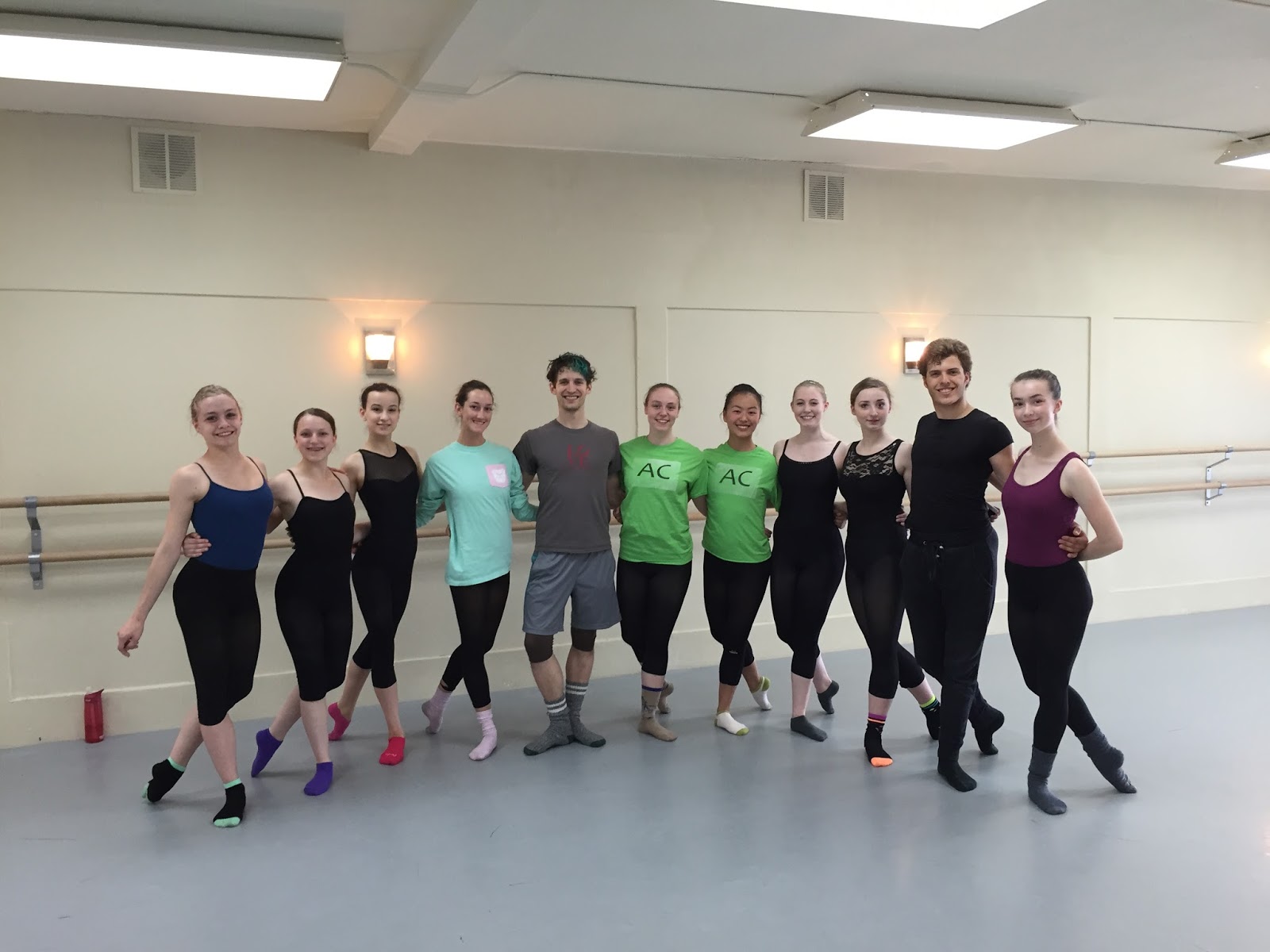
For two weeks from June 8 - 19th, Studio Pulse was full of intermediate and advanced level students from Anchorage, Palmer, Wasilla, Butler University, Colorado State University, and the University of Arizona. We began each day with a classical ballet technique class. Many people get confused when they hear the term contemporary ballet. I have oft been asked to teach classes in this genre, but have turned down the request because I don't fully believe in a contemporary ballet class. It is my opinion that contemporary ballet is the perfect fusion of classical ballet and contemporary dance techniques. To teach a class in contemporary ballet would endanger tainting the beautiful lines and necessary strength it takes to properly execute ballet technique. For this reason, I strongly believe in having classical technique separated from contemporary movement. So, we started each day with nearly 2-hours in ballet class.
Contemporary Technique (Photo: Pamela Montgomery)

Following morning technique, we either held pointe class, learned classical or contemporary variations, or explored improvisation techniques. After a short lunch, we spent our afternoons expanding our movement into the contemporary realm. In these classes, we worked through a progressive warm up, honed our classical work into a more stylized movement quality, and used choreographic techniques to develop a collaborative piece of choreography.

At the end of the two weeks, it was quite exciting to see the physical and emotional progress my students had made in this short period of time. In my classes, we don't only work on perfecting technique. I make sure that class is a conversation between my students and myself, where we discuss the reasoning for why things are taught a certain way and the emotional implications of tough pre-professional training. Also, I strongly believe that the studio is a place where it is perfectly acceptable (and encouraged) to fail. Without failure, we can not figure out how to succeed. My students were preparing to attend summer intensives at schools including Ballet Met, Kansas City Ballet, Ailey, Ballet Arizona, and Walnut Hill (to name a few), and my goal was to make sure that each student was wholly prepared to show themselves at their strongest for these programs.

Students of AK-BK Contemporary Ballet Workshop (minus 3 students)
If you thought running my own summer intensive wasn't enough, I also wanted to offer something to the greater freelance community of Anchorage (yes, there is a small group of freelancers in the state's capitol). A few times during my program, I taught master classes to local adult dancers. I also spent some time staging a short piece that will be performed in Pulse Dance Company's upcoming season. Working with these dancers was inspiring. My hope for these dancers is that they can be major advocates for the arts and dance in a place that needs passionate people to educate their community about why they should attend performances and give to the arts. This is not an easy task, but I feel that they are up to the challenge.
Working w/ Pulse Dance Company

Usually, at the end of gigs I've been brought in for, I head home or onto the next job. But like my time in New Orleans, I chose to tag a few more days onto my trip in Alaska. While this was my 4th extended period of time in this great state, I was astounded by the numerous activities available that I still hadn't explored.

One of the brown bears we made friends with (about 10 feet away)
Along with my partner, a friend joined us in our continued explorations of south-central Alaska. Immediately after my last rehearsal with Pulse Dance Company, I ran to Ellison Air to fly on a 6-seater plane to the Lake Clark Wilderness Reserve. As we flew past Anchorage over Cook Inlet into the wild, we saw the incredible lay-out of this glacially carved landscape. With the color of mineral-rich soil staining water bodies, red-tinted tundra, and stunningly peaked mountains, we flew for nearly an hour in our hunt for bears. Yes. BEARS! After landing in a lake and transferring to a small boat, we floated for a few hours, where we viewed brown bears swimming and eating salmon (within a few feet of our boat), bald eagles flying above our heads, and fish jumping out of the water in preparation to run up Wolverine Creek. Perhaps, the most intense part of our journey was when two of us had to briefly depart the boat to walk a short trail in deep brush to an out house. We couldn't see left or right as we pushed brush out of the way and screamed at the top of our lungs in this forestry teeming with bears. We yelled and clapped to warn any that might be sleeping beside us as we walked by that we were heading their way. Next time, I'll just go off the side of the boat.

Beautiful glacial blue of Surprise glacier
The day after our adventurous bear outing we headed to the odd town of Whittier, where you must drive through the longest multi-use one-way tunnel in the world and nearly all of its denizens live in one tall apartment building. From here, we took a 26-glacier boat tour on Phillips Cruises. This 5-hour trip had us watching whale fins slapping the water, sea otters swimming on their backs with babies on their chests, and amazingly ancient endangered glaciers of all types. While the stunning beauty of this trip will definitely remain in my mind for years to come, the obnoxious nature of the people on these boats will hopefully fade. To see so many people stuffed on a boat to view endangered nature and to see how selfishly they acted to catch a selfie was a sad reminder of why many of these places are at risk for being destroyed or lost.

After our glacier tour, we headed across the Kenai Peninsula to the stunning town of Homer. I love this place and have fond memories of my 31st birthday here. I received a surprise from our friend who had secretly convinced my partner to cancel our accommodations. Instead, she had us stay with her at the top of the hill in Homer with a glorious view. For the next two days, I essentially rested my AK-BK exhausted mind while taking in the culture of this fishing town and sitting on the couch of our house staring at the incredible view.

Panoramic of our home and view while staying in Homer, AK
Once we had completed our two days of rest in Homer, we headed back to Anchorage to catch our flight home. But Alaska wasn't done with us yet. Along the drive back, multiple moose (bucks, moms, and babies) came to the side of the highway to eat a meal and pose for our cameras. We made a stop-off at an incredible artist's wood carving outpost in the middle of nowhere. We stopped in Soldotna before heading to the miniature, historic town of Hope for dinner. After enjoying too much time talking to the wood carver's wife and stopping to determine how to remove a bird from the grill of our car (as we left Hope, it flew in front of our car...I guess it had left Hope behind), we were feeling rushed to get back to our home-stay to repack before our 1 AM flight. But incredibly, at about 9:45 pm, as the sun still shined brightly, our lateness happened to run into a rare phenomenon known as the boretide (explained here) in Cook Inlet. As I dramatically threw the car into a U-turn on the Seward Highway, my car-mates didn't understand why I had acted so erraticly. As I threw the door open and ran away from the car screaming, "GRAB YOUR CAMERAS AND RUN!!!!" they quickly realized why I was so excited. Surfers and Beluga whales alike were riding this 6-ish foot wave that dramatically sweeps through Cook Inlet as it transitions past low-tide. Alaska was clearly waving goodbye to us after an incredible 3 weeks in the state.


I never expected to visit Alaska in my lifetime. When my partner and I decided to leave Seattle, we made a bucket list for our time left in the state. One item on our list was to visit Alaska since it was so close to Seattle. Unfortunately, that didn't happen and we wrote off visiting since it wasn't an easy possibility. Little did I know that only a few short years later, I would proudly call Alaska my 2nd home. I can't wait to return to this magical state, whether it be before or during my next AK-BK Contemporary Ballet Workshop!

Cheers to a successful trip to Alaska!!!!!

10.13.2014

The Rules of Company Class

I started writing this post back in July while creating at the National Choreographers Initiative, but quickly got distracted by the intensity of the choreographic process. It has been awhile since I posted, as I have been swamped while working the past few weeks in Anchorage, Alaska. While it is a few months since I started writing this blog, I feel that this topic is very relevant and hasn't been addressed much. So, I'd like to share. Enjoy!


National Choreographers Initiative dancers taking company class onstage
Back in October, I posted the rules of taking open class while prepping to dance with Barak Ballet in Los Angeles. Nine months later, I am back in the LA area having a completely different experience working as a choreographer for the National Choreographers Initiative. Each of us four choreographers have been offered the opportunity to teach company class for the professionals that have been brought in for this 3-week choreographic laboratory. I love teaching, so I happily took the director up on her offer. Having spent my first hour and a half on the other side of company class and digesting my vast experience taking class in an array of company cultures through freelancing has inspired me to gather a list of general rules for company class from both the teacher's side and the professional's side.

- Company class is a time for dancers to warmup their bodies and to improve their technique. This should generally be on their own terms. Some days a dancer is exhausted and just needs to wake their body up. Other days, a dancer may not have much rehearsal or may be understudying much of the day. During these periods, a pro may use class to push their technique to the next level. Company class is not an equal effort day to day.

- Company class instructors should approach class from an external perspective. Warmup should be approached very differently than classes that would be given to academy students. Yes, professionals need to be pushed, corrected, and kept on task. But company class should be nothing about the instructor and all about the dancers.

- It can be really effective for an instructor to offer combinations that relate to the work that is being prepared for performance. This offers the dancers an opportunity to perfect challenging sequences in choreography.

- Expectations of a dancer in company class should be very individual. If there is not a developed relationship with a group of dancers, it can be rude to make assumptions about why a dancer is acting a certain way in class. If a dancer changes my combination, I am assuming that they are making an important decision for themselves. Back to the first rule in this post, some dancers may be tired or hurting. Company class is a vehicle for the rest of the rehearsal day. Their is often an assumption that dancers must take class like they are students until they retire. Do every combination 100%, even if it doesn't feel good on your body. Of course, it is the dancer's responsibility to remain reasonable about their choices. For instance, if my back is sore from my recent injury, I may not perform arabesques or attitudes derriere in adagio or grand battements at barre. I am not being lazy. I am being smart about my body and extending the length of my career by making an educated decision to leave a combination out.

          (My mom sneaked video taking company class at PNB circa 2008)

- Apprentices and less experienced professionals should approach company class like they approached school class. It takes time to develop an understanding of what your body needs. I didn't start altering my approach to company class until I had my first injury three years into my career. At that point, I recognized that overworking any position in arabesque may be more detrimental to my dancing than beneficial.

- Instructors should try their own combinations with the music to make sure that the tempo is comfortable, doable, and what they imagined the exercise to be. To speak and hear a combination versus executing a combination is a very different experience.

- If a dancer is entering class with an established company, they should ask other dancers if they can stand in any specific barre spot before claiming space. If there aren't many spots available and you are waiting for dancers to show up and claim their regular spot, wait away from the barre until the instructor walks in. Typically, somebody will point you in the right direction of a dancer's place that isn't in attendance.

- I strongly believe that those who teach class should still be taking class. I find that I teach much better when I am checking in with my body and reminding myself what it feels like to dance. 

- If you are going to leave class early, you should always give the teacher a wave as you leave. To walk up and thank the teacher directly, as you would at the end of class, interrupts the flow for those who are continuing with class. Quietly grab your stuff, walk to the door, and wait for the teacher to acknowledge your exit.

- Generally, new or auditioning dancers should pay attention to the hierarchy of individuals in a class. If a dancer has been with the company for many years or is a Principal dancer, let them dance where they want to dance in center. Some dancers could care less about hierarchy, but some are very particular about this order.

- It is the instructors job to be sensitive about when to push dancers in class. I am a dancer that always appreciates corrections. As I stated before, some dancers just want to warm up and focus on their technique in rehearsals. If an instructor feels that a dancer is being lazy, then they can bring that up outside of class and try to push a dancer to work harder. One common error I see is that instructors make judgements about dancers that they barely know. A dancer that is altering a combination or skipping a combination is not necessarily a lazy dancer. Only when their is a developed relationship between a teacher and a professional is it fair to make a judgement.

- Teachers that don't teach to their ego are generally the most respected teachers.

- Do offer corrections to technique, but be careful when offering corrections in style. Once a dancer becomes a professional, for instance, they are very unlikely to change certain parts of their dancing. For instance, if a dancer takes their pirouette preparation from a straight back leg, they may not be willing to execute this from a bent back leg. If they have figured out how to execute a beautiful pirouette from one position, why force them to change it unless it is for choreography that requires unison.

- This is a pet peeve of mine, not necessarily a definitive rule. It is merely a suggestion. Professionals generally don't need to be given specific combinations for plies and stretching. Plies should be about telling the body that class is beginning and stretching should be about limbering your own individual needs. If a dancer doesn't know how to execute these on their own, they probably shouldn't be professionals. I tend to shut down if I am given an extravagant plie combination.

- In most companies that I have danced, it is generally acceptable to wear what you wish for class. When dancers are forced to wear a dress code or to take off their warmups, I have found that dancers are generally treated with a lower level of respect in those workplaces. 

- Instructors should learn to trust the dancers that they are teaching in their decisions. There is not often enough trust in dancers to make their own decisions.

- This is kind of a given. It is more common for dancers to talk in company class, whether catching up with a friend or discussing choreography for a later rehearsal. While it is ok to chat here and there, don't be disrespectful and talk throughout all of center. Show the instructor respect and offer your attention for a majority of class.

- One rule that I am a big advocate of is to support your fellow dancers. If somebody executes a major feat, show your appreciation. I'm also one of the first people to start clapping to the beat when a dancer accidentally ends up having a solo across the floor. Comaraderie and support go a long way in a difficult and competitive career.

- It is acceptable to miss company class here and there if your body really needs a break. Don't make a habit of missing class. If there is an instructor whose class you don't mesh well with, try to find a way to take another class to warm up, like open or academy classes.

- Now that you are a professional, don't approach class like you know everything. There is always something else you can learn.

- While most unionized companies don't require dancers to attend company class, keep in mind that this is more of a technicality than a pass to miss class. Beyond that, a great deal of casting, especially for incoming choreographers, takes place during class.

Company class can be a blur (PNB company class onstage circa 2004)
 - This is my own personal rule. I feel that company class, whether for a classical or contemporary company, should still be a classical ballet class. Ballet is the basis for most technical dance. When company class starts turning into an instructor's interpretation of a mix of classical and contemporary styles, dancer technique will suffer. Keep class as class.

- Whether you like the class or not, always thank the instructor and pianist after class. It is in our culture to clap at the end of class. If you really loved class, hoot and holler. Walk up to the pianist and shake their hand. Walk up to the instructor and say thank you. Instructors appreciate applause and recognition as much as dancers do. Most of them still are or once were in your position. 

2.02.2014

Emotional Training in Ballet

After writing about the challenges of success last week, I've had a handful of conversations about success and failure. The world of dance, and beyond, idolizes a story of failure and adversity that opens up unknown doors, eventually leading to hard-won success. Who doesn't love a good cinematic happy ending? Unfortunately, for students in training and professionals with big goals, things don't always turn out that way. For this reason, there are many former and current dancers living jaded with emotional pain, regret, and without closure from the wounds that often go along with such a challenging, strenuous, and personal effort.

Valeska Mosich-Miller in Clara Magazine
While out in Los Angeles prepping to perform for one of my many Nutcracker gigs, I found myself in a conversation consoling a former dancer about her training years. I was staying with my friend and the woman, who was subletting her brother's room while he is out of town working on an FX series, just happened to be a dancer that was in Pacific Northwest Ballet's school during my first few years with the company. Valeska Mosich-Miller and I knew each other from that time, but didn't really interact much. In most schools attached to a company, there is a clear delineation between company talking to school and school talking to company (school students rarely approach company members). Although we had little interaction during that time, I surely remembered her. The reason being that I, and most other company members, recognized that she had stunning looks and a beautiful, tall stature. Many dancers would comment that she should find an agent and become a model. Apparently, we weren't the only ones that felt that way.

Valeska Mosich-Miller in Marie Claire
Valeska left PNB's school to train elsewhere for a short period of time. After a handful of unsuccessful auditions, she stopped searching for a company to call home because she started getting picked up by multiple modeling agencies across the world in places like Brazil, South Africa, London, and Los Angeles. While spending a week living with Valeska and catching up on where we are in our lives, we went out to dinner and had a very striking conversation. While Valeska has had great successes that most people could only dream of having, she was still struggling with the loss of her ballet career and her perception of wasted effort that was put into so many years of training.

I could tell that nearly 5 years of time away from ballet had not healed the emotional trauma and wounds of rejection that the ballet world can place upon dancers. Being that I am very interested in teaching future generations of dance artists, I have put a lot of thought into the whats and whys of a ballet career and how training affects young dancers. And what I have determined is that ballet training is essentially survival of the fittest.

Classical ballet instruction is extremely harsh on the body. Aside from the physical requirements of natural flexibility, accurate proportions, strength, and aesthetic; a dancer needs emotional fortitude to truly make it in this career. How is a dancer going to cope with casting that isn't in their favor? Will a dancer be able to continue with a performance after receiving bad news? What does a dancer do if they mess up onstage? Each one of these items can really challenge a dancer's ability to handle the stresses of a dance career. The physical demands of training will prepare one to execute the most difficult of feats with ease. While the emotional aspects of training ensure that a dancer doesn't fall apart in high stress situations. Unfortunately, the concept of emotional training is rarely revealed to students throughout their studies.  Perhaps, because teachers aren't even aware that they are teaching it.

Very few of my teachers really explained much about the emotional challenges of dancing other than saying, "Ballet is hard," "People get injured," or, "You don't want to be stuck in the corps."  That is until I started training under Jock Soto at the School of American Ballet. One day I particularly remember, Jock had stopped class after a student was having a mini-breakdown over the failed execution of a partnering combination. Trying to calm the student down and keep their head in the game, he stated, "Your grandfather just passed away and you got a phone call minutes before you step onstage to premiere the lead in Theme and Variations. That gray-haired lady seated in the orchestra paid $200 for her ticket and has no idea about your troubles. No matter what happens you must always perform to your best abilities because all the audience knows is that they paid a lot of money to see a good show." This comment seemed utterly heartless having never heard anything like it before. I remember many conversations after class where we tried to validate that what he had been saying was just downright heartless. But I can now tell you from experience, I have watched this exact story happen. I've experienced traumas and performed while reeling through an emotional life experience. It is a part of the job and our training helps us deal with this. Now, if only, as teenagers and young adults, we knew that a handful of the comments and experiences we have on the road to success are a part of the training, and not always teachers and directors playing mind games.

It is very common for students who never become professionals and professionals who never become principals to focus their anger and bitterness towards the last organization or two that they feel let them down or kept them from achieving their dream. I don't think this is avoidable and, sometimes, agree with these dancer's feelings. Unfortunately, though, these dancers got weeded out by ballet's survival of the fittest training. If your body is too weak, it will break down often. If your body doesn't fit the aesthetic, and dancers go to dangerous lengths to fit the mold, they will not make it through the training. I am always asked about anorexic and bulimic dancers, as is every professional in the field. I typically respond that there were some sick dancers while I was training. But for the most part, the career is too challenging to maintain that lifestyle and those dancers with eating problems fall apart before they finish their training or within a year of obtaining a job. If a dancer's technique isn't strong enough and they audition for years and years and eventually give up, they have been weeded out. If a dancer had everything going for them and obtains a job, but quits a year or two in because they didn't have a fairytale rise to the top, they have again been weeded out. There are so many challenges that ballet presents to dancers that make sure that the last dancers standing are those onstage and selling tickets.

It is rare to find a teacher or director that is so especially harsh that they seek to destroy a dancer's love for ballet. There are exceptions to the rule, but it isn't common. Most leaders want a dancer to succeed at what they are doing. The misinterpretation of emotional training is often the downfall of many potential dance careers. When one is involved in a school or institution, that one place becomes the dancer's entire world. My favorite example of this takes place at the dance academy where I was raised. Every year when Nutcracker casting is posted, parents call the director shouting, "WHY DIDN'T MY DAUGHTER GET CLARA." In a fair-sized school in the suburbs of Philadelphia, like clockwork, parents freak out because their child wasn't handed a role just for showing up and paying their tuition. Within days, studio gossip ensues and one small performance becomes a big ordeal, as if it is the make it or break it moment of their child's life. People forget that somebody is always going to be at the top and somebody is always going to be at the bottom. It is like this in school and it is like this in a company. It can become difficult to remember that there are hundreds of schools and companies across the country. And if a dancer is truly unhappy, they can always look elsewhere for an improved situation. Rejection and disappointment tend to be one of ballet's first emotional lessons.

If a dancer is truly talented and being overlooked, it may be time to try somewhere new or to understand that sometimes you are the best and sometimes you are the worst. And sometimes it is all a matter of needs and timing. Dancers often forget, like Valeska did, that ballet is based purely on opinion. Casting decisions and class placement often upset people because there is no formal basis to judge technique, artistry, and performance. Maybe a director put a dancer onstage for a specific role because they thought big eyes would look good in that role. Perhaps, she doesn't have the best technique, but she is intriguing to look at and intrigue sells more tickets than technique. And if the same group of dancers travel from state to state, school to school, or company to company whilst performing the same work, different opinions and choices may put completely different dancers onstage at every institution. There is no best dancer. There is, instead, I prefer this dancer.

What it comes down to is that ballet is often full of political opinion. The end goal of an institution is to put productions onstage as best they can and to please its' patrons and donors. Dancers are just pieces of a puzzle that need to be fit together. If a dancer doesn't fit in a certain part of the puzzle, then they don't fit. A company can't be so concerned about hurting a dancer's feelings that the quality of a production becomes a secondary priority. While dancer's feelings may get hurt, it is rarely personal. Ballet doesn't remember that dancers are human beings with emotions. But people do (and should). For this reason, it is the human side, or artistic staff, of an organization that is responsible in ensuring that there is still humane treatment towards a dancer who may be disappointed by casting or has been left out of a performance during their integral final years of training. This is often where emotional training fails. Instead of having a hard, potentially disappointing conversation, many company and school directors prefer to keep quiet about their reasoning. This leaves dancers to make assumptions that may be far from the truth. Maybe staff feels that they don't owe the dancer an explanation for putting them in the second cast of the corps after giving them a leading role in the last production. Or perhaps, that corps member isn't being cast well to test and see if they can handle performing less, which often occurs during the first years after promotion to soloist. Why can't a dancer just be told that they are being tested, instead of creating circumstances and sitting back to watch their reaction. Directors owe the human being, not the dancer, a reason for casting disappointments, frustrating circumstances, and mixed signals.

A great amount of emotional training happens every day in dance. I have found that, more often than not, the higher powers of dance organizations don't even realize that they are taking part in this important aspect of training. Since ballet is passed on by oral tradition, there is no text book on the exact way to train a dancer. My teachers taught me what their teachers taught them and so on and so on. Every generation tries to take the best part of their training and pass it on, while attempting to avoid passing on the worst parts of their training. But, sometimes, the harshest parts of their training were to make sure that they could survive in our stressful profession. Unfortunately, there are often better ways to go about things and those with power aren't even aware that they are doing more than just training the physicality of a dancer. If students are more aware of the emotional tests that they will be put through, they may have greater lasting power. It is really confusing for a teenager to understand that there are tests in our training, beyond how high one can developpe or how many pirouettes one can execute, if they are not made aware of it. Emotional strength is just as important a factor as technique in becoming a successful dancer.

Valeska Mosich-Miller (Photo: Patrick Fraser)
I felt for Valeska while we talked out her training trauma over tasty pork bao at a trendy L.A. eatery. And at the end of our conversation, she was shocked that she may have been ignored in school as a test to see if she could handle being ignored in a company. Or maybe she just didn't fit into the intricate puzzle of the school that year. Years and years of resentment didn't disappear, but she seemed more at ease with what was a very disheartening and hurtful time of her life. Over the last decade there has been a greater push to help preserve the bodies of dancers through proper maintenance, cross training, and better body awareness. Today, I would like to call upon the dance world to do the same thing with the dancer's mind. We need to start treating dancers with respect, openness, and honesty. There needs to be more support for teenagers who are working as high-level adults, often living on their own, and dealing with insane amounts of pressure. Bringing awareness and structure to the emotional training that is necessary to have a successful career will be the next step in extending the life of a dance career.

What do you think we can do to improve the emotional struggles that dancers experience in their training?

10.16.2013

The rules of taking open class

I know that my last blog was a list post, but inspiration has struck and I feel that it is completely necessary to offer you another list. I was taking our morning warm-up class today at the Westside School of Ballet, where I am preparing a performance with Barak Ballet, and I found myself wildly frustrated. The annoyance I felt is actually not uncommon for me. In fact, I find myself needing to stifle my emotions often while taking open class. Most people that don't take open class don't understand what I am referring to. But any professional that has had to suffer through an open class knows exactly what I am talking about.

Open ballet classes are essentially the zoo of dance, but for people. I have taken open class in New York City, Philadelphia, Seattle, Los Angeles, Houston, DC, and beyond. So I have a pretty good take on this. There can be any combination of people taking class, from young students looking for an extra class to middle-age professionals (non-dance professionals) trying to stay in shape. Sometimes, you find tweens in class and, at other times, the dancers may be closer in age to your grandparents. Add a handful of professional dancers trying to stay in shape and you can only imagine the cast of characters that have arrived to partake in the art of ballet. For some reason, "dance-etiquette" is rarely taught in combination with the strict set of exercises that are given from barre to center and jumps . For this reason specifically, I feel that I need to speak up about the horrors faced and the lack of understanding and respect that occurs around the world daily in these classes open to all. When I teach class, I do my best to educate my students about an art that is borne out of respect. So, let's proceed and learn a lesson or two in the etiquette of ballet.

King Louis XIV
- Traditional ballet was founded by a king to be performed by those in the higher class. Royalty. There were many expectations in place when these royals interacted with each other and those considered to be below them. While things have changed as we have evolved out of this culture, there should still be a great sense of respect for those around you and their relationship to you in class.

- Look around the room. Yes, most everybody has paid an equal sum to partake in class. But each dancer is individual and has come from a different background. If a dancer looks like they really know what they are doing, they are likely professional dancers. They have put in a lot of time and effort, plus they have been highly trained in the rules of ballet. Don't assume that you have an equal standing in class as these professionals. Take a step back and take a lesson in humility. Watch these dancers and learn from them. Dance is an art that is passed on by spoken word and careful, visual observation. The next step down from the professionals are the regulars. They have put in their time at the studio, they have cultivated relationships with teachers, and they have a better understanding of the culture of their specific community. Next on the list are pre-professional students. These students are hopeful to achieve the status of professional. They are still learning the ins and outs of ballet and may not fully grasp the system that is commonly in place during a class. But they are on their way. Lastly, you have the drop-in students that come for fun and health. These dancers aren't necessarily interested in performing professionally or regularlity in attendance, but they stop by here and there to keep in shape and enjoy themselves.

- Show up to class before it begins. This doesn't mean you should walk in the door at the listed time. Arrive at least 10 minutes prior to the scheduled start time to sign in, pay your fee, and change. Here in Los Angeles, it is not uncommon for people to get stuck in heavy traffic and arrive late. This happens. But respect the fact that others showed up on time. If you are late, immediately look for a barre that is unused or the least full. DO NOT stand in front of somebody who has a direct view of themselves in the mirror. They probably arrived early to ensure that they could watch themselves and improve. If there are multiple barres in the room with two people on each side and one barre with 3 people on it, join one of the barres with fewer people on it and stand in the less comfortable spot. Whatever you do, if you are tardy, you should not place yourself somewhere that makes it harder for someone who arrived on time to work properly and effectively.

- It is perfectly fine to have a conversational moment with the teacher or your peers, but only for a short moment. Do not engage in loud, extended, or multiple conversations between combinations with the teacher. Also, if you have a question, by all means ask. But if you find yourself asking a question after nearly every combination, be more attentive and start watching other dancers. If you didn't catch a combination the first time in center, go in the second group. If you don't know how to execute a step properly, watch a dancer that looks like they know what they are doing. Ballet classes are a series of stops and starts to learn combinations, then execute them. Adding more time between the end of a combination and the start of the next one leaves time to get cold and to lose focus.

She does not belong in an advanced class
- Study the list of classes and ask the front desk questions before you enter a class at a level potentially higher than your ability. If you danced for years, but haven't taken class in five years, you should start in an intro or beginner class. Always take a level lower than you think you should before you consider moving up. There are constantly dancers taking the most advanced classes that do not belong in these classes. Not only are they a distraction to those that understand the intricacies of an advanced class, they are putting themselves in danger of potential injury. If you aren't sure where you should be placed, take the lower level classes and ask the teacher what they think after class. Also keep in mind that it takes a student years to progress to an intermediate, then advanced level.

- If you are not a regular or a professional, you should be weary of standing in the front or going first in groups. If you don't know the combination, you should definitely not go in the first group.

- Evenly space yourself in class. Do not stand in front of everybody while only moving forward halfway to the front. I always teach that the best way to respect others is to respect yourself. If you stand to close to a barre or person, you are making it more difficult for yourself to execute the combinations. You are offering yourself less of a chance to succeed. If you respect yourself by giving yourself enough space, you will also be respecting others because they won't be avoiding your limbs while they are dancing. Dance is based on ideals of respect. When you are at barre, if you are going to hit somebody, you need to turn the angle of your body away from the barre to the front and in towards the barre to the back. If you are doing center work, don't stand directly next to somebody. Stagger yourself. This means that one person stands forward and another stands back. If you are going from the corner, stand as close to the corner as possible in a triangle with the point towards the corner you are coming from or a square in two diagonals.

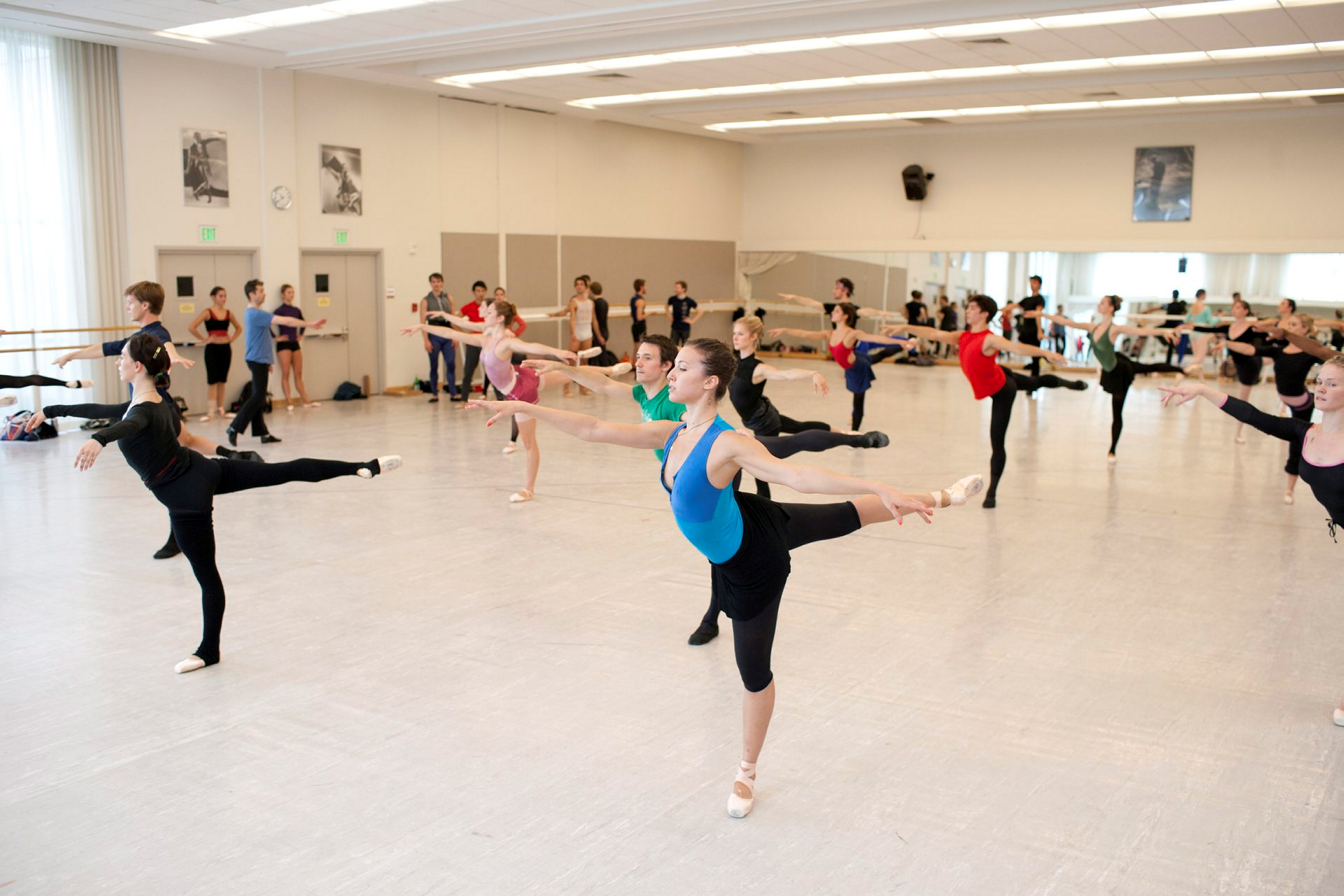
San Francisco Ballet dancers properly staggering themselves
 - If a professional or regular moves over, it doesn't necessarily mean that they are making space for you to move over as well. It likely means that you are too close to them and they are trying to gain more space to avoid hitting you.

- If you are not going to or unable to execute the combination in full, absolutely do not stand in front of anybody. It is disrespectful and prevents anybody behind you from fully executing the dance.

- One rule that is very important in ballet class is that you should never step in front of anybody. If somebody is standing in fifth position or B-plus, they are communicating that they are ready to perform. It is rude and disrespectful (and distracting) to step in front of or next to a dancer that has already expressed that they are going to do the combination.

- When a combination is over, it is proper to run forward, first, and to the side, second, as fast as possible to allow the next group of dancers to run into place. This will help you avoid collisions and keep class flowing.

- Most of the time, professionals are in class to stay in shape and improve their abilities. They are not in class as a hobby or to hang out. Think twice before you start talking to them. Chances are, if they don't approach you, they are working very hard and trying to concentrate on improving their art. If you want to start a conversation with one of these dancers, wait until class has ended.

- All dancers enjoy a compliment for executing a step exceptionally. If you absolutely feel the need to express your appreciation or awe, clap for that dancer or say something at the end of class. To constantly walk up to a dancer after each combination because you are impressed with them is a distraction and changes the compliment into a frustration.

- After class, a professional is likely running to rehearsal or a job. Class is a warmup for them. Feel free to engage them in conversation, but be aware that they are probably trying to leave the studio. Make sure that your conversations are appropriate and not asking too much. Don't corner a dancer and remain unaware that they are trying to gracefully exit the conversation. Most dancers are glad to offer helpful advice, but in small pieces.

- If I have one rule that is extremely important to maintain, it would be to remain aware of your spatial awareness. Not to be dramatic, but there is an epidemic of ignorance towards spatial awareness in open classes. Learning how to dance within a certain confined amount of space is just as important as learning how to point your feet, lift your legs, and develop a floating sense in your port de bras. Nearly every professional dancer starts their career in the corps de ballet. Twenty four swans can not exist on a stage without having an acute sense of what is happening around them. Learn how to look around your body while you are dancing. Use your peripheral vision. Don't battements your leg toward a person if they "may be" too close. If there is any chance that you could hit somebody, you are too close. You can practice spatial awareness by dancing in a small, confined room and avoiding hitting the walls with your limbs.

If more dancers understand this set of rules before entering an open class, you will be more likely to enjoy yourself and improve faster. While it is important for many professionals to take open class daily to maintain their technique, it is equally important that anybody who wants to partake has the option as well. Not only do these classes fund schools and companies, but attendance of non-professionals keep numbers up, which allows class to keep happening. Attending ballet classes also develops certain appreciations for those that won't necessarily have a career in dance. These "open-class" dancers come to performances, spread the word to those less educated in dance, and may even be inspired to donate to professional companies to keep them up and running. While it is important that open class remains open to all, it is also important that we begin to educate dancers in the codes of conduct and the finer details that are involved in a ballet class beyond the steps.

8.24.2012

Things I've learned while freelancing thus far

I'm in a weird mood today and have really been itching to get some content out for my readers. Per my odd mood, instead of writing a regular run-of-the-mill blog, I am going to change it up and serve you with a BList, or Blog List (aren't I ingenious?). Today, I offer you a list of things I've learned while freelancing thus far. Ya know, since I still have so much more to learn and experience. Enjoy!

- Since I don't dance for any company full-time, I don't have the option of company class every morning. If I don't take class every day of the week, I am not going to get out of shape, lose all of the technique I've been working on since I was 2, or get fat.

- If I don't take class multiple times a week, I will get out of shape, find certain areas of my technique are faltering, lose strength, and possibly get fat.

- Just because you are offered to travel somewhere exotic, doesn't mean it is a great offer. For instance, I was offered to go to Hawaii to perform Nutcracker. I would fly the day before the shows and go straight from the airport to rehearsal. And I would fly out the day after the shows. Nothing like a half-day of travel into rehearsal, 6 shows, and then another half-day of travel without getting the glory of seeing this paradise.

- Sometimes it seems you are approaching an agreement with an employer. This doesn't mean you should get excited. It is not uncommon for all communication to suddenly cease and to never hear from said employer ever again.

- Getting to travel to dance around the world is exciting and really cool. Most people you interact with will think it is the most glorious thing ever. Though, sometimes you just want to sleep in your own bed, pet your cats, and spend time with your partner/lover/close friends/family/etc.

- It doesn't matter how small or under the radar most companies are, there are amazing dancers EVERYWHERE! Not just in the largest companies that receive the most press.

- Nobody should EVER be placed with a host family that doesn't have wireless internet. Just saying.

- Usually, at least half of the people that take advanced open classes probably belong in beginner open classes. Also, they have absolutely no spatial awareness. This can present a challenge when you are trying to keep in shape and challenge yourself as your own teacher.

- NEVER negotiate via skype or phone. Get it in writing (usually via email). Also, don't be afraid to make requests that you may feel are out of reach. If they are and the employer is in this negotiation in good faith, they will compromise or explain why they can't agree to certain terms.

10 degrees in Anchorage - I left coat in car to go clubbing
- Alaska isn't a scary place.  (I will be returning to dance with Alaska Dance Theatre for their Winter season this January - April).

- Leaving for a gig that is more than a month is a great reason to throw a party! Which means you get multiple going away parties a year!

-  It is alright if I take a contemporary class for my warm-up/technique class. I won't lose my ballet technique by supplementing other styles and I will expand my reach as an artist.

- Some people will ask you to do things for free. But others will compensate you like a rockstar. Show your appreciation when due. And be prepared to perform like said rockstar!

- You will have better access to footage/pictures of your career than you would ever have dancing for a unionized company.

- If you need something, you have to ask for it.

- New York is the easiest and hardest place to freelance. There are more gigs per capita, which are easily accessible, but most freelancers can't afford to live comfortably on dancing itself in Manhattan, let alone any other safe neighborhood in a different borough

- Some gigs will be horribly unprofessional. Try your best to complete your duties, but don't forget to respect and protect yourself. If you feel like conditions are unsafe, speak up. If you are not getting paid on time/correctly, make the employer very aware that this practice is not acceptable. Be sure to document all of these activities to protect yourself.

- Integrity is everything.

- The internet is your best friend. Along with Google. Go on the search engine, think of a place you want to visit, add the word ballet at the end, and unabashedly email. (I want to visit Atlanta and I love to dance. Google: Atlanta Ballet. Obviously, you will get Atlanta Ballet, but keep searching. Then, email these companies that you are available for work. Before you know it, you could be traveling to Atlanta to work).

- One of the most important tools of the trade are your freelancing friends. Not only can these friends pass work along to you if they are unavailable, but they know exactly what it is like to be a freelance dancer. Nothing beats the support and advice of a friend that has been through exactly what you may be going through.

- Most professional dancers are the same around the world. Amazingly talented and slightly insecure. No matter the front they put up, they really just want to be accepted. Also, nearly all pros really know how to have a good time.

7.20.2012

Continuing to better your technique in open class or on your own

I was taking a particularly good open ballet class from Natalia Charova at Koresh Dance Company's school this morning. I was given a lot of attention and a handful of corrections, when a particular thought crossed my mind. It isn't very frequent that open class teachers give me more than one correction during a class. If a freelancer takes class at a school, they are typically overlooked because it is the teacher's responsibility to give more to their students than a professional. But if a professional dancer only has the option to take open classes, how do they continue to improve themselves as a dancer?

My last week has been extremely busy, from teaching to rehearsals to going up to NYC to audition for Sleep No More. I didn't realize that this topic would become my next post, but I should have seen it coming after class on Wednesday. Most of the classes I have been taking since becoming a full-time freelancer have been open classes. When a professional dancer enters an open class, it can take a while to establish a relationship with the teacher. These open class teachers, in most situations, appear to give dancers space as a gesture of respect and acknowledgement of their time put in and talent. Some dancers like to receive corrections, some are just trying to take a class that is a change from their regular company class, and others just want to be in a safe environment where they can warm up as they wish. As a dancer comes to class more often, teachers tend to test the waters and see how each particular dancer wants to take their open class.

Now, the reason that I should have seen this topic coming is because I went to Steps On Broadway to take a warm up class before my audition. I took from one of my favorite teachers, Nancy Bielski. I have been taking from Nancy since the days I thought I would become a Broadway dancer. This was well before I fell in love with ballet (maybe at the age of 15). I was particularly driven to make it professionally and would push myself to the front of her class, perhaps when I shouldn't have been. I remember her specifically pulling me aside and telling me that there are professionals in class and that I should be more respectful. I am sure she doesn't remember this, as we have only really connected in the past year. But that is besides the point. I was spending a few weeks in NYC this past October doing a gig with Avi Scher & Dancers at the Guggenheim (stay tuned for an experience report in an upcoming blog) and began taking Nancy's class regularly for that time. From day one, she quickly and effectively offered me corrections. After that first class with her in years, she pulled me aside to see who I was and where I danced. Ever since that conversation, I have been greatly impressed by her memory. Each time I have returned to her class, even if it has been months, she remembers my name and keeps on me throughout the entire class. That is one thing that I really appreciate about Nancy. From the start, she doesn't hold back when it comes to correcting dancers. I feel that she realizes how important it is for a dancer to keep growing well beyond their formal training. I walked into class this past Wednesday and, right as class got underway, I was given a direct correction in plies, "Barry...when you are in 4th position you have to pull your left hip back, even with the right." Then, again, in our first tendu combination, she walks up to me and says, "You have to fix this and then I'll leave you alone for a bit." I began to think to myself, "Wow! It has been so long since I have been corrected. I can't believe that I've been doing this on my own. How do I realize what I need to work on if I don't have a set of eyes looking directly at me." And there the basis for this post was created.

As a freelance dancer who doesn't have a regular artistic director/ballet master/teacher that knows who you are and what you need in order to grow as a dancer, how do you make sure that you are continuing to perfect your art? I feel that it really depends on who you are as a dancer. The simple but not always practical answer is to go straight up to the teacher and say, "I like to be corrected." I don't know any dancer that has done that the first or second time they have met a new teacher. I am one of those dancers that enjoys being constructively corrected. When I enter a new classroom, instead of verbally stating this, I imply with my body language that corrections are important to me. I don't hang out in the back for each combination. Instead, I stand as close to the front as possible, in plain sight of the teacher. If the teacher does offer me a correction, I nod my head or verbally acknowledge the note. Then, I try to work on that correction right away so the teacher sees me doing it. This shows the teacher that I am comfortable and accepting of corrections. If I really just want to warm up in a class, I will hang out in the back of the room for combinations and offer others a chance to be in the foreground.

If you aren't lucky enough to find a teacher that is comfortable correcting professionals or if you are giving yourself your own class at times, how do you continue getting better? I've toyed around with this idea a lot in the past few months. I have always approached class with the thought that I shouldn't just be warming up, but I should be bettering my form. When I start class, I usually have a general thought continuously flowing through my head. Something along the lines of, pull my inner thighs together to close any air showing between the legs, or hold my core but leave the natural curve of my lower spine, or reach my limbs as far away from my core as possible without distorting my placement to create a longer line. I take one idea and use that as my focus throughout the entire class. I am not so focused on the idea that I can't analyze other things that need to be fixed. But if I start with that foundation, at least I'm always working on something. Dancers can use this method on their own for a period of time, but eventually they will need to have a set of outside eyes to watch them. Another educated dancer or teacher can give you new ideas to use as your foundation correction for class.

Another important tool that I have utilized as a dancer that often has to rely on myself to continue improving is Youtube. If I need inspiration as a choreographer, I will look at footage of choreography by some of my favorite choreographers. I realized that I can do the same thing if I need to find inspiration to better my skills. I have learned that watching dancers that inspire me offers a new look at my own dancing. If I watch a dancer performing online and see that I am really impressed by the execution of their pirouettes, I'll watch the video multiple times to evaluate how they are performing the feat. The next time I get into a studio, I try to mimic what they have done. Of course, this method requires true knowledge of technique, as a dancer doesn't necessarily want to emulate a choreographically stylized version of a step. But if a dancer doesn't have access to another pair of eyes, they can use other tools to remind themselves of corrections that may not have come to mind while they were working on their own.

There are many ways that dancers can better themselves in an environment that doesn't have a leader to guide you on a path of bettering your technique. The above ideas should be very helpful to any dancer, in a company or freelancing. Of course, there are surely other ways to improve yourself that I haven't listed or explored. So, if you have any other ideas that I have forgotten or haven't thought about, please feel free to share them in the comment box below.