Life of a Freelance Dancer is a blog, journal, and tool for those who are interested in freelancing themselves, that want to know the ins and outs of freelance work, or are just curious about the life of a freelance dancer.
A typical scene around Jackson Square in New Orleans
If you follow me on any of my other social media outlets (Facebook, Instagram, Twitter, Pas de Chát podcast), you will see and hear that I took an important break from my teaching, choreographic, and media work while vacationing in The Big Easy. While I did post a few work-related items, most of my sharing consisted of personal experiences and artsy items I found while running around the charmed streets of New Orleans with my husband and friend, J-Ro. It wasn’t always this way, but I now feel funny when I use social media mainly for personal use. I’m so attuned to creating content for all of you guys that I feel odd when I revert back to more typical ways that I used social media before I began freelancing in 2011. As I head home (I’m writing this from the airport) and start revving back up into work mode, it has gotten me thinking about what I post and how I share across multiple media platforms. So, instead of keeping this knowledge to myself, I figured I’d share it with all of you. Keep on reading for a comprehensive list of 7 Rules for Posting on Social Media for an Audience.
1. Be sure to offer a variety of emotional content to appeal to a wide audience. Remember that people relate to people, so letting the public have a view into your private experience can be an extremely relatable asset to promoting your dancing, work, business, and ventures. Unfortunately, it is a harsh reality that many people hiding behind the privacy of a computer screen can become very judgmental of a person based off of the information they share on social media. If you only ever post updates about your successes, people may start to think that you have an over-inflated ego. If a majority of your posts are sad or depress, people may start to ignore your content because they don’t want to absorb your negative mood. If you focus your posts on writing disgruntled messages, people may assume that you are dramatic and unstable. Creating a range and variety of publishable content is a job within itself. You can write a legitimately upset or angry post on your social media here or there (see #7), but be sure that you offer a range of life experiences for your audience to relate to. In summing this up, be sure to come up with a game plan pertaining to the regularity of posts, range of content, and how often you plan to post about certain life happenings.
2. Post daily, but don’t post too frequently. This is one of my ultimate challenges, as I like to share a lot of content. Frequency of publishing engaging material has no perfect formula. It really comes down to seeing what your friends and audience respond to best. If you post too often, followers may feel like you are spamming their feed and unfollow or de-friend you. If you post too infrequently, your public may forget to look for your content or you may fall out of the algorithm that many social media sites rely on to share your relevant content with others. Play around with the amount of posting that your audience seems to respond to and tweak your posts and content from there.
Rehearsal to Performance of my new ballet (Photo: Eduardo Patino)
3. Try to add a visual to as many of your posts as possible. It is easy to share visual content on platforms like Instagram, where you are required to post images anytime you share . This isn’t a requirement for other outlets like Facebook and Twitter. As human beings, we are much more visual when it comes to exploring content. Think about what first draws you to read articles in magazines or on websites. Images. If you are able to upload visually relevant images along with your content, you will be that much more likely to catch the eye of followers who are scrolling through a handful of other artist's feeds just like yours.
4. If you are feeling angry, hurt, disappointed, or any range of adjectives that could be described as emotional, have at least one sleep before you write any public posts. When you are emotional, you tend to respond by reacting without reasoning. This is often the last thing you want to do. If you sleep on your reaction for just one night, you will likely wake up more rational than when you went to sleep. From there, you can decide whether you still want to follow through by sharing your original reaction, you can temper your original post into something more censored, or you can choose to scrap the whole thing altogether. You don’t want to end up in a situation like the talented choreographer David Dawson found himself in recently. After a London critic wrote a poor review of his work, his stager (who sets his ballets on companies) wrote an emotionally charged comment on the piece sparking great controversy. Mr. Dawson chose to tweet that he would attempt to avoid working in London’s dance scene in response, then almost immediately deleted the post. As he learned, even if you post something for just one minute and delete it, there is such a thing as a screenshot. Trust me on this one!
5. Stay engaged and interact with your audience as best as you can. It is easier to be responsive to your audience when you are in earlier stages of building your social media following. As your following grows, you may find that you are receiving more comments and requests for personal feedback than you can handle. It is important that you continue to maintain some semblance of interaction with your audience no matter how great their reaction may be. While I average anywhere between 2-10 messages from an array of dancers, readers, and listeners a day, I do my best to respond to each of them (even if a few months later). Don’t let these interactions take over the entirety of your work and free time. But do be sure to respond directly to as many people as you reasonably can. It is important to remember that these friends, followers, and fans are the reason that many of us get to thrive in the work that we do.
Courtesy of @thefatjewish on Instagram
6. Remember, anything that you post today could eventually be dug up years from now. Yes, most of us go through fun party phases where we might want to share our fun and debauchery. Yes, many of us share diverse and, sometimes, divisive perspectives. Yes, a majority of us have regretted posting something and deleted what we shared the following morning. The one thing that most kids and young adults don’t understand is that social media somehow morphs from a platform to share with friends to a platform for professional associations. Keep in mind that we sometimes share things that feel acceptable and culturally appropriate in the moment, but may reflect poorly upon us when a potential employer looks up your information, when you become the face of an organization/movement, or you react too quickly to a particular situation (see #4).
7. Make sure you are presenting your most genuine self. This is, perhaps, the most challenging task for anybody using social media to enhance or promote their work. Projecting confidence and sharing exciting experiences should absolutely be a part of your social media behaviors. But people are drawn to experiences that they can relate to more than things that are out of their social reach. If you can make yourself relatable by sharing genuine thoughts, successes, challenges, and experiences whilst throwing some unique and intriguing content out there, you will find that you can easily maintain and grow an audience that is emotionally invested in your life’s work.
Many of you may have have been disappointed that I wasn't living up to my claim of being a nationally touring freelancer over the past few months. Honestly, I needed a break from the chaos of sitting amongst my fellow homo sapiens at airport gates from city to sparkling city, among other reasons. Yes, I traveled by bus to New York City a handful of times over the past 6 months (and luckily took the Bolt Bus instead of the train the night of the Amtrak crash), but I haven't existed amongst the rank and file economy class of aerial travelers for some time. It has been glorious to say the least. But, I'm back at it. In fact, I began writing this blog on my phone waiting in the security line at Philadelphia International Airport and continued while flying from Philadelphia to Phoenix. Now, during my layover in Phoenix on my way back to Anchorage, I am beginning to transcribe it from a random table at a random coffee stand with this beautiful image burning color into my eyes.
Looking out the window at the airport in Phoenix
With that said, I'm actually quite inspired by reentering the regular travel schedule of a freelance dancer and choreographer. I am heading back to Alaska to kick off my inaugural intensive training experience, AK-BK Contemporary Ballet Workshop. And, as I was attempting to check in for my flight with the ticket attendant waving me to the counter, not one of the three people blocking my path moved (or even turned their heads) when I kindly, but audibly spoke, "Excuse me." There is just something about airports that make most people lose their sensibilities and act like animals sitting around a watering hole, a la Mean Girls.
So, this time around, I've decided to have an interlude list blog between all of these "Create Your Own Project" series postings. With that said, I am here to offer you all of the advice you could ever need on how to CALM DOWN and act with civility when you are at an airport. Cheers!
- Keep this in mind at all times. It's just an airport. It is no different than the rest of life. In fact, the rules are almost exactly the same as they were in elementary school. Stand in line. Be nice to and aware of the people around you. Listen to the people in charge. And you will have few problems. Simple.
- If you are all like, "OMG!!! I get nervous before I fly...and sometimes it...umm...affects my stomach...but I need privacy...to...umm..." too much information, DON'T FRET! There usually are bathrooms located on the floor where you collect your ticket and drop your baggage off. These lavatories are usually completely empty and absolutely spotless. Aside from the occasional employee who goes in there to take a whiz, nobody goes in there or seems to know they exist.
(Note: at this point, my flight is probably already boarding...and I'm still sitting here in the cafe typing my blog. See how calm I am?)
- If you have a question or concern, ask an employee or TSA agent. They may seem to rudely ignore you, cut you off, or be short with you. They have a lot to tend to. Just wait patiently until they can find a moment to answer you. If you stand there and wait for them to assess the many situations in front of them, they will eventually give you a competent, attentive answer...even if they don't smile and say "Have a nice day!" They are more interested in maintaining all of the crazies running around than giving you their full attention and offering a smile. And, more often than not, when they realize that you get how it works, they will be nicer and more willing to help you out.
- Oh no! You raised your voice at or approached an airline worker or security agent with an angry tone. Be prepared for them to have no interest in assisting you in any way, shape, or form. It, honestly, is never ever acceptable to treat airport employees this way. No matter how in the right you are, they are in control and can make your trip miserable from start to finish.
In no rush...
(OK...I finally left the cafe at this point. I was one of the last people to board my plane. And I even had time to take a picture!)
- I have flown hundreds of times and my luggage has always shown up at my location...eventually. If your luggage doesn't show up with your person, unless you are carrying an organ for transplant or the hope diamond, calm down, take a breathe, and stop somewhere inexpensive like Target (and price-match) for a cheap new outfit and some toiletries. Chances are you'll have a good memory/story every time you wear it again. I always find that my best experiences come from working through adversity.
- Employees and TSA agents want you to make your flight. You aren't the only person that has somewhere to go. You honestly don't need to be at your gate until about 10 minutes before departure, when they close the door to your plane. If you are cutting it close, talk to an airport employee. Just understand that everybody's goal is to get you to your destination. If you miss your flight, not only are you a hassle to the airline, you are lost revenue.
- With the above said, you don't need to be at your gate an hour before your flight (if I haven't driven that point home yet). I usually show up about 5-10 minutes after boarding begins. What's the rush? And who really wants to be the first passenger on the plane to stake their claim and feel pride in their victory of knowing they made it on the flight. I'd rather be the last person on the plane and shorten the length of time I'm strapped into those damn uncomfortable economy seats. Everybody on that flight is going to get to their destination, whether you are first or last.
- Do you really want to drag your carry-on around that airport during your layover? And how often do you truly get up to pull something out of it during the flight? In fact, I don't think I've ever seen somebody pull their rolling luggage down into the aisle mid-flight, unzip it, pull something out, and put it back up in the overhead compartment. I always pack my heaviest items in my carry-on to save on baggage fees, then walk straight to the counter at the gate and offer my carry-on to be checked to my destination. It's free. It helps. It's not a hassle. The gate agents love you for it. And a majority of the time, I only needed that extra thing from my carry-on before I got onto the flight.
- You are not the most important person in the airport (unless, perhaps, you're an A-list celebrity). Just like driving or walking down the street, your time is not more important than everybody else's. Calm down and act with a sense of humanity.
- You've traveled more than once in your lifetime? Congratulations...you've been delayed. Now calm down, grab a beer, charge your devices, and do something practical. Write a blog ;-) or play a game. Or explore your terminal. Or find a quiet place in a corner of the airport and take that nap you need because you were too nervous about your travels to sleep.
- You've lost your ID or passport. Calm down. Think about the places you might have left it or put it down. Is it in your car? On the seat of the train? At the magazine shop's counter? Can't find it? PANIC!!!!! Honestly, this would be the only time I would really lose my cool.
- AHHHH!!!! I have to get scanned by an X-ray machine. Is it gonna give me cancer? How invasive! Chill! The shadowy silhouette of your penis or breasts are nothing the TSA agents are writing home about (or taking pictures of). Again, you are one of thousands of penises and breasts being scanned each and every day. Again, you are not the most important person walking through the airport.
- Rolling luggage rolls behind you. Turn your head around and look behind yourself every once in awhile. Also, don't walk into my rolling luggage. I just walked by you and you clearly saw it. But you lack enough common sense to slow down (or have lost it in your airport panic). And if you trip yourself over my luggage, don't give me a dirty look because I'm already flashing one back at you.
- If somebody says "Excuse me," look at them and determine what they are seeking. "Excuse me" does not mean "STAND YOUR GROUND" and ignore everybody around you."
- Not all security lines are created equal. Maybe you can go to a security line that is located a bit further away in distance, but has a much shorter queue. Most terminals are connected once you get past those pesky TSA procedures, anyway.
- If you have to suffer through a flight of loud talkers and crying babies, it is probably your fault for not making a playlist to block out the noises echoing back and forth in that happy tube we call a fuselage.
- I've mentioned this before, while you are waiting to go through security you should be emptying
your pockets into your bag, pulling out your ID and boarding pass, and prepping to remove your laptop from your carry-on. There is no excuse for being unprepared and imploding once you walk up to the conveyor belt. Maybe, mentally preparing in line will occupy your panicked thoughts about missing your flight or losing your luggage.
- Nearly everything you travel with can be replaced. If it can't, leave it at home or keep it on your person at all times. Though, if my phone or ID go missing you might see some frantic actions.
- Need to waste time in a terminal? If it is a big enough airport, treat the shops like the mall. Don't buy anything because it's likely overpriced, but go window shopping. Or, even better, download the game Ingress on your phone and run around the airport stealing portals for good or evil (just make sure to leave enough time to recharge your phone).
- If you don't plan on watching your kids or teaching them appropriate airport etiquette, don't conceive them in the first place.
- If you plan on having a bad attitude on the plane (reasonably or not), whether with a fellow passenger or a flight attendant, prepare to be shamed. A few years ago, I got snappy with an elderly man sitting in the seat behind me in the middle of Nutcracker season. He probably pulled on the back of my seat about 20 times throughout the flight. I was burnt out on traveling and exhausted from all of my gigs. Whether I was in the right or not, the death stares and shameful looks I got from those around me took away any gratification I got from having my seat stay in one position for the last 2 hours of the flight.
It's JUST AN AIRPORT!!!! and not worth the stress
Remember...airports and airplanes are not unique or uncommon experiences. While it may be that for you, at any given time thousands of people are flying miles above your very head. There is no reason to treat an airport experience like you are standing in a depleted food ration line after a natural disaster. As I like to say, CTFD (which isn't only an acronym for Career Transitions for Dancers...and may begin with the word calm and end with the word down).
I know that my last blog was a list post, but inspiration has struck and I feel that it is completely necessary to offer you another list. I was taking our morning warm-up class today at the Westside School of Ballet, where I am preparing a performance with Barak Ballet, and I found myself wildly frustrated. The annoyance I felt is actually not uncommon for me. In fact, I find myself needing to stifle my emotions often while taking open class. Most people that don't take open class don't understand what I am referring to. But any professional that has had to suffer through an open class knows exactly what I am talking about.
Open ballet classes are essentially the zoo of dance, but for people. I have taken open class in New York City, Philadelphia, Seattle, Los Angeles, Houston, DC, and beyond. So I have a pretty good take on this. There can be any combination of people taking class, from young students looking for an extra class to middle-age professionals (non-dance professionals) trying to stay in shape. Sometimes, you find tweens in class and, at other times, the dancers may be closer in age to your grandparents. Add a handful of professional dancers trying to stay in shape and you can only imagine the cast of characters that have arrived to partake in the art of ballet. For some reason, "dance-etiquette" is rarely taught in combination with the strict set of exercises that are given from barre to center and jumps . For this reason specifically, I feel that I need to speak up about the horrors faced and the lack of understanding and respect that occurs around the world daily in these classes open to all. When I teach class, I do my best to educate my students about an art that is borne out of respect. So, let's proceed and learn a lesson or two in the etiquette of ballet.
King Louis XIV
- Traditional ballet was founded by a king to be performed by those in the higher class. Royalty. There were many expectations in place when these royals interacted with each other and those considered to be below them. While things have changed as we have evolved out of this culture, there should still be a great sense of respect for those around you and their relationship to you in class.
- Look around the room. Yes, most everybody has paid an equal sum to partake in class. But each dancer is individual and has come from a different background. If a dancer looks like they really know what they are doing, they are likely professional dancers. They have put in a lot of time and effort, plus they have been highly trained in the rules of ballet. Don't assume that you have an equal standing in class as these professionals. Take a step back and take a lesson in humility. Watch these dancers and learn from them. Dance is an art that is passed on by spoken word and careful, visual observation. The next step down from the professionals are the regulars. They have put in their time at the studio, they have cultivated relationships with teachers, and they have a better understanding of the culture of their specific community. Next on the list are pre-professional students. These students are hopeful to achieve the status of professional. They are still learning the ins and outs of ballet and may not fully grasp the system that is commonly in place during a class. But they are on their way. Lastly, you have the drop-in students that come for fun and health. These dancers aren't necessarily interested in performing professionally or regularlity in attendance, but they stop by here and there to keep in shape and enjoy themselves.
- Show up to class before it begins. This doesn't mean you should walk in the door at the listed time. Arrive at least 10 minutes prior to the scheduled start time to sign in, pay your fee, and change. Here in Los Angeles, it is not uncommon for people to get stuck in heavy traffic and arrive late. This happens. But respect the fact that others showed up on time. If you are late, immediately look for a barre that is unused or the least full. DO NOT stand in front of somebody who has a direct view of themselves in the mirror. They probably arrived early to ensure that they could watch themselves and improve. If there are multiple barres in the room with two people on each side and one barre with 3 people on it, join one of the barres with fewer people on it and stand in the less comfortable spot. Whatever you do, if you are tardy, you should not place yourself somewhere that makes it harder for someone who arrived on time to work properly and effectively.
- It is perfectly fine to have a conversational moment with the teacher or your peers, but only for a short moment. Do not engage in loud, extended, or multiple conversations between combinations with the teacher. Also, if you have a question, by all means ask. But if you find yourself asking a question after nearly every combination, be more attentive and start watching other dancers. If you didn't catch a combination the first time in center, go in the second group. If you don't know how to execute a step properly, watch a dancer that looks like they know what they are doing. Ballet classes are a series of stops and starts to learn combinations, then execute them. Adding more time between the end of a combination and the start of the next one leaves time to get cold and to lose focus.
She does not belong in an advanced class
- Study the list of classes and ask the front desk questions before you enter a class at a level potentially higher than your ability. If you danced for years, but haven't taken class in five years, you should start in an intro or beginner class. Always take a level lower than you think you should before you consider moving up. There are constantly dancers taking the most advanced classes that do not belong in these classes. Not only are they a distraction to those that understand the intricacies of an advanced class, they are putting themselves in danger of potential injury. If you aren't sure where you should be placed, take the lower level classes and ask the teacher what they think after class. Also keep in mind that it takes a student years to progress to an intermediate, then advanced level.
- If you are not a regular or a professional, you should be weary of standing in the front or going first in groups. If you don't know the combination, you should definitely not go in the first group.
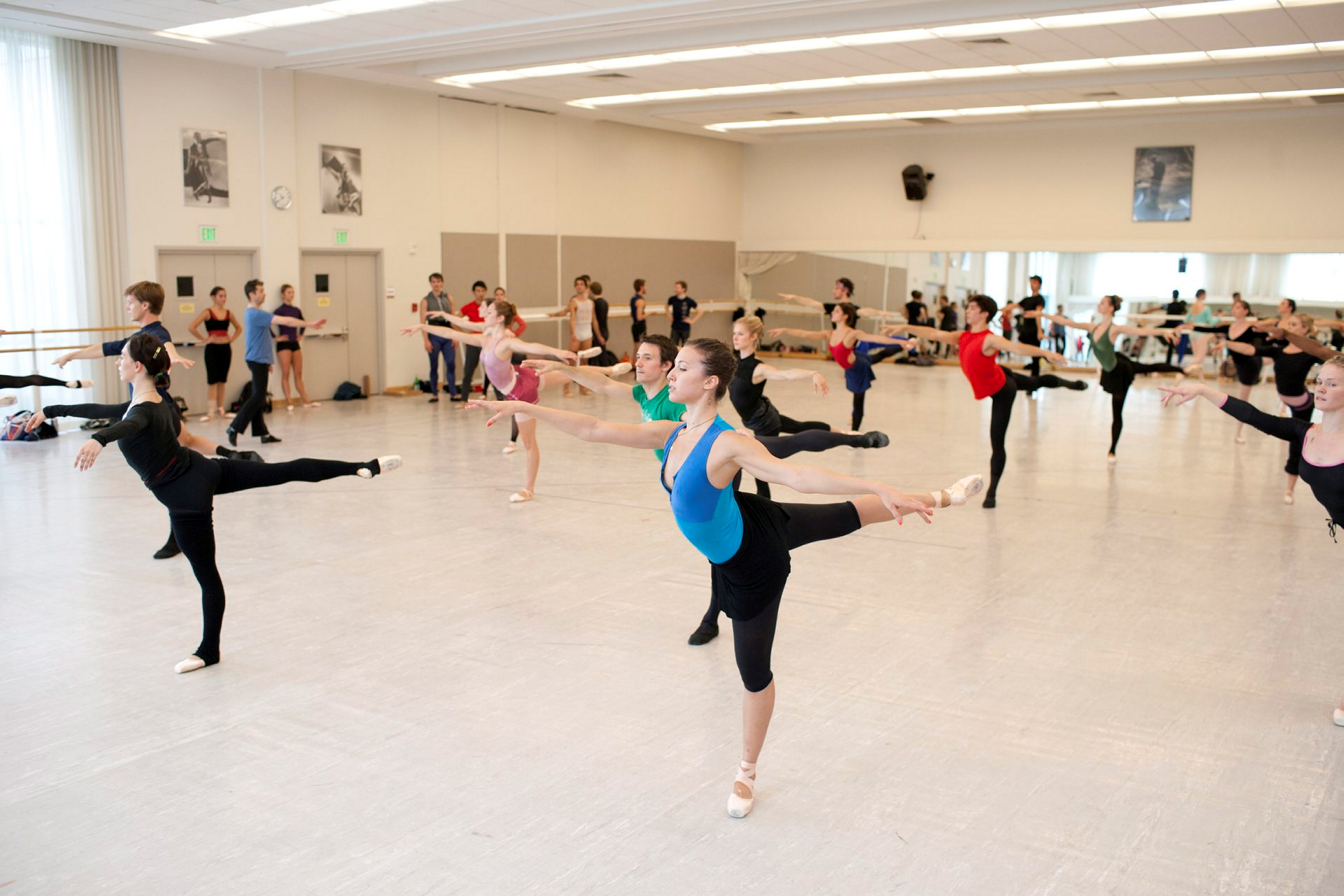
- Evenly space yourself in class. Do not stand in front of everybody while only moving forward halfway to the front. I always teach that the best way to respect others is to respect yourself. If you stand to close to a barre or person, you are making it more difficult for yourself to execute the combinations. You are offering yourself less of a chance to succeed. If you respect yourself by giving yourself enough space, you will also be respecting others because they won't be avoiding your limbs while they are dancing. Dance is based on ideals of respect. When you are at barre, if you are going to hit somebody, you need to turn the angle of your body away from the barre to the front and in towards the barre to the back. If you are doing center work, don't stand directly next to somebody. Stagger yourself. This means that one person stands forward and another stands back. If you are going from the corner, stand as close to the corner as possible in a triangle with the point towards the corner you are coming from or a square in two diagonals.
San Francisco Ballet dancers properly staggering themselves
- If a professional or regular moves over, it doesn't necessarily mean that they are making space for you to move over as well. It likely means that you are too close to them and they are trying to gain more space to avoid hitting you.
- If you are not going to or unable to execute the combination in full, absolutely do not stand in front of anybody. It is disrespectful and prevents anybody behind you from fully executing the dance.
- One rule that is very important in ballet class is that you should never step in front of anybody. If somebody is standing in fifth position or B-plus, they are communicating that they are ready to perform. It is rude and disrespectful (and distracting) to step in front of or next to a dancer that has already expressed that they are going to do the combination.
- When a combination is over, it is proper to run forward, first, and to the side, second, as fast as possible to allow the next group of dancers to run into place. This will help you avoid collisions and keep class flowing.
- Most of the time, professionals are in class to stay in shape and improve their abilities. They are not in class as a hobby or to hang out. Think twice before you start talking to them. Chances are, if they don't approach you, they are working very hard and trying to concentrate on improving their art. If you want to start a conversation with one of these dancers, wait until class has ended.
- All dancers enjoy a compliment for executing a step exceptionally. If you absolutely feel the need to express your appreciation or awe, clap for that dancer or say something at the end of class. To constantly walk up to a dancer after each combination because you are impressed with them is a distraction and changes the compliment into a frustration.
- After class, a professional is likely running to rehearsal or a job. Class is a warmup for them. Feel free to engage them in conversation, but be aware that they are probably trying to leave the studio. Make sure that your conversations are appropriate and not asking too much. Don't corner a dancer and remain unaware that they are trying to gracefully exit the conversation. Most dancers are glad to offer helpful advice, but in small pieces.
- If I have one rule that is extremely important to maintain, it would be to remain aware of your spatial awareness. Not to be dramatic, but there is an epidemic of ignorance towards spatial awareness in open classes. Learning how to dance within a certain confined amount of space is just as important as learning how to point your feet, lift your legs, and develop a floating sense in your port de bras. Nearly every professional dancer starts their career in the corps de ballet. Twenty four swans can not exist on a stage without having an acute sense of what is happening around them. Learn how to look around your body while you are dancing. Use your peripheral vision. Don't battements your leg toward a person if they "may be" too close. If there is any chance that you could hit somebody, you are too close. You can practice spatial awareness by dancing in a small, confined room and avoiding hitting the walls with your limbs.
If more dancers understand this set of rules before entering an open class, you will be more likely to enjoy yourself and improve faster. While it is important for many professionals to take open class daily to maintain their technique, it is equally important that anybody who wants to partake has the option as well. Not only do these classes fund schools and companies, but attendance of non-professionals keep numbers up, which allows class to keep happening. Attending ballet classes also develops certain appreciations for those that won't necessarily have a career in dance. These "open-class" dancers come to performances, spread the word to those less educated in dance, and may even be inspired to donate to professional companies to keep them up and running. While it is important that open class remains open to all, it is also important that we begin to educate dancers in the codes of conduct and the finer details that are involved in a ballet class beyond the steps.