Life of a Freelance Dancer

Life of a Freelance Dancer is a blog, journal, and tool for those who are interested in freelancing themselves, that want to know the ins and outs of freelance work, or are just curious about the life of a freelance dancer.

Showing posts with label art. Show all posts

3.27.2017

You Can't Please Everybody

I had a very interesting experience last week. Something happened to me that has NEVER happened before. It took me awhile to figure out exactly what was going on and to determine how to digest the situation. A disgruntled student contacted one of my many employers and wrote a scathing three paragraph email attacking my integrity as an instructor and my personality outside the dance studio. I won't go into specific details about the message that was clearly meant to disparage my employer from continuing to work with me. But what I can tell you is that I was completely and utterly blindsided that a student who has only taken my class a very few times would go as far as trying to affect my employment because they disliked my attempt to share my art with them and improve their skills. Luckily, I have amazing friends and peers who have helped support me through this situation. And as a few of them have said, I officially have a HATER, which means that I must have made it! ๐Ÿ˜‚


The dance world is a place that is brimming with judgment. We judge ourselves every day in the mirror, while teachers and peers are judging us, as well. Now, this judgment doesn't always have a negative connotation. A majority of judgment in a classroom setting comes from your instructors, whose job is to give you combinations, judge your execution, and offer corrections to help put you on the right path towards success. Your peers may judge you in order to determine what you are and aren't doing well to help them along their path, too. Once you leave the studio and step onstage, you are putting yourself on a platform that opens up a whole different world of judgment from the general public. Some of these people are critics, some are couples on dates, and others are ballet aficionados that spend as much free time as possible sitting in the anonymity that the darkness of a theatre provides. A performing artist is setting themselves up to be critiqued constantly.

Judging Art
One difficult reality that dancers must face is that judgement of their work often feels like a personal attack on one's character. A dancer creates their art by physically exhausting themselves and tapping into emotional parts of their life experience to portray certain roles. When a bad review comes out, a dancer may feel that their own being is under attack. This often isn't true, but that doesn't take away the pain of a negative critique.

There is a great deal of judgment and critique in our careers that is never intended to be malicious. But, then, all of a sudden, out of nowhere, somebody comes along who just doesn't like you. Whether it is a critic that never likes how you perform a role compared to other dancers, a colleague that you always rub the wrong way, or somebody who you somehow offend with any and every action you take, there will be some people that you just can't please. This has been the great lesson of my career as of late.

As an instructor in dance, I have passed beyond the sometimes selfish period of my performance career. When I am in the studio working with my students, class has nothing to do with me and everything to do with getting my students to achieve the impossible. I am heavy in the correction department, try to inspire honest conversation among students, and try to provide valuable feedback to each student in my classes. Where a performance career involves a great deal of focus on oneself, a teaching career is the complete opposite. In fact, I say that the only way I can be successful as a teacher is to help my students become successful. Being a teacher of dance differs from a performance career in the sense that an instructor's sole focus should be to give fully to their students.

Working w/dancer on my new work for Columbia Ballet Collaborative (Photo: Eduardo Patino)
At the end of my time teaching a class, I often wait afterwards to talk with students and answer any questions that have gone unanswered in the fast-pace environment of a technique class. During this time, I also often receive feedback from my students. Nearly all of this feedback is positive. It is rare to never that a student comes up to a teacher with a complaint (they usually reserve this type of feedback for management). But it seems that while many students enjoy a class, it isn't uncommon for a student or two to have an opposite experience. If these students choose to express their discontent, having received opposing positive feedback, an instructor may find it difficult to understand where things went wrong and how to resolve it. The same can happen with a performer. Perhaps, after a show, a dancer receives a plethora of gracious comments and positive attention from peers, management, and friends who have watched their performance. But when that review comes out and tears them off of their performance pedestal, it can be painful and confusing to read something written for the public and to assess where things went wrong.

What I have learned in my most recent experience with my hater is that it is impossible to please everybody. As a friend recently told me, "I am not everyone's cup of tea." As dancers and former dancers, we tend to strive for this ideal that everybody around us will like us as people and artists. I feel that many people, non-dancers included want everybody to like them. But this is just completely impossible. There are so many people on this earth with so many different personalities, lifestyles, expectations, tastes, and more. And to have the expectation that you can please everybody and leave this life with every person you touched feeling positively about their experience with you is one hundred percent impossible. For instance, some students prefer an aggressive teacher that really pushes a dancer outside of their comfort zone. While other students want to attend class to have fun and prefer not to be corrected once. It is impossible to please everybody in the room, in the company, in the theatre, and in the world.


Sometimes, it is baffling to comprehend that those who choose to express their opinions have seen the same performance. One person's taste may differ greatly from another. Or one person's education and knowledge of dance may be vastly different from the people sitting next to them. The same goes for an instructor trying to impart their knowledge upon a studio of dancers. Some students may thrive under a challenging teacher, while others may collapse into negativity. Luckily, there is great beauty in having so many people involved in our field. Every teacher and every dancer is not someone's cup of tea. And that is fine. There are a range of options for each person to choose from. As long as we understand this concept, we can move forward from negative feedback much quicker. Yes, you should assess whether you feel that feedback is true and could potentially help you grow and cultivate your craft. But you can't please everybody and you absolutely shouldn't lose grasp of the type of artist you want to be just to please somebody who may never actually be pleased with you. You may just not be their cup of tea!
Posted by Barry Kerollis at 11:53:00 PM 2 comments:
Email ThisBlogThis!Share to XShare to FacebookShare to Pinterest
Labels: art, artist, bad review, critique, disgruntled, feedback, Hater, Haters Back Off, I am not everyone's cup of tea, instructor, judgment, miranda sings, student, success, teacher

12.08.2016

Accepting Payment at the End of a Gig

Performing with the cast of CVDA's The Nutcracker
I recently performed in yet another production of every non-dancer's favorite holiday production of The Nutcracker. The shows went well, I wore white tights onstage for the first time this season, and I made a pretty penny all while playing the role of King of the Cranes, or the actual title of the role, Sugar Plum Fairy Cavalier. When all was said and done, I'm glad that I participated yet again in this seasonal tradition. One of my favorite memories from this year's production was watching one of my former students from Alaska, whom I still mentor, perform in one of his first professional guesting gigs. He performed the role of Snow King and did a stellar job at jumping in, learning the choreography quickly, and delivering solid performances. During the final intermission of his 3 show run, as I took the stage to warm up and prepare my presentation of the Sugar Plum Fairy, I noticed my student sitting on the side of the stage, fully-costumed with sweat dripping down his brow. I took a moment to determine why he was still sitting around in costume during the intermission when I quickly noted that his hands were holding a handful of Amtrak tickets that needed to be reimbursed for his travel to rehearsals and the theatre. Considering I have been mentoring this kid for some years, I kindly walked over, suggested he get changed, and hang around to watch the 2nd act of the production. What I hadn't contemplated until that moment is that there is actually an art to receiving payment that nearly every freelancer will experience at some point as a gig comes to an end.

There are a handful of different payment arrangements that can be made in order to make sure that a freelancer is compensated appropriately and within a respectful time frame. I've spoken about some of these in previous blogs, so I am not going to go into way too much detail here. If a dancer is spending a handful of weeks dancing for an employer, they often receive weekly paychecks or direct deposit into their bank account. But for many freelancers, especially during times like the holiday Nutcracker season, directors often save payment until the end of the last performance of a series. While I have sometimes received a nice little thank you note with payment at the top of my last show, it is much more common to be handed a check after you've received your applause, taken off your makeup, and changed into street clothes. This makes sense, especially if this is your first time working for a company or school. The organization likely wants to be sure you fulfill all of your contractual obligations before handing over your handsome fee. Sometimes, this transaction is taken care of quickly and goes over without thought or attention. Other times, you may be ready to head home, to your hotel, or to the airport, and wondering when you are going to be compensated for you artistic services.

For my student, he found himself in an awkward predicament. He wasn't performing or bowing in the second act, plus he had a local friend ready to drive him to the train back into the city. Since the train wasn't until later, I suggested he wait around and watch the rest of the show. I offered this advice for one reason. The director of a show, who usually issues payment, is likely overwhelmed with the process of making sure that the performance is running on track. From dancers to crew to wardrobe, audience, and beyond, there are many aspects of a show that a director must take care of in order to keep things running smoothly. To stop the director in their tracks asking for payment could be a huge distraction and may even make your intentions and desire to work come off greedy. You don't want it to look like you are only focused on the paycheck. You are a part of a production and there is a certain amount of excitement, emotion, and cultural etiquette that can quickly be cut off or broken by asking for payment. This may be especially true if you head out before the show is over. You want to be supportive of the show and your cast, especially if you are performing for a school and being brought in as a role model.

Now, if you absolutely have a time crunch where you need to get out of the theatre to catch transport, be sure to discuss this with the director prior to the beginning of the show. This is quite understandable, but should be addressed in advance. Usually, the director will make sure that they or an advocate are available to pay you on your way out. Or they often will just give you payment at the top of the show.

So, what do you do if the show has finished and you still haven't been paid? Sometimes, the overwhelming chaos at the end of a production can make a director forgetful, as the crew loads out, the wardrobe collects costumes to be cleaned and stored, and the dancers congratulate one another and change into street clothes. It is possible that intentions can get lost. In this situation, it is perfectly appropriate to seek out the director and request payment. This can be a bit awkward since nobody likes to talk money. But I find that writing a simple thank you card and handing it to them after the series can be an easy pathway to remind them that they owe you something. Think along the lines of a reminder that some type of exchange should be happening. Beyond this, it is good etiquette and relationship building to do this. If you didn't think ahead and get a thank you card, be sure to say goodbye and offer a verbal thank you. And if you still aren't handed your hard-earned salary, do ask when you should expect to receive a check. This is a customary way of saying, "I need to be paid", without demanding it. Usually, by this point, you will be collecting your salary. If not, then that is an entirely different conversation and blog post.

It is a rare occasion when payment isn't received at the end of a show, unless another arrangement has been agreed upon. As I always say, make sure you get an idea of when you should receive payment in writing (or at least in an email). It is never appropriate for an employer to pay you whenever they feel like it. You should know when to expect payment in order to keep track of whether you've been compensated or not. In fact, New York City recently passed the Freelance Isn't Free Act (have they been reading my blog ๐Ÿ˜‰), which requires any freelance artist that makes more than $800 with an organization to have a written contract and receive payment in full within 30 days. This seems like a fair guideline to hold all organizations to, whether you live in New York City or not.

As I've stated many times in this blog, money can be one of the most awkward and uncomfortable things to discuss. But it is important that you get paid within an appropriate time frame. If you don't know when to expect being paid, don't wait around hoping it will happen. Be proactive and start a conversation. Just make sure that you don't start that conversation too late or in the middle of a hectic performance.

Be sure to check out my Holiday Shopping Ideas for Dancers on Pas de Chรกt: Talking Dance on iTunes - Me & my niece playing around before Nutcracker

Posted by Barry Kerollis at 12:42:00 PM No comments:
Email ThisBlogThis!Share to XShare to FacebookShare to Pinterest
Labels: advice, Amtrak, art, bank account, cavalier, compensated, compensation, direct deposit, etiquette, Freelance Isn't Free Act, holiday season, intermission, Nutcracker, paycheck, student, sugar plum, thank you note

9.18.2015

Core-ography: "A Global Dance Storytelling Project" - Preview

Over the past few months, I've been writing a "Create Your Own Project" series as I have been developing my own project, Core-ography: "A Global Dance Storytelling Project." Well, I've definitely been creating over the past few months. And now I am finally in a place where I can start showing you the fruits of my efforts. After working hard to gain fiscal sponsorship, determining my budget, reaching out to friends and colleagues for private donations, and running a successful crowdfunding campaign, I finally made it into the studio to create my art. Enjoy this preview of my recent week interviewing, choreographing, and filming Pennsylvania Ballet Principal Dancer Lauren Fadeley speaking about how she fell out of love with ballet, quit New York City Ballet, and slowly found her way back to the beautiful art form of ballet. Enjoy!

 
Posted by Barry Kerollis at 12:48:00 PM 2 comments:
Email ThisBlogThis!Share to XShare to FacebookShare to Pinterest
Labels: art, budget, campaign, choreograph, Core-ography, Create Your Own Project series, crowdfunding, documentary, film, interview, Lauren Fadeley, New York City Ballet, Pennsylvania Ballet, Principal Dancer

9.13.2015

LOFD Reaches Major Milestone - How My Life Has Changed Since I Began Freelancing

Screen shot from editing - Core-ography Core-Artist Lauren Fadeley
I know it has been awhile since I've posted, but a lot has been going on. Nearly two weeks ago, I successfully ended my first public fundraising campaign for Core-ography, where we surpassed our $6,000 goal by nearly $300. This allowed me to begin working with my first Core-Artist this past week. I spent nearly 10 hours interviewing, choreographing, and filming Pennsylvania Ballet Principal Lauren Fadeley. Beyond all of this, I was named a finalist in the prestigious McCallum Theatre's 18th annual Choreography Festival. This means that I will be heading to Palm Desert, CA with two dancers to perform my pas de deux from "Distinct Perceptions" and compete against the likes of 9 other established and emerging choreographers. What an honor!

Now, I know that all of the above may seem like major milestones (which they are), but today I am here to discuss a significant achievement that we just reached together. Almost 3 1/2 years after being thrust into this freelance lifestyle and beginning this blog to share my journey and knowledge as I learned the ropes, Life of a Freelance Dancer has officially reached 100,000 views. Back when I started writing the first of these 137 posts, I never imagined that I would have an audience reading from as close as the United States to as far as Australia. Dancers and freelancers alike from the United Kingdom, Phillippines, Russia, France, Japan, India, and beyond, check in regularly to see what is happening in my life, my art, and my mind. I am so appreciative of my audience and the support that I have received from you. A GREAT BIG THANK YOU to all of my readers for helping me achieve this milestone!

With all of this said and done, I want to reward you with some great content. I've been thinking about what to write for this post for awhile, as I noticed we would hit this marker at the beginning of the month. After much thought, I determined it would be best to share with you how my life has changed since I began freelancing, and writing this blog
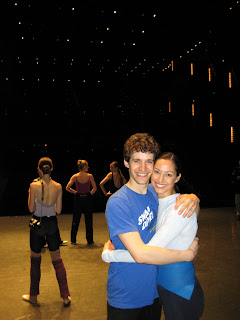
My last day at PNB onstage w/Maria Chapman
Let's go back to the beginning. When I moved to Philadelphia on June 17th, 2011, I had big dreams. I was taking a huge risk, leaving Pacific Northwest Ballet to join the fledgling, more contemporary Ballet X. By joining this organization, I cut my former salary down by nearly 2/3's, cut my guaranteed work weeks practically in half, and gave up all of the benefits that came with a big company contract. Why? Because like most artists do, I wanted to stretch myself as far as I possibly could. If you had told me that 4 years later I would be completely in charge of running my own career, traveling the country regularly, creating my own projects, directing organizations, and much more, I would have probably laughed in your face. Little did I know at the time that I would stretch myself in ways that I couldn't have imagined.

When I first moved to Philly, I was used to having a regular schedule. In Seattle, we had a Monday through Friday work week. We would begin class at 10:15 am and end our rehearsal days at 7 pm. I assumed things would be the same. But when I started freelancing, things changed drastically. All of a sudden I was in charge of my own technique, seeking work, negotiating contracts, self-promotion, marketing, staying in shape, and much more. I went from only having to show up in the studio to doing every aspect necessary to have a chance to show up in the studio and perform. I went from stretching in the morning, taking technique class, and rehearsing all day to never having a moment to breathe. After nearly 3 years of barely ever taking a day off, I had too much. This was one of my first major freelancing lessons. I started to burn out and displayed symptoms of severe anxiety. Today, while I still live the same lifestyle that I began four years ago, I have learned to nearly always take Sunday completely off for myself (today being an exception to write this exciting, timely blog). By giving myself Sunday, I take some pressure off myself and have a chance to relax and refresh for the upcoming week. Dancing for a company, a two-day weekend was a given unless we were performing. Today, a two-day weekend happens maybe once or twice a year.

Another part of my life that has changed drastically since crossing the country to try something new is my mobility as an artist and my perception of what encompasses a long period away from home and my partner. I have this really bad habit of getting what I ask for, but not exactly how I thought I would get it. When I left PNB, I was really interested in making travel a part of my art form. When dancing at PNB, we rarely went on tour. This was something that I had always imagined would be a part of my career. When I joined Ballet X, there was talk that the company would have a few opportunities to tour each season. I never made it long enough with the company to attend any tours outside of the performance at an APAP conference in New York where I sustained the injury for which they eventually fired me. But once I began to freelance, things changed drastically.

Performing @ the Guggenheim (Photo: Matthew Murphy)
My first few freelancing gigs had me excited to travel, but nervous about leaving my partner for very small amounts of time. When I performed at the Guggenheim's Works & Process series, I wasn't too worried about being away from home for 3 weeks because my partner was to join me in NYC for a week in the middle. Next, I danced for the first time with Alaska Dance Theatre for 5 weeks. Again, I was lucky that my man joined me right in the middle of the gig. So, the longest we had been apart at the time was less than 14 days. I remember being so upset when I was invited to dance with Festival Ballet Providence and found out that we would be away from each other for over 3 weeks. It was the longest that we had ever not seen each other since we moved in together in 2006. Today, I have been away from home for nearly 4 months and the longest we have gone without seeing each other has been 2 months. It is hard and not my favorite part of freelancing, but we make it work for us through regular phone and skype sessions, a relaxed approach to communicating, and the advice of a counselor.

On the traveling front, I always imagined myself touring to major cities with the company I danced for headlining in this organization's productions. But the past four years have instead featured me traveling to cities large and small, near and far, all on my own. Up until this past June, in fact, I hadn't been home for longer than 7 week in 3 1/2 years. In this time, I have danced, choreographed, and taught in New York City, Anchorage, Long Island, Providence, Philadelphia, Rochester, D.C., Myrtle Beach, Los Angeles, West Virginia, Ventura, Walnut Creek, San Francisco, Fort Wayne, Lafayette, Oakland, Irvine, Little Rock, and a few more that I'm probably missing. I used to be afraid of traveling to smaller cities. I assumed that the people would be conservative in nature, the culture would be limited, and that I would run out of things to do. This is one place that freelancing has really changed my perception. Nearly each place that I have worked has shown me that, while in differing stages of development, there are amazing people and places almost everywhere in the country. I hope to expand my perception of this outside of our country in the near future!

My last day as Interim Artistic Director of Alaska Dance Theatre
Another area of my life that has changed greatly since I started freelancing has been my awareness of what I am capable of creating. As a dancer, you are expected to be submissive. Most dancers are always following the lead of somebody else, often dreaming of the day that they grab the wheel of their career. I guess I was lucky that I didn't have to wait for this to happen. When I was left without a company to call home, I had no choice but to take control of things, create my own opportunities, and expand my experience. Again, if you told me 4 years ago that I would direct Alaska Dance Theatre, choreograph for the National Choreographers Initiative, create my own summer intensive in Anchorage, teach at Peridance Capezio Center, write my very own popular blog, throw networking events for freelancers, or create a film project, I would have looked at you like you had 20 heads.

Many days, I just can't believe that I have experienced and made the things happen that I have. While my stress and anxiety levels have increased ten-fold since I began living the life of a freelance dancer, I wouldn't take back getting the chance to see where my mind and body can lead me. Even with all of the challenges that I have been through over these difficultly fruitful years, the opportunity to lead my own creativity and career have defined me in ways that would be impossible under the culture and structure of most dance companies. And while I miss that structure and safety net provided by working for an established organization, I will continue to value my freedom while I stay in this career-style. Thank you again for sharing this journey with me as I find my way through joy, struggle, and creativity. And CHEERS to the years of this to come!

Thanks for joining me on this journey to 100,000!!!!!

Posted by Barry Kerollis at 1:31:00 PM No comments:
Email ThisBlogThis!Share to XShare to FacebookShare to Pinterest
Labels: APAP, art, career-style, Core-ography, Guggenheim, joy, Lauren Fadeley, McCallum Theatre Choreography Festival, Pacific Northwest Ballet, Pennsylvania Ballet, struggle, thank you

5.22.2015

"Create Your Own Project" series - Writing Your Own Budget

In the first two parts of our Create Your Own Project series, I talked about gaining fiscal sponsorship in order to accept tax-deductible donations and how to write a fundraising letter to obtain those investments. For the third part of this series, I will go into detail on how to write a budget for your project. As a dancer, you rarely have to worry about funding beyond, “Am I going to get paid by this presenter?” Now that you have decided to make art on your own, you have a lot more to worry about then simply collecting a salary. If you are following my series as a step-by-step process, you may find things a little backwards, as you will likely need to determine your budget in order to apply for fiscal sponsorship. In the end, there is no correct order to execute these items. But in order to gain the trust of donors and sponsors alike, you will need some semblance of a budget in place.

You want me to write a budget?
Where does one start when writing a budget? Again, I don’t think there is a proper place to start, but this is how I went about it. First, I looked at my project and picked apart major aspects of production that will require funding. Core-ography has a multitude of parts that need financing in order to execute the project fully. It involves dancers, film, editing, travel, choreography, and more. To make life easier, I broke my budget down into 7 categories. These areas that can't be executed without cost include equipment, artist fees, travel, legal fees, facility rental, salary, and unexpected costs. Each of these areas are important to the quality of my final product, so I took these broader subjects and broke them down a bit further.

One of the most difficult parts of writing a budget is the unknown. While there are methods to writing the financial requirements to fulfill your vision, it can be challenging to determine exactly how much money to seek out. If you create a plan that seems way out of proportion, you may turn off any larger-scale donors, grant-makers, or sponsors that see your financial plan as impractical. Especially for first time project-makers, if you create a budget that appears grossly over-projected, you may threaten losing the trust of those that want to see your project come to fruition. While funders give to artists because they want to share in their art, they also want to see the proposed product come to fruition.

Be practical when adding up the sum of your expenses, but don’t go too far in the opposite direction. If you plan for too little within your budget and later find that your expenses are much greater than you expected, you are going to run into some tight spots or risk failing to complete your vision altogether. Find a middle ground and try to come from a practical standpoint in your projections.

Now that I have shared the broader list of places that I need to raise money for Core-ography, let’s talk about how I broke down these categories. Since this project relies on my ability to film high-quality content, I know that I need a professional camera, lens, microphone, and tripod. There may also be additional accessories necessary; like an additional battery or travel case. Beyond this, I need a computer with high-quality editing software that can also handle loads of video footage.

In determining my needs, I didn’t suddenly become an expert on the essentials of a filmmaker. I reached out to my gloriously talented friend, Pacific Northwest Ballet videographer Lindsay Thomas (she is responsible for most of the videos from the PNB channel, like the one seen below), who is quite the expert at dance and film. She offered me suggestions for equipment, as well as less expensive second options in the event that I don’t meet my budget for costs. Whenever you find that you lack knowledge in an area of your project, brainstorm within your network to find friends and colleagues with expertise that can help guide you. The best projections come from somebody that has already been through what you are about to experience. Don’t be afraid to reach out.


Next, a major part of my Core-ography project is traveling on-site to work with each artist. My breakdown for this includes transport and accommodations. While I haven’t yet purchased my tickets for travel, I did a search on Orbitz of round-trip airfares to the cities I plan to visit. For some, traveling by bus or train is more feasible and much less expensive. Taking a general look at fares on plane, train, and bus, I projected that most round-trip plane tickets would cost about $500. Since 6 of my artists are outside of the northeast corridor, I must fly to work with them. When it comes to the other 6, it will probably be more financially responsible and even, possibly, easier to travel via train or bus. Beyond travel, I also researched the average cost of one week in a hotel room on-site. I may be able to defray costs by staying with friends. But I can’t project the possibility of this happening until I solidify travel plans. So, I included the cost of hotel accommodations with 8 of the 12 artists with whom I will be collaborating. Taking into consideration that I live in Philadelphia, have plenty of friends to stay with in New York and Seattle, and will likely figure out one more place, I projected 8 weeks worth of hotel stays.

From here, my next costs are artist fees, legal costs, and facility rentals. Obviously, you want to provide your dancers incentive beyond sharing their art and getting exposure. If an artist is providing you their time and skill, then you should be providing them with some compensation. Now, to get your artists on board and to make sure that they are committed to you and you to them, you need to have a contractual obligation between each other. Since this is your first time creating a project, it is highly unlikely that you understand how to write a legally binding contract. I do have a lot of experience with contracts, especially since I prepared and negotiated a three year contract at PNB. But this was with the assistance of AGMA personnel who negotiates contracts for a living. Even with my substantial experience with AGMA and working as a freelancer, I am still planning on reaching out to have an outside party take care of these documents. Lastly, I took into consideration that I need appropriate studio space to work with my artists throughout the weeks that we work together.

The final two areas that artists surprisingly leave out of their budget are salary for themselves and unexpected costs. If a dancer/choreographer is creating art and investing a great deal of time into their work, they must plan to pay themselves. Yes, artists often have passion projects. But passion doesn’t put food on your table or a roof over your head. It can feel selfish and pretentious to include a livable wage in your costs, but it is, perhaps, the most important part of your budget. Beyond this, I feel one should always include a bit of wiggle room for emergencies. Perhaps, I need to change my flight or the camera lens breaks after an accidental grand battement. For this reason, I would suggest that you always leave room for unexpected costs in your budget. Again, don’t be outrageous, but allow some wiggle room to assure yourself that a minor snafu doesn’t become a full-fledged crisis.

Keep your head from spinning and plan for unexpected costs (Photo: J.J. Tiziou)
One thing I keep in mind when sharing my budget with potential funders is that costs can be offset by donated equipment and space, shared accommodations, crowd-sourced funding campaigns, and grants. Rarely will an artist fund the entirety of their project through private donations. For this reason, it is important to project your budget to be fulfilled by an array of funding options. Just like a 401(k), the more diverse your portfolio of funding possibilities is, the more likely you will be able to meet or exceed your budget goals. Now, go ahead and project your financial needs and start figuring out how to get people and organizations invested in your art.
Posted by Barry Kerollis at 7:29:00 PM No comments:
Email ThisBlogThis!Share to XShare to FacebookShare to Pinterest
Labels: 401(k), art, artist fees, Core-ography, donors, editing, equipment, film, financial plan, financing, funding, grant-makers, investment, legal fees, Lindsay Thomas, project, salary, sponsors, travel

5.06.2015

"Create Your Own Project" series - Writing a Fundraising Letter


Speaking at a fundraising event for Alaska Dance Theatre (2013)

(Be sure to read to the bottom for a complete example of my recent fundraising letter)

In my first post of LOFD's Create Your Own Project series, I talked about the importance of fiscal sponsorship (which allows you to accept tax-deductible donations). Now that we are clear on the benefits of funneling your funds through a non-profit organization in hope of increasing the chances of more generous donations, your next step is to write a fundraising letter. Read on to find out how to fine-tune your initial asking campaign.

I don't know many dancers who outright enjoy asking people to donate money to their cause. Too often, artists live on the edge of poverty. So, when it comes to asking for money, many dancers shy away from this fearful act. Dancers are hard workers and often prefer to achieve their accomplishments through their own grit and determination. But there is nothing wrong with asking for assistance in creating your art and having the ability to survive financially throughout the creation process. Where is one to start in preparing correspondence with potential donors?

This may seem counterintuitive, but the first place any inspired artist should begin is with a business plan (the next topic in my Create Your Own Project series). To gain fiscal sponsorship, you will likely need to complete a loose proposal for your project; which should include your mission, project description, goals, budget, etc. By this point in the game, you need to have a more solid plan in place. You never want to be lacking in data when a potential donor asks you where their money will go. If a prospective sponsor catches you off guard and you aren't immediately prepared to explain the finely tuned details of your project, you will likely lose that prospect.

After your business plan is in place, it is time to begin writing. Of course, always start with a simple greeting, like"Dear Mrs. Johnson" or "Dear Dance Supporter." If you know their name, make sure to address the letter directly to them. But if you are going to ask a friend to share your letter with other potential donors, you may want to use a more general greeting to allow them freedom to send the letter on to their connections. Keep the length of your message down to one single-spaced page using a 12-point font of your choosing.

Now that you have the structure of your letter down, it is time to work on your content. When I first started writing my current fundraising campaign, my natural inclination was to prove my value to my audience and tell them why they should support me. Luckily, a great friend and supporter of mine, who just happens to be a professional dance writer, stepped forward and offered to mentor me through this process. Without their advice, I would have been lost. Throughout the editing phase, I learned that a first asking campaign usually goes out to people that love and support you. Therefore, less time needs to be invested in writing about your worthiness of their support. My friend kept returning to this statement,  "Why does this project matter to your audience?" Essentially, patrons are more likely to support your work when your subject means something to them.

Your letter should be very concise and to the point. Start the body of your letter by drawing your reader into the subject matter of the project and ask why it is relevant to your audience. Next, speak directly about the project. Only include key details, as the finer details may cause the reader to lose interest before they get to the ask. Since most projects are deeply personal to the creator, it is easy to go on a rant about aspects of the work that are only important to yourself. This is why it is pertinent to have a neutral party edit your first drafts. The last thing you want is to offer information that is meaningless to the person reading.

After sharing the details of your hopeful creation, you need to ask for an exact amount of money and explain why you need that amount. If you need $500, ask for $500. If you need $10,000, ask for $10,000. If you are shy about asking and somebody does decide to give, you will receive the lower amount. But if you ask for what you need, and they choose to invest at a lower level, you are still ahead of the game. Be sure to include clear details on the allocation of their donation.

Now that you have talked about money, you should give a short summation of your background and qualifications. This helps to build trust in the integrity of the final product and shows your ability to follow through with your promises. Keep in mind that a donation is an act of trust. People give out of trust that you will be honest about your intentions and follow through with a quality product. Again, don't go overboard, as most of the people you reach out to already know your achievements and work ethic.

The final paragraph of your letter should restate the need for public support and offer information on how to donate. If you plan to correspond via email, be sure to include links to your past work and donation page. Also, check with your fiscal sponsor to see if you are required to include any fine print, as many do. Be sure to mention that you are willing to accept any level of donation if they are not able to meet your exact request.

Once you have completed a few drafts of your letter and let another pair of eyes edit your work, you need to determine your audience. Look at how much you are asking for and be practical. If you know somebody has been having financial difficulties or recently encountered a major expense (medical, car repairs, etc.), wait until later in the campaign to reach out to them when you are seeking smaller amounts to cover lesser costs. Try not to ask for money around big holidays or in the midst of tax season. Don't be shy, but ask yourself, "Would this be a big or small stretch for Mr./Mrs. ______?" From there, determine whether you'll send this letter via email or physically. Keep in mind that sending a letter in the mail is more professional, but will incur greater cost before you have received funding. You will need to retroactively put this into your budget. If you are trying to cut down costs, send your letter via email. I actually prefer email because it allows me to add a link to my choreography and donation page.

Now that you better understand the art of writing a fundraising letter, keep scrolling down to check out the letter that I recently developed for my upcoming project. With that said, readers of Life of a Freelance Dancer, please allow me to introduce my upcoming project, Core-ography.

(I am offering this as a tool. This letter/project is my property and can/should not be replicated or reproduced in any way, part, shape, or form. I retain the rights to the letter/project/intellectual property below)

Greetings Dance Supporter,

We’ve all been through times when immense growth and significant challenge seem to go hand-in-hand. Commonly, we look back at these experiences as positive building blocks in our lives. But did you feel you had to keep private and deal with things all on your own? Did you worry how people would judge you if you admitted that you were less than happy and content all the time?

My new project, Core-ography, tackles these questions through dance. We’ll travel the globe to tell dancer’s defining stories and promote the idea that it can be positive to share life’s most revelatory moments. Our Core-ography channel will be easily accessible on Youtube, making it available to audiences worldwide. I am writing you to ask for your help in making this unique project come to fruition.

Each artist will be interviewed to pinpoint their most defining experiences. After, we will collaborate to create a choreographic expression of their personal story as public art. This project brings superhuman dancers down to their most human qualities and inspires people to share without judgment.

Here is where your support is crucial. The initial phase of Core-ography costs $50,000. I am seeking 12 Core-sponsors to make a tax-deductible donation of $2,000, which will give us solid footing to work from for our first 12 artists.  Dancers from companies in New York City, London, Philadelphia, Los Angeles, Seattle, Atlanta, Washington D. C., Richmond, and more are already prepared to work on this project.

My experience spans more than a dozen years working with some of the nation’s most prestigious dance organizations. I have choreographed for the National Choreographers Initiative and won an Outstanding Choreographer award at the Youth America Grand Prix international ballet competition. I am excited to use my skills to offer mental health awareness through dance and film.

Your generous gift will cover the cost of travel, accommodations, facilities, legal fees, compensation, and more. Core-sponsors receive direct acknowledgement in artist videos and insider updates. Your support gives us legs to lift this project off the ground and into the studio. The remainder of costs for Core-ography will be covered by grants and a crowd-sourced funding campaign.

Please help me make Core-ography possible by sponsoring an artist today! If you are unable to be a Core-sponsor, donations of any amount are welcome and greatly appreciated. Donations can be made online via this link or by check (see below). Checks can be mailed to: Barry Kerollis, PO Box 63723, Philadelphia, PA 19147.

Choreography Sample
 
Barry Kerollis is a member artist of New York Live Arts, Inc., a non-profit tax-exempt organization. Contributions in support of Barry Kerollis’ work are greatly appreciated and may be made payable to New York Live Arts, Inc., earmarked for “the New York Live Arts member project of Barry Kerollis.” A description of the work and current project activities for which such contributions will be used are available from Barry Kerollis or New York Live Arts, upon request. All contributions are fully deductible to the extent allowed by law. (Note: A copy of New York Live Arts’ latest annual financial report filed with New York State Department of State may be obtained by writing to the N.Y.S. Dept. of State Charities Registration, 162 Washington Avenue, Albany, NY, 12231, or to New York Live Arts, 219 West 19th Street, New York, NY, 10011)

Warm regards,
Barry Kerollis
Core-ography Founder/Choreographer
http://barrykerollis.com/
http://lifeofafreelancedancer.blogspot.com/


Greetings Dance Supporte
Posted by Barry Kerollis at 10:15:00 PM No comments:
Email ThisBlogThis!Share to XShare to FacebookShare to Pinterest
Labels: art, ask, audience, body, campaign, Core-ography, donations, edit, fiscal sponsorship, fundraising, greeting, money, non-profit, project, structure, tax deductible, trust, write

3.16.2014

Dancing in Fear

As dancers, we tend to live in fear of many things. The physical pain that we experience and the brevity of our careers often cause great stress and anxiety in the mind's eye of most dancers. In recognition of my 11 years as a professional; dancing through fear, happiness, injury, passion, and much more, I offer you 11 fears that I have coped with over those years. Sometimes, we feel like we are the only individual experiencing some of the most stressful moments. I strongly believe in sharing experiences to help others feel that they are not alone in this career's most stressful moments.

Me and James Moore performing Romeo et Juliette (Photo: Angela Sterling)
1. Let's get this one out of the way first. Injury. Most dancers biggest fear is that they will get hurt. This is a factor that every dancer has to contend with at some point in their dancing. Whether minor or major, injury is inevitable. The most stressful part of this job having a high potential for injury is timing. Timing is so important in a dance career. Timing of an audition. Timing of a performance. Timing of paying your bills. The closer one gets to these perfectly timed moments, the harder this anxiety can be to contain. I remember being cast to dance Mercutio in Jean Christophe Maillot's Romeo et Juliette. My fear of injury prior to my big debut became so great that I would knock on wood constantly throughout the day. Anytime I had a bad thought or a moment of fear, I would knock on the dance floor, or a ballet barre, or a lighting boom. I must have knocked on wood hundreds of times over those weeks leading up to that show. I knew that knocking on wood wasn't going to change what was going to happen, but it at least helped me cope with this great amount of fear.

2.  One of the best parts about being a dancer is the way that our art sculpts and forms our bodies. The general population is obsessed with the ballet body and people are not shy about openly discussing it with dancers. For me, I can't deny that I enjoy the attention that I get for the physique that ballet training has given me. But with that said, one of my biggest fears is that I will gain weight and the form that I have created over years and years of meticulous sculpting will crumble. I never really had this fear earlier in my career, as my body was different then. But as a freelancer, I am not always taking class daily and rehearsing for 6 hours afterwards. While I am still in the shape I have maintained over the years, it has become increasingly difficult to keep things going when I am in between gigs. This may be a shallow fear, but it is one nonetheless.

3. When I am stressed about something, I have nightmares. I call them drama dreams. One of these recurring dreams is that I have to perform a ballet that was never taught to me. Somehow, I find myself standing onstage waiting for my entrance and was never given any information about the performance that I am about to do. This dream comes from the feeling that I haven't been properly prepared for a performance. In the land of dance art, where funding is low and expectations are high, there isn't always enough time to rehearse a piece until you feel appropriately prepared to perform for hundreds or thousands of people. Nonetheless, it is all too common for dancers to step onstage with a dark, cloudy question-mark about the outcome of their performance. This lack of preparation creates a great amount of fear and stress that it will negatively affect one's performance.

4. This is trivial and silly, but it is a legitimate worry of mine. As dancers, we are often overtly exposing our bodies. Whether wearing tights, or shorts, or even just a dance belt, our art often exposes the body for the public to view and enjoy. While dancers are often viewed as superhuman, we are, in the end, only human. And as humans, we have human functioning. Sometimes, prior to a performance, you aren't feeling that well. But the show must go on. Perhaps, you ate something for lunch that didn't agree with you. One of the most embarrassing things that could happen onstage might just occur before you get onstage. Think along the lines of your digestive system being off and you have to immediately put on a pair of white tights. Or say, a lady is having her time of the month and putting on a white leotard. Ummm....yeah. Enough said!

This was me selling out...
5. One of the main reasons that I decided to leave Pacific Northwest Ballet was because I was afraid that I was selling out as an artist. Often, dancers will take a job that they wouldn't ideally be a part of, but they need a paycheck. At other times, dancers will perform in work that they don't really agree with just to get press. In my final year at PNB, I felt that I was holding on to my contract only because of the great benefits that were offered to me through my union agreement. Looking back, I know now that this wasn't fully, or even half, true. But I was so scared of being untrue to myself as an artist, that it became a driving factor in me leaving the company. In that case, fear won.

6. One fear that I have had to live with is that I will finish my dance career with unfinished business. It is way too often that dancer's careers end early or in a way that the dancer doesn't have a say. Or even, perhaps, they didn't achieve what they thought they could as they entered their career. Nonetheless, I experience great unease about feeling incomplete when I decide to end the performance side of my career. I have seen too many directors and teachers trying to live out their dance careers through their company members and students. I want to leave performing feeling content.

7. The dance community is so extremely connected by people, but so greatly disconnected in practice. One company's culture is going to be completely different than another. Being a freelancer, it can be difficult to remain fluid throughout every gig and within each process. I have stepped out of cultural expectation (sometimes knowingly, other times unknowingly) within a company or two and, sometimes, that leaves people confused, edgy, and/or angry. While my actions may not have been within a company's cultural understanding, I fear that I may burn a bridge that was built over territory with no agreement. Misunderstandings that are purely professional can easily become personal and hurt a person's ability to work within tightly knit social communities of the dance world.

8. I am afraid of being stuck in the warmup class of an old school Russian-style teacher on a performance day. Enough said!

9. One major stress of mine is picking up choreography. Some days I can pick up faster than anybody else in the room. But other days, I swear you could teach the same choreography and I may have trouble latching on. There is nothing more stressful and frightening than being taught a shit ton of choreography and watching everybody else catch on while you struggle your way through the material.
Rehearsing wildly fast & intricate choreography w/ Elizel Long - Choreo: Seiwert (Photo: Gutierrez Phography)
10. It is often taught that you must always continue growing your technique or you are doing poorly. If you are maintaining a certain level of technique, but not improving in any area, you are actually getting worse. I think this is due to the shortness of our careers. But I live in constant fear that I am not getting better, and this was taught. And while we do want to improve, sometimes it is more important to maintain for a period of time than to grow too fast and peak too soon.

11. My biggest fear in my career is the same fear that most people live with at some point in their lives. After putting so much time into my career and giving everything I have had to make it happen, I fear that it will all be in vain. I don't need to be a star. I don't need to win awards. But I do want to feel like I made a mark, an impression, and moved people with my art. People always say, "Dance as if nobody is watching," or, "Dance for yourself." I never agreed with those statements. I dance because somebody is watching. I dance because it makes me feel good to let others enjoy watching me dance. And if I were to only dance while nobody is watching, I feel my career would have no point. I want to leave this career knowing that I gave something valuable to my art.

What fears have you experienced throughout your career?
Posted by Barry Kerollis at 10:40:00 PM No comments:
Email ThisBlogThis!Share to XShare to FacebookShare to Pinterest
Labels: art, company culture, dance as if nobody is watching, fear, human, injury, jean christophe maillot, Mercutio, nightmare, picking up choreography, preparation, Romeo et Juliette, selling out, unfinished business

3.17.2013

The Mental Game of Freelancing

Look who was recently featured on renowned photographer Jordan Matter's "Dancers Among Us" Facebook page. Although my image didn't make the final cut into his New York Times Bestseller, I was also featured in his blog during the creation of this beautiful book. Being photographed by this man was a wildly unforgettable experience and I hope to be a part of his future projects.

Performing w/Alaska Dance Theatre in Duran's "Cash & Cline" (Photo: Gutierrez Photgraphy)
Now that I've got that out, moving on to this weeks' posting. I have a handful of topics that I want to write about this week, but I always feel more compelled to write on subjects that directly relate to things/emotions I am currently experiencing. One subject that I find comes up most often in conversation with my freelancing friends is whether or not we want to continue freelancing. Finding work on the fly is not only stressful, but often poses the threat of career, relationship, and financial disaster. While these fears are always looming in the back of every freelancers mind, we continue to dance because we love it and we continue to freelance in order to sustain ourselves. A combination of passionate (and sometimes blind) drive and fear for survival often cause nomadic dancers to swing back and forth between the choices of continuing freelancing, finding more stable company work, or quitting altogether.

I have discussed this in past posts and want to revisit the reasons that most dancers begin freelancing. A large amount of people who freelance do so because they were not able to obtain a job with a full-time company. Often, this is due to the fact that they just weren't in the right place at the right time or they were fresh out of school and still developing as a dancer. Another reason that many people start freelancing is because they feel that they have reached a certain point in their career with a company and want to go out on their own to find more fulfilling work. There are also people, like me, who were thrust out into the world of freelancing against their will. After spending a handful of months dancing with a company that I left PNB to join, I became injured during a rehearsal. Details aside, the young company broke my contract when I tried to take time off to heal because they didn't want to support an injured dancer. This happened in the middle of the company's season and right at the end of audition season. I was injured and couldn't get better in time to make myself presentable for company auditions. And at the same time, I didn't want to move from the city that I had just moved to only months before. Thus, I began healing and set out to become an established freelancer. Other reasons for freelancing include change of location for non-career reasons, short seasonal company contracts, and more.

Looking at the list above, you can see that freelancers become who they are for more reasons that are out of their control than those in their control. For those of us that didn't make the choice to freelance, aside from the fact that we knew we wanted dance to continue as the focus of our careers, it can become easy to start questioning the track of our career. Many dancers enter freelancing with a clear intention of joining a company in the future. But as you become more popular in your field and hold a busier schedule, the line blurs and the tendency is to flip-flop between company aspirations and the never-ending quest for the next gig. At what point do you know that you are ready to commit to another season as a freelancer or to start prepping for audition season?

There are many stresses involved in the art of freelancing that can push you in different directions. Dance/work-related stresses include (and are not limited to) finding work, staying in shape, quality of work, continuing to grow as an artist, feeling fulfilled in the work you are doing, and feeling like your value is represented by treatment and pay. Personal stresses include (among others) location, time away from home, works' affect on personal relationships, financial survivability, and work-life balance. Seeking to attain some sort of balance of these stresses can make it very difficult to make the conscious decision to continue freelancing. If a dancer chooses to take a two month gig across the country, how will that decision affect their two year relationship that they are leaving behind at home? Or if a dancer chooses only to seek work with academies and schools because the pay is greater than company work, how does that affect their feelings of fulfillment and growth? What if a dancer risks all of the stresses that are important to them only to find that the work they accepted is not up to par with what they had been expecting? Freelancing is a difficult choice because it carries such great risk and affects much more than your work-life.

Performing "La Esmeralda" at gala (Photo: Dmitri Papadakos)
While I have had some experiences that have brought me to some low places on my list, I have also had my fair share of great highs throughout my career in freelancing. One of my biggest goals I had hoped to accomplish during my dance career was to travel and see the world through my work. I couldn't do that in the companies I was dancing for full-time. I also found out that I have a lot more respect for myself as a classical ballet dancer after performing in a gala for a gig. This was an opportunity that I wouldn't have been offered while dancing at PNB, where I was pigeon-holed into the role of a contemporary specialist. While some of my freelancing experiences have made me feel less than valuable, many more have built my confidence to new levels and offered me experiences that weren't offered to me in my life as a company dancer.

Looking at these abridged lists of stressors that can affect your career as a freelancer, it becomes quite clear that there is great push and pull in the mind of a freelance dancer. At what point does a nomad choose to find more stable living? When does the choice to live wild versus living a normal life become too overwhelming to continue? Obviously, I am not in a place to tell people what their breaking point may be, but I can at least open up this topic for discussion on this forum and let people know that it is absolutely normal to question living the gypsy life. It is in every freelance dancer's best interest to constantly assess their needs, fulfillment, and happiness in order to remain healthy, stay at the top of their game, and to live a sustainable/enjoyable lifestyle. With all of these things in consideration, the mental games that freelancing presents are much easier to understand.
Posted by Barry Kerollis at 8:49:00 PM No comments:
Email ThisBlogThis!Share to XShare to FacebookShare to Pinterest
Labels: art, blog, career, classical ballet, company, Dancers Among Us, gypsy, Jordan Matter, New York Times Bestseller, nomad, Pacific Northwest Ballet, personal, season, stressors
Older Posts Home
Subscribe to: Posts (Atom)

Barry Kerollis

Barry Kerollis
(Photo: Brian Mengini)

About Me

My photo
Barry Kerollis
Philadelphia, PA, United States
It is every dancers dream to land a job in one of America's top dance companies. I did that twice, staying with one company for 7 seasons. I spent years successfully pushing forward to get the opportunity to perform featured and leading roles within the company. In 2011, I chose to exit the luxurious world of a major ballet company to enter the small concert dance scene. After less than a year in this new lifestyle, unforeseen circumstances thrust me out into the world of dance on my own with no company to call home. My name is Barry Kerollis and I am a freelance dancer (http://barrykerollis.com/)
View my complete profile

Blog Archive

  • ▼  2017 (14)
    • ▼  November (1)
      • Chapter Closed
    • ►  August (1)
    • ►  June (1)
    • ►  May (2)
    • ►  April (2)
    • ►  March (2)
    • ►  February (3)
    • ►  January (2)
  • ►  2016 (32)
    • ►  December (3)
    • ►  November (3)
    • ►  October (3)
    • ►  September (2)
    • ►  August (3)
    • ►  July (2)
    • ►  June (2)
    • ►  May (3)
    • ►  April (3)
    • ►  March (2)
    • ►  February (3)
    • ►  January (3)
  • ►  2015 (32)
    • ►  December (4)
    • ►  November (2)
    • ►  October (3)
    • ►  September (2)
    • ►  August (4)
    • ►  July (1)
    • ►  June (2)
    • ►  May (4)
    • ►  April (2)
    • ►  March (2)
    • ►  February (3)
    • ►  January (3)
  • ►  2014 (37)
    • ►  December (4)
    • ►  November (3)
    • ►  October (2)
    • ►  September (3)
    • ►  August (2)
    • ►  July (2)
    • ►  June (3)
    • ►  May (3)
    • ►  April (3)
    • ►  March (4)
    • ►  February (3)
    • ►  January (5)
  • ►  2013 (39)
    • ►  December (4)
    • ►  November (3)
    • ►  October (4)
    • ►  September (3)
    • ►  August (2)
    • ►  July (3)
    • ►  June (3)
    • ►  May (3)
    • ►  April (3)
    • ►  March (4)
    • ►  February (2)
    • ►  January (5)
  • ►  2012 (39)
    • ►  December (3)
    • ►  November (2)
    • ►  October (4)
    • ►  September (4)
    • ►  August (5)
    • ►  July (4)
    • ►  June (6)
    • ►  May (8)
    • ►  April (3)

Additional Media/Services

  • Pas de Chat: Talking Dance podcast
  • Spaces Transformed - Professional Organizing Services

Freelance Followers

Freelancing Frequencies

Awesome Inc. theme. Powered by Blogger.