It's been a while since I've done a list post. And it's Halloween weekend, so I thought I'd have a little fun with this one. If you are looking for high-brow, in-depth quality content, stay tuned for my next post or look at my previous posts via this link. For now, please enjoy these 11 SCARY thoughts that different types of dancers have.
via GIPHY
The Freelance Dancer - "Well, this is a really nice gig, but I don't have anything else lined up after this. Could this be the end of my career?"
via GIPHY
The Street Dancer - "What if this subway car slams on the breaks while I'm doing my big finale?"
via GIPHY
The Company Dancer - "If I show up to class in costume, will the director think that I'm not serious about my dance career and take it out on me in casting?"
via GIPHY
The Open Class Dancer -"What am I going to make for dinner after this class?"
via GIPHY
The Broadway Dancer - "If I have to do this show one more time, will I lose my mind!"
via GIPHY
The Break Dancer - "Does spinning on my head increase my risk of balding?"
via GIPHY
The Pre-Professional Dancer - "This is my second year at this finishing program. If I don't get a job by the end of this year, does that mean I need to quit and go to college?"
via GIPHY
The Ballroom Dancer - "Why is she talking to that other guy over there? Is she plotting to switch partners?"
via GIPHY
The Recreational Dancer - "What will ever come of my true aspirations to have a dance career if I'm not cast as Clara in The Nutcracker this year?"
via GIPHY
The Club Dancer - "If I go out there and dance, everybody is clearly going to only be watching and judging me, right?"
via GIPHY
The Stay-at-Home Dancer - "What if my Husband is secretly filming me sing and dance to my 90's playlist while I am vacuuming the floor to post it on the internet?"
via GIPHY

10.17.2016
Acting Professionally in a Rehearsal Studio
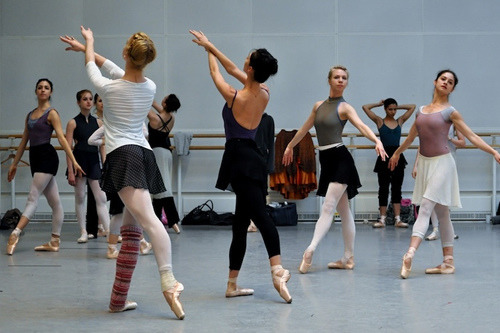 |
| The Royal Ballet in rehearsal (Photo: Unknown) |
Back a handful of years ago I was working with a pickup company that employed enough dancers to fill a small rehearsal room. In other words, our athletic group of 8 had to get along considering our company's size. A few of us were more seasoned than the others. But one dancer was enjoying the raw, empowering, and often shocking experience of their first job as a professional. Previously, I talked about my experience at my first full-time job with Houston Ballet and how I stepped on dancer's toes without even realizing it. After watching this type of situation from the other side, as a senior dancer, I was taught a lesson in kindness, patience, and humility.
Dancing for a big company is very different than dancing for a small ensemble. In a bigger company, dancers often feel more comfortable being up front (if not, sometimes, mean) when trying to streamline a young dancer into their place in the unique culture of a professional company. If any interaction becomes tense, dancers can retreat into their clique for comfort or hide behind other dancers who are more willing to stand their ground. But in a small company, there is nowhere to hide, very little hierarchy, and everybody has to interact frequently with one another in the studio.
 |
| Smuin Ballet in rehearsal (Photo: Chris Hardy) |
Now, it is perfectly healthy to run a studio where dancers feel that they are a valuable part of the process, where the environment is light and friendly, and where a dancer feels that they can speak up when they feel that something isn't working properly. But this dancer started to become a distraction and affected the ability of others to work to the best of their abilities. Due to the size of the company, where another more experienced dancer may have talked to their freshly minted colleague, this dancer was left continually breaking "rehearsal-code" for the extent of the gig. This was most likely due to the fact that, in such a small group, everybody knew that a small amount of tension between two dancers would be felt by all.
In this company, many of the dancers looked up to me and respected my work. And for that reason, it was suggested by some that I speak to this dancer to give them an idea of professional rehearsal etiquette. But, as I stated before, I felt it would cause too much tension and that it was actually the responsibility of those in the front of the studio to hone this character in. Looking back, I'm glad I maintained this position. But this is the advice that I would offer that dancer today if I were the person at the front of the studio.
First things first, the way you act in a rehearsal studio as a student is completely different than when you are a professional. Most students who become professionals have reached the top of the hierarchy of a school. Essentially, if the school had a ranking, these dancers are the Principals of the school. In a professional company, a top-level student most often enters at the lowest rank and seniority. In most professional rehearsal setting, Principals have more leeway and freedom in their choices, actions, and vocal interaction than others. Not to say that a new professional can't have a voice or input. But it is the job of an apprentice or first year dancer to sit back and absorb what is happening around them. They don't have equal cultural standing to those higher ranked or more senior dancers. Just like in medieval times, the apprentice to the blacksmith didn't walk in on day one and start working with the iron. It may have taken a long time before the mentor allowed the apprentice to even touch any equipment, let alone lead the creation of a work of art.
My next bit of advice is to keep an open mind about your idea of what a rehearsal should look like. School rehearsals are often much slower paced with more time to retain choreography, fine-tune, and engage in conversation. Many professional environments are much faster-paced and don't open up the room to ask questions or discuss particular material until all of the material is already out. This is to help streamline the process and may even be an effective money-saver. In school, most of the students are paying to dance. In a professional environment, time is money. The longer dancers are in rehearsal, the more they get paid and the more time spent paying for rehearsal space (esp. in freelance or project based gigs that don't have a home studio). There are reasons for professional rehearsal culture that go beyond personalities and people getting along.
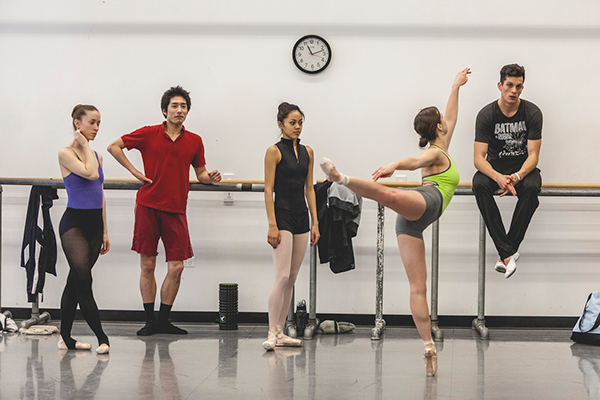 |
| Joffrey Ballet in rehearsal (Photo: Lenny Gilmore) |
As you can see, I shied away from sharing too many specific items about how to act in a studio. This is mostly because each and every studio functions differently and most effectively per the needs of an organization. I don't want any dancer to ever feel completely stifled by trying to fit in to the culture of a dance company's rehearsal process. But if you approach a professional rehearsal studio with respect for those around you and respect for what came before, it will be much easier to acclimate to dancing for a company. And, if you are lucky enough, perhaps, you will have the staying power to become one of those dancers that helps the next generation learn a company's culture from your fine example.
10.05.2016
Get Out of Your Comfort Zone - Honeymoon Edition
 |
| One of my images from our trip to Machu Picchu |
 |
| Exploring the historic Plaza de Armas of Cusco, Peru |
I wanted to talk a bit about what I've been up to, and at the same time create some relevant content for you guys. In my thought process while prepping to write this piece, it clicked for me that it was time to talk about getting out of our comfort zones. There are many ways to get out of your comfort zone. For instance, I am an expert traveler. But only when it comes to domestic travel within the United States. I haven't been out of the country in 6 years as I've focused on building certain aspects of my career. For me, I could have stayed comfortable and had my honeymoon in the US. But that idea, while easy and relaxing, would have been completely within my husband and my comfort zone. We threw around the possibility of traveling somewhere international, but in a more developed country with lavish, comfortable accommodations. This option would have been slightly out of our comfort zone, but still offer us some ease of mind and relaxation to celebrate our union. But if any of you have gotten to know me over the years while reading Life of a Freelance Dancer, you know that neither of those experiences are close to my style (nor my husbands).
 |
| Enjoying art in the Parque Esulturas in Santiago, Chile |
I remember back when I first fell in love with ballet. I didn't know much about what I was doing, aside from the knowledge that there was this amazing school where kids were selected to dance in the mornings and afternoons (the School of American Ballet) and got to focus on dance like I had been focusing on math and science. I also knew that I was a little behind, but felt I might be able to catch up if I did enough research and worked my ass off. I pulled open the January 2000 issue of Dance Magazine and decided to ask if I could audition for the summer intensives I had found with either the biggest ads or in the biggest cities (because, ya know, the bigger the city or the bigger the ad, the better the company?). I was lucky to have a supportive family and an even more supportive teacher and school director to help me follow my uncultivated dream. I jumped into the deep-end fast, and nobody stopped to second guess my ambition. And I guess a lot hasn't changed since then.
 |
| Enjoying the centerpiece of our honeymoon, Machu Picchu |
But in typical Barry fashion, I had my eyes set on jumping into a pool of water with no definitive bottom. At the time, I just did it. But I can explain this decision more clearly now. I innately knew that there were two ways to grow as a person; in small, safe building steps or in one fell swoop with great potential for success or failure. I made the choice to put a lot of money on one number, instead of buying a handful of inexpensive scratch tickets from the lottery.
 |
| Dancing thru a tour of Teatro Colon in Buenos Aires |
There is so much to learn from putting oneself out there in multiple different aspects of their lives, especially as an artist. It is the job of an artist to offer unexplored perspectives to audiences for acceptance, discomfort, and expansion of their own values and life experiences. If one doesn't want to push themselves outside of their own comfort zone, it is our responsibility to share our experiences and challenge them to grow. In life, we are often presented with three different options. Ones that allow zero growth, little growth, and great growth. Those choices that often offer the greatest growth can be the most painful, challenging, and uncomfortable experiences. Like a caterpillar bursting out of its cocoon as a butterfly or like a mother giving birth to a child, these experiences are likely very frightening and often painful. But the rewards from stepping into the unknown, discomfort and pain in growth, and expansion of mind, self, and being can reap benefits, rewards, and joy that couldn't be understood or experienced in one's life otherwise.
 |
| Taking in standing atop the amazingness that is Cusco, Peru |
9.12.2016
How to Reach Out to Somebody You Don't Know
 |
| Will this be me during my honeymoon in Buenos Aires? (Photo: Say Hueque blog) |
Now, moving on to what you are all here for... some fresh content! I'm inspired to share information with you today from a recent experience I had. Now, I must forewarn you all. While I am ecstatic to share myself as a public persona that is both approachable and candid, at any point anybody I know/meet or any experience I have may become a topic of conversation within my media work. I don't do this for a laugh or to shame anybody. I take my work in sharing information and learning through each other's experiences very seriously. But I think that we can all learn strong lessons from one anothers missteps, failures, and successes. So, with that disclaimer out there, let's move forward with this post's topic.
 |
| Performing in "The Nutcracker" (Photo: Glenn Mata) |
What happened was this freelance artist sent me a private message stating that they knew somebody I knew. Then without providing much additional information, requested I put them in touch with my contacts to give them freelance work. What threw me off here was the appearance of expectation that I would just offer up opportunities to any person that reaches out to me and requests them. When I first read this message, I thought to myself, " Who does this person think they are? And who do they think that I am?" But once my initial reactions began to fade, I recognized that this amateur (and sometimes professional) error was one I had committed before and was more revealing of this dancer's experience and understanding of how the dance world functions than anything else.
Let's get one thing straight. There is no magical, easy way that a dancer gets work; whether they are seeking company or freelance positions. I don't have dozens of people asking me on the regular to find artists for them. In fact, my freelance career has been full of quick bursts of fantastic feasts and sometimes long, desperately desperate famine periods. The success that I have obtained in both my dancing and choreographic/teaching career have been the result of insurmountably relentless hard work, trial-and-error, and unassuming vulnerability. Looking at this dancer's daring ask, I recognized she had tapped into her vulnerability by reaching out to a stranger who had figured out their own path to success in her field of interest. But, perhaps, her error lay in zeal. Instead of taking some time to develop a carefully curated approach, she asked to ride on the coat tails of my perceived success. Yet, even if I had work to offer, I already knew that she was unlikely to be in a place to best represent me as an example of my taste and consideration for excellence. It is important to remember that any referral almost equally reflects back on the person who suggested a dancer for work.
Before I even perused this dancer's Facebook account, I was already questioning whether she was working at a high enough level to perform some of the work that she had requested. Let me preface this with a disclaimer that I still don't know the true quality of this dancer, therefore I can't judge them. And if I did, I would not share that information publicly. But alarm bells rang the moment I finished reading the Facebook message I received because the request was missing important pieces of information, had one glaring statement, and read overall as an assumption that I already wanted to help. The missing information was a clear error, as there was no professional background or history given by this dancer whatsoever. No statement of past experience, no images or reel to validate quality, and no resumé or CV to inform me that "I am a highly-qualified candidate for work." The glaring statement that jumped out to me let me know that they were mostly looking to perform starring roles in works, but would be willing to step into lesser roles if they weren't available. And the final deal-sealer was the request I already spoke about to be put in contact with "my people" (which, unfortunately don't really exist). By the time I reluctantly sauntered over to her profile to perform a quality assurance search on photos, I already knew that if I could have helped that I would probably have passed up.
 |
| Me and "My People" (Photo: Danya) |
So, I hope you can see how all of this relates. What I did there was I tried to show confidence and get the recipient on board with what I felt I had to offer. But it instead showed a lack of grace, humility, and general understanding about the way that things work in our field. This was the same mistake that this hopeful freelancer made when reaching out to me. By reaching out to me in the way she did, I already didn't trust her as a person and wrote her off as unqualified or having an over-inflated sense of worth as a dancer. This was almost to the point where I considered ignoring the message.
Now, let's move forward with this. What can we learn from these stories? In the event that you want to reach out to somebody to ask them for work (whether dancing, teaching, choreographing, or beyond - both in and out of the dance world), I always suggest that you introduce yourself quickly on a personal level and more in depth on a professional level. Don't wait for the recipient to request information to back up your requests for work or networking (like a website, CV/résumé, photos, reel, etc.). Do be sure to clearly express what you hope to get out of the contact while keeping your word count to a minimum. Be wary of making assumptions that this person already wants to help you. I always say the best way to go about this is to ask for assistance in reaching your intention or for information about how to go about getting what you are looking for, instead of going straight for the punch and asking for work. Sometimes, this is unavoidable, but try to be direct without being demanding. Beyond this (and this doesn't apply for me because I do suggest the public reach me via my website contact page for anything from work to personal questions or via Facebook message for personal questions), if at all possible, try and contact people via a professional email address. Most people prefer to keep Facebook personal. Requesting work or help with getting work is not a personal request and can really turn somebody off if they don't know who you are.
It can be challenging to determine the best, most streamlined way to find success and live out your dreams. One of the hardest pieces of this puzzle is helping to tie people into your network without coming off like you are only using that person for your own professional gain. Be sure that you are always prepared to share a sufficient amount of information and you will come off as somebody who knows the way our world works because you have functioned within it. We live in a tricky web where some things work for some people and don't work for others. But please feel free to use this information as a guideline to help expand your network and to hopefully get that work you are seeking!
9.06.2016
Sharing LOFD on Popular Podcasts

In the meantime, I have been busy, busy, busy mixing with a handful of people and organizations that have recently reached out to me for interviews and more. Soon, I will be featured on an app that is coming out that will offer you the opportunity to video chat with me for advice, information, or just to talk to me about dance. Beyond this, I have been in conversation with the Dance Network about possible collaborations. There are a few other things coming up that I can't yet talk about, but I promise you will know as soon as I can talk about these things.

Last week, I also had the wonderful opportunity to chat with Ken Scheck when he interviewed me on his so popular, so fun, SO GAY podcast. We talked on THIS SHOW IS SO GAY about everything from masculinity in ballet to my recent marriage. There was also an extended conversation about this blog right here and my recent post on retirement. I was so honored to be a part of this podcast. So, I suggest you go ahead and give this interview a listen while you eagerly await next week's post. It's gonna be an interesting one!
8.22.2016
The "R" Word - Retirement
 |
| The Nutcracker (Photo: Ruth Judson) |
Martha Graham was once quoted as saying, "A dancer dies twice." I can tell you from experience that this is one of the most credible statements that has ever been spoken about the pathway a dancer takes as they end their performance career and transition forward into the next stage of their lives. I have been told that one of my most defining attributes as a writer is my level of candor in talking about the realities of our wonderful dance world. But I don't feel that I have been completely candid about where I am as an artist today. And I finally feel that I am ready to change that.
If you have shared the journey of Life of a Freelance Dancer, you have walked hand-in-hand with me from the commencement of my career as a freelance artist. If you look back to 2014, where I posted about dealing with injury and working my way back from burn out, it was quite clear that I was working through a difficult period of my performance career. I had been traveling non-stop for 4 seasons and felt that I was beginning to forget who I was at my core. While I recovered from injury and worked to figure out how I ended up so emotionally lost, I took a job with Alaska Dance Theatre, created my own choreography project, and began working to transition my career to New York City. While I spent a great amount of time giving myself technique class at the gym and dropping in to take classes from other instructors, my performance career remained on hiatus. And, for the longest time, I didn't even know why.
Throughout this period, there were a handful of times that I found myself giving awkward explanations about the state of my career. I've been lucky enough that this blog has given me a great deal of credibility and has offered me visibility to other artists in my field. I've been approached a handful of times for work through this blog or in person from those who have read it. I felt awkward turning down these kind offers, as my persona has become understood as that of a highly sought, successful performer.
But more difficult than turning down the work was trying to find the words to explain why I was turning it down. More often than not, I would offer to pass jobs on to my peers because I didn't feel I was in appropriate shape to take on a performance at that moment. But in all honestly, I just wasn't able to bring myself to get back into a rehearsal studio.
Often, I would find myself at social events and people would ask me what I did for a living. My natural response was that I was a dancer. But as my choreography, teaching, and media career started to take off, I found myself in an awkward situation where a friend corrected me mid-conversation about my position. Sipping a glass of wine after telling a party-goer that I was a dancer, this friend interrupted me and stated, "Actually, he is a choreographer. He isn't performing anymore." I sheepishly smiled at this person and nodded my head, but what they couldn't recognize was the rush of adrenaline flooding my body. That rushing of natural chemicals flowing through my veins mimicked the feeling you might get when you receive extremely bad news; like finding out about an illness or a death. In that very moment, I was forced to come to terms with the creeping, slow death of my performance career. My body's reaction reinforced the statement I posted earlier about the death of a dancer. A dancer dies once when their career is over and again when the person passes on.
Now, I know that I was deeply affected by this experience. But like many occasions when you receive bad news, you go into denial or silently acknowledge the issue while maintaining a certain level of public mum surrounding the item. After toying around with the idea that I may be officially retiring from my performance career for many months, I finally decided to work on transitioning my career base to New York City. This transition has finally allowed me to come to terms with what I am trying to tell you. Once I finally started getting into Nancy Bielski's class on a regular basis, I began to feel my body returning to it's normal ballet shape. While I still had aches and pains from the devastating injury I experienced dancing with Oakland Ballet, I was able to maintain my body and return to class daily. A few more offers for work came to me and I graciously turned those offers down. As you also know, I've been given a handful of teaching opportunities during this time, as well. Whether at Steps on Broadway, Broadway Dance Center, or teaching master classes across the country, I have found a great deal of excitement and growth in this facet of my career. With the addition of having my choreography sought out more and seeing my media work from my blog and podcast explode, things started to become clearer and clearer.
I don't know exactly when it happened and I don't know how it happened, but in the past few months I have finally been able to say it. And maybe the reason I hadn't been able to say it was because I didn't want to admit to myself that I had already moved on. Or maybe it was because it is the only thing I have ever known since I was a young child. And while I have finally admitted it to myself and in private conversation, I still feel slightly choked up writing this post to share what this experience is like for me and may be like for you. And I promise you it's coming. And it's coming right now. I am officially retired from my performance career (and my heart is racing just typing this).
 |
| The Nutcracker (Photo: J-Ro) |
Going through the process of finding the strength to use the "R" word, I feel that I did go through a grieving process. I didn't have a big retirement performance to let fans fawn all over me or to gain closure. There was no exact day I can look back to for the rest of my life to call the anniversary of my retirement. But over the last few months, I suddenly became comfortable with responding to my peers and curious acquaintances questions by proudly stating, "I am a choreographer, dance educator, and advocate for the dance world through my media work." I feel that any dancer working towards or going through retirement can benefit from having something to look forward to, no matter how exciting or mundane. So, when you find yourself approaching this new life of yours, remember this. While we may no longer be on the stage to share our gifts with audiences small and large, we will always be dancers. A dancer may die two deaths, but that doesn't mean they live two lives.
(As I enter this new stage of my career, if any readers are ever interested in booking me for choreography, master classes in ballet or contemporary technique, or for speaking engagements, you are always welcome to reach me on my contact page by clicking here. I am available for local, national, and international work).
8.11.2016
A Candid Perspective - Curate This
 |
| Performing my own choreography - Gated Lies in Philly Fringe Festival (Photo: Bill Hebert) |
One of a few of my recent opportunities became public this week. I was asked by a lovely dancer in the Philadelphia post-modern dance scene, Mira Treatman, to write an article for a week-long series she was asked to curate on the Philadelphia arts website, Curate This. When Mira asked me to write for her week as curator, she offered a handful of topics for me to write on. The one that really jumped out for me was the subject of why I need to move my art outside of Philadelphia. Once I had chosen my topic, I spoke with Mira and stated, "I am really interested in writing this article. But I will only write it if I can be completely candid about my experience failing to make Philadelphia my artistic home." Gladly (and probably a bit nervously), she accepted my request and I moved forward to write this piece. Please be sure to click the link below to read my personal experience trying to work in the Philadelphia dance scene for 5 years and why I have spent the last 7 months transitioning my choreographic and teaching career from the birthplace of our nation to the capitol of the dance world. Enjoy!
Curate This - Crossing the Border - "Disorganization, Nepotism, and Lack of Community"
Subscribe to:
Posts (Atom)