Showing posts with label jumps. Show all posts

3.13.2016

How to Come Back After an Injury


I have been living between New York City and Philadelphia for nearly 2 months at this point. And while I am still working hard on finding stable teaching and choreographic work, it has allowed me plenty of time to ease myself back into shape with my favorite NYC ballet teacher, Nancy Bielski, as well as trying some new instructors and dance styles (I just tried Gaga at the Mark Morris Dance Center) to expand my scope of the scene up here. While I have been getting a great many questions about what I'm auditioning for or where I am performing, I've found it nearly impossible to explain my situation. In fact, I don't really know what my situation is and where the performing part of my career is leading me. For a long time, I tried to force myself back into shape after suffering such a severe injury in Oakland nearly 2 years ago. At times, I went about this in the appropriate ways. But at other times, even with 13 years of dancing professionally behind me, I fell down a path that was not most conducive to repair. I found it difficult to appropriately strengthen a body damaged by years of wear and tear and a mind weakened by too many daunting situations in too short a period of time.

The inspiration for this post? The other day I found that one of my former students had posted three photos of herself on her Facebook account. Initially, I was cheerful to see this talented student posting some photos. But I quickly realized that these images, which included big jumps and extreme extensions, had been taken only one day after returning from nearly 6 months off due to injury. Granted, this student is a child, I was mortified to think that she had spent so much time off in order to return healthy to dance and out of pain. Whether she was motivated to post these photos online out of excitement or ego, I'm actually glad that this happened. Not only did this allow me to intervene to keep this dancer on the right path. It reminded me that I (ripe into my 30's) have committed such acts of excitement, even if I didn't post images of it online.

There is no guidebook for returning from an injury. Every injury is different and every person's body will react differently to therapy, conditioning, and exercises. But what I have learned is that there is truly an appropriate way to come back from a long-term injury. After your doctor has given you the OK to return to class, you must resist the urge to jump into class full force. Getting the green light to return to dance doesn't mean that the work of recovery is over. It means that you are in a safe place to start producing the building blocks of your technique.

My "barre" at the gym
After getting approval to start taking class again last May (after nearly a year off from taking full class), I started things off correctly. I feel that there is often a lot of pressure to take another's class the first few times that you start executing your plies and tendus. Not everybody is like me, but I always feel pressure to follow the instructors combinations to the T. Now, as a professional, I may alter a few things in class, I still tend to do things that I shouldn't be doing if I am taking somebody's class. For this reason, my first week back to class I prefer to find a space either in a studio, gym, or at home where I can start with some simple plies, tendus, and jetes. I focus this first week on remembering what it feels like to pull my inner thighs together, to support my spine with my core muscles, and beyond. By the end of this first week, I may progress to rond de jambes. But I am reluctant to push too fast, too soon because I want to remain healthy.

Posing for Instagram, but only working up to tendus this day
Once my first week has passed, I take a day or two off and continue to build on the structure of class. I add rond de jambe, rond de jambe en l'air, fondu, adagio, frappe, and grand battement exercises at a rate of one new exercise per day. If I feel that I need more strength, I may repeat a combination twice or refrain from moving forward to a new exercise until I feel ready. I try to resist the urge to add two combinations at a time. Again, this is all about building blocks. I focus on executing exercises properly with the correct muscle groups versus forcing my way through combinations without noting what muscle groups are initiating action. I know a great many dancers that move too fast in their progression towards being in shape, and what happens is they execute exercises using the incorrect muscles. Not that they don't know which muscles they should be using, but they haven't built enough strength in the right ones to avoid gripping superficial muscles. This often causes new pain or injury. At this point, feel free to enter somebody's classroom, but be sure to tell them that you are recovering from an injury. For me, I still like to work up to this point by myself, away from the pressure of any watching eyes. Keep in mind that it is completely appropriate to start adagio with your working leg at 45 degrees or to only perform fondu or frappe on flat for some time. Give yourself a pass at judgement and offer yourself some empathy towards health.

At this point, now that I can complete barre to a degree, I feel comfortable to finally enter a classroom. Again, after speaking with the teacher before class starts, I feel more at liberty to do things on my terms. For the next few weeks, I work my way towards jumps. Sometimes, I add one combination a day. Sometimes, I choose to only execute combinations like adagio once to allow my body to acclimate. The biggest part of this return game is to make sure that I am pushing myself along my own schedule without holding back everywhere because of fear or pushing too quickly out of impatience or excitement.

I am mostly reluctant to take any dance classes outside of the genre of ballet during my recovery period due to the structure provided by ballet class. Most classes in contemporary, jazz, musical theatre, hip hop, and beyond begin with a warm-up in center, followed by technique exercises and choreography. The structure of a ballet class gives you something to hold on to for starters (barre), a period of time between each exercise to analyze how your body is responding to information, and an easy opportunity to bow out when you have reached your maximum. Dance classes in other genres, at the beginning of a recovery period, can make it difficult to gauge when and where to stop and can potentially prolong recovery or result in new injury.

After I have progressed past center, I spend the most attention coddling my jumps. Throughout this past recovery period, I began to get in shape and then fell off the wagon due to my Core-ography project, traveling for work, and a lack of classes that inspired me. Now that I am in New York and back on track, it has taken me nearly one and a half months to finally finish class. Strength for jumps is the first thing to disappear after a long period off. And since there are so many different things involved in launching yourself into the air and because it is the end of class when your muscles are tired, jumps are the last thing to build back up. The last thing you want to do is jump straight into saut de chats or other large jumps, feel great on the way up, and realize that you don't have the strength to slow down the force of gravity in your landing. TAKE YOUR TIME. Perhaps, start doing a few combinations holding onto the barre. Then, progressively move forward at your own pace. This time around, I spent nearly two weeks only working through petite allegro.

One of the biggest issues in recovery is excitement to get back in class. Whether you missed moving your body, you are responding to end of class adrenaline, or you just can't let go of that ego, don't wait for the instructor to stop you or, worse, your body. Be reasonable and keep your long-term goals in sight. Dancing feels amazing for the mind, body, soul, and ego. But nothing creates more emotional injuries than a continuous stream of physical ones. As I continue to work myself back into what I consider performance shape, when people ask me what I'm auditioning for or where I'm performing I tell them this. I am getting back in shape for me and so that I can fully show my choreography when creating and instruction when teaching, since this is what I'm focusing on. If I feel healthy enough to perform again, then so be it. But this time, I'm getting in shape for me. Not for my ego. Not for the applause of live audiences or for likes on social media. Now that I finally have access to the tools to potentially perform again, I'm pacing myself and doing things on my body's terms and in my own time.

Working on some choreography at the gym
 (Follow me on Instagram: https://www.instagram.com/bkerollis/)

10.16.2013

The rules of taking open class

I know that my last blog was a list post, but inspiration has struck and I feel that it is completely necessary to offer you another list. I was taking our morning warm-up class today at the Westside School of Ballet, where I am preparing a performance with Barak Ballet, and I found myself wildly frustrated. The annoyance I felt is actually not uncommon for me. In fact, I find myself needing to stifle my emotions often while taking open class. Most people that don't take open class don't understand what I am referring to. But any professional that has had to suffer through an open class knows exactly what I am talking about.

Open ballet classes are essentially the zoo of dance, but for people. I have taken open class in New York City, Philadelphia, Seattle, Los Angeles, Houston, DC, and beyond. So I have a pretty good take on this. There can be any combination of people taking class, from young students looking for an extra class to middle-age professionals (non-dance professionals) trying to stay in shape. Sometimes, you find tweens in class and, at other times, the dancers may be closer in age to your grandparents. Add a handful of professional dancers trying to stay in shape and you can only imagine the cast of characters that have arrived to partake in the art of ballet. For some reason, "dance-etiquette" is rarely taught in combination with the strict set of exercises that are given from barre to center and jumps . For this reason specifically, I feel that I need to speak up about the horrors faced and the lack of understanding and respect that occurs around the world daily in these classes open to all. When I teach class, I do my best to educate my students about an art that is borne out of respect. So, let's proceed and learn a lesson or two in the etiquette of ballet.

King Louis XIV
- Traditional ballet was founded by a king to be performed by those in the higher class. Royalty. There were many expectations in place when these royals interacted with each other and those considered to be below them. While things have changed as we have evolved out of this culture, there should still be a great sense of respect for those around you and their relationship to you in class.

- Look around the room. Yes, most everybody has paid an equal sum to partake in class. But each dancer is individual and has come from a different background. If a dancer looks like they really know what they are doing, they are likely professional dancers. They have put in a lot of time and effort, plus they have been highly trained in the rules of ballet. Don't assume that you have an equal standing in class as these professionals. Take a step back and take a lesson in humility. Watch these dancers and learn from them. Dance is an art that is passed on by spoken word and careful, visual observation. The next step down from the professionals are the regulars. They have put in their time at the studio, they have cultivated relationships with teachers, and they have a better understanding of the culture of their specific community. Next on the list are pre-professional students. These students are hopeful to achieve the status of professional. They are still learning the ins and outs of ballet and may not fully grasp the system that is commonly in place during a class. But they are on their way. Lastly, you have the drop-in students that come for fun and health. These dancers aren't necessarily interested in performing professionally or regularlity in attendance, but they stop by here and there to keep in shape and enjoy themselves.

- Show up to class before it begins. This doesn't mean you should walk in the door at the listed time. Arrive at least 10 minutes prior to the scheduled start time to sign in, pay your fee, and change. Here in Los Angeles, it is not uncommon for people to get stuck in heavy traffic and arrive late. This happens. But respect the fact that others showed up on time. If you are late, immediately look for a barre that is unused or the least full. DO NOT stand in front of somebody who has a direct view of themselves in the mirror. They probably arrived early to ensure that they could watch themselves and improve. If there are multiple barres in the room with two people on each side and one barre with 3 people on it, join one of the barres with fewer people on it and stand in the less comfortable spot. Whatever you do, if you are tardy, you should not place yourself somewhere that makes it harder for someone who arrived on time to work properly and effectively.

- It is perfectly fine to have a conversational moment with the teacher or your peers, but only for a short moment. Do not engage in loud, extended, or multiple conversations between combinations with the teacher. Also, if you have a question, by all means ask. But if you find yourself asking a question after nearly every combination, be more attentive and start watching other dancers. If you didn't catch a combination the first time in center, go in the second group. If you don't know how to execute a step properly, watch a dancer that looks like they know what they are doing. Ballet classes are a series of stops and starts to learn combinations, then execute them. Adding more time between the end of a combination and the start of the next one leaves time to get cold and to lose focus.

She does not belong in an advanced class
- Study the list of classes and ask the front desk questions before you enter a class at a level potentially higher than your ability. If you danced for years, but haven't taken class in five years, you should start in an intro or beginner class. Always take a level lower than you think you should before you consider moving up. There are constantly dancers taking the most advanced classes that do not belong in these classes. Not only are they a distraction to those that understand the intricacies of an advanced class, they are putting themselves in danger of potential injury. If you aren't sure where you should be placed, take the lower level classes and ask the teacher what they think after class. Also keep in mind that it takes a student years to progress to an intermediate, then advanced level.

- If you are not a regular or a professional, you should be weary of standing in the front or going first in groups. If you don't know the combination, you should definitely not go in the first group.

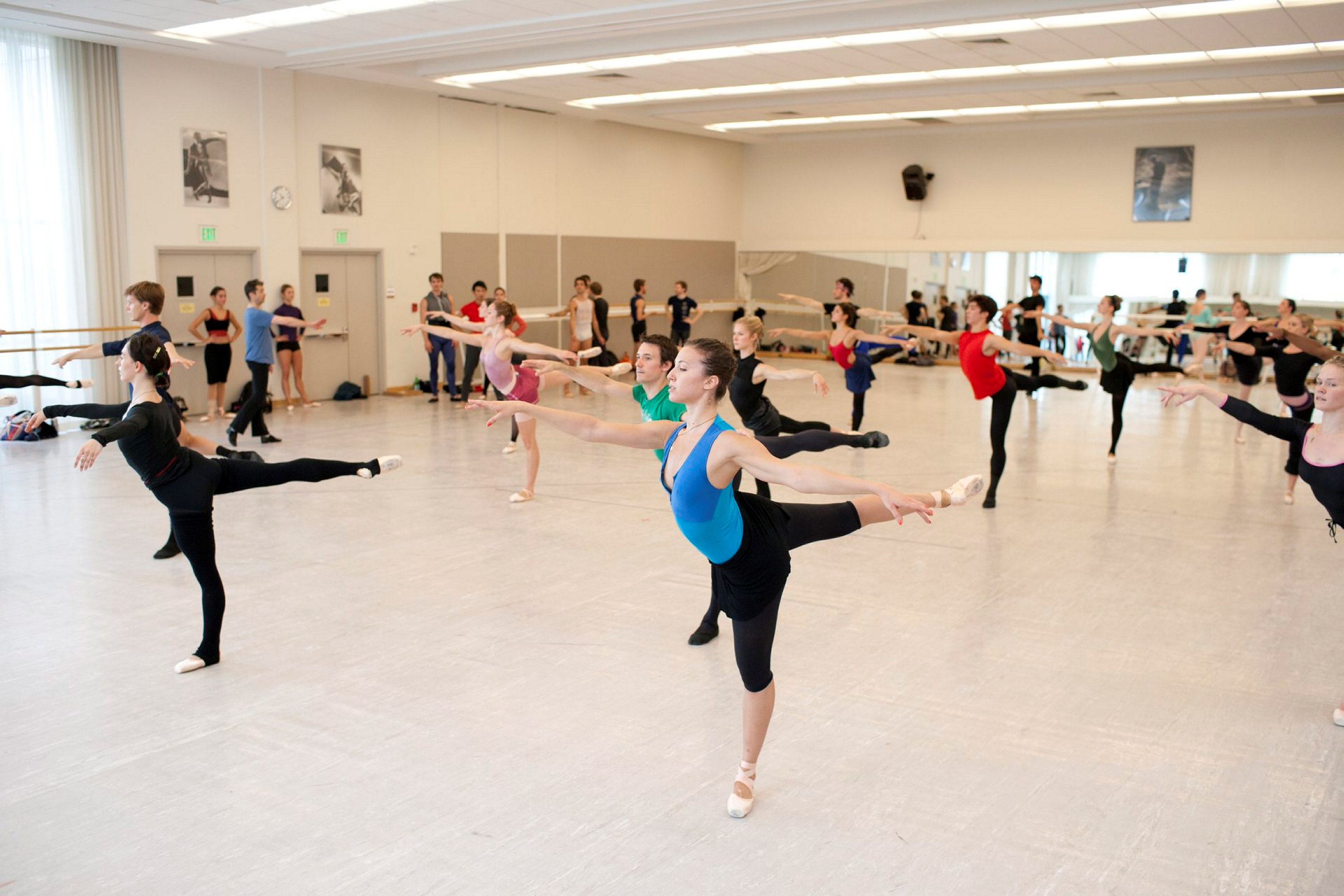
- Evenly space yourself in class. Do not stand in front of everybody while only moving forward halfway to the front. I always teach that the best way to respect others is to respect yourself. If you stand to close to a barre or person, you are making it more difficult for yourself to execute the combinations. You are offering yourself less of a chance to succeed. If you respect yourself by giving yourself enough space, you will also be respecting others because they won't be avoiding your limbs while they are dancing. Dance is based on ideals of respect. When you are at barre, if you are going to hit somebody, you need to turn the angle of your body away from the barre to the front and in towards the barre to the back. If you are doing center work, don't stand directly next to somebody. Stagger yourself. This means that one person stands forward and another stands back. If you are going from the corner, stand as close to the corner as possible in a triangle with the point towards the corner you are coming from or a square in two diagonals.

San Francisco Ballet dancers properly staggering themselves
 - If a professional or regular moves over, it doesn't necessarily mean that they are making space for you to move over as well. It likely means that you are too close to them and they are trying to gain more space to avoid hitting you.

- If you are not going to or unable to execute the combination in full, absolutely do not stand in front of anybody. It is disrespectful and prevents anybody behind you from fully executing the dance.

- One rule that is very important in ballet class is that you should never step in front of anybody. If somebody is standing in fifth position or B-plus, they are communicating that they are ready to perform. It is rude and disrespectful (and distracting) to step in front of or next to a dancer that has already expressed that they are going to do the combination.

- When a combination is over, it is proper to run forward, first, and to the side, second, as fast as possible to allow the next group of dancers to run into place. This will help you avoid collisions and keep class flowing.

- Most of the time, professionals are in class to stay in shape and improve their abilities. They are not in class as a hobby or to hang out. Think twice before you start talking to them. Chances are, if they don't approach you, they are working very hard and trying to concentrate on improving their art. If you want to start a conversation with one of these dancers, wait until class has ended.

- All dancers enjoy a compliment for executing a step exceptionally. If you absolutely feel the need to express your appreciation or awe, clap for that dancer or say something at the end of class. To constantly walk up to a dancer after each combination because you are impressed with them is a distraction and changes the compliment into a frustration.

- After class, a professional is likely running to rehearsal or a job. Class is a warmup for them. Feel free to engage them in conversation, but be aware that they are probably trying to leave the studio. Make sure that your conversations are appropriate and not asking too much. Don't corner a dancer and remain unaware that they are trying to gracefully exit the conversation. Most dancers are glad to offer helpful advice, but in small pieces.

- If I have one rule that is extremely important to maintain, it would be to remain aware of your spatial awareness. Not to be dramatic, but there is an epidemic of ignorance towards spatial awareness in open classes. Learning how to dance within a certain confined amount of space is just as important as learning how to point your feet, lift your legs, and develop a floating sense in your port de bras. Nearly every professional dancer starts their career in the corps de ballet. Twenty four swans can not exist on a stage without having an acute sense of what is happening around them. Learn how to look around your body while you are dancing. Use your peripheral vision. Don't battements your leg toward a person if they "may be" too close. If there is any chance that you could hit somebody, you are too close. You can practice spatial awareness by dancing in a small, confined room and avoiding hitting the walls with your limbs.

If more dancers understand this set of rules before entering an open class, you will be more likely to enjoy yourself and improve faster. While it is important for many professionals to take open class daily to maintain their technique, it is equally important that anybody who wants to partake has the option as well. Not only do these classes fund schools and companies, but attendance of non-professionals keep numbers up, which allows class to keep happening. Attending ballet classes also develops certain appreciations for those that won't necessarily have a career in dance. These "open-class" dancers come to performances, spread the word to those less educated in dance, and may even be inspired to donate to professional companies to keep them up and running. While it is important that open class remains open to all, it is also important that we begin to educate dancers in the codes of conduct and the finer details that are involved in a ballet class beyond the steps.