3.27.2017

You Can't Please Everybody

I had a very interesting experience last week. Something happened to me that has NEVER happened before. It took me awhile to figure out exactly what was going on and to determine how to digest the situation. A disgruntled student contacted one of my many employers and wrote a scathing three paragraph email attacking my integrity as an instructor and my personality outside the dance studio. I won't go into specific details about the message that was clearly meant to disparage my employer from continuing to work with me. But what I can tell you is that I was completely and utterly blindsided that a student who has only taken my class a very few times would go as far as trying to affect my employment because they disliked my attempt to share my art with them and improve their skills. Luckily, I have amazing friends and peers who have helped support me through this situation. And as a few of them have said, I officially have a HATER, which means that I must have made it! ๐Ÿ˜‚


The dance world is a place that is brimming with judgment. We judge ourselves every day in the mirror, while teachers and peers are judging us, as well. Now, this judgment doesn't always have a negative connotation. A majority of judgment in a classroom setting comes from your instructors, whose job is to give you combinations, judge your execution, and offer corrections to help put you on the right path towards success. Your peers may judge you in order to determine what you are and aren't doing well to help them along their path, too. Once you leave the studio and step onstage, you are putting yourself on a platform that opens up a whole different world of judgment from the general public. Some of these people are critics, some are couples on dates, and others are ballet aficionados that spend as much free time as possible sitting in the anonymity that the darkness of a theatre provides. A performing artist is setting themselves up to be critiqued constantly.

Judging Art
One difficult reality that dancers must face is that judgement of their work often feels like a personal attack on one's character. A dancer creates their art by physically exhausting themselves and tapping into emotional parts of their life experience to portray certain roles. When a bad review comes out, a dancer may feel that their own being is under attack. This often isn't true, but that doesn't take away the pain of a negative critique.

There is a great deal of judgment and critique in our careers that is never intended to be malicious. But, then, all of a sudden, out of nowhere, somebody comes along who just doesn't like you. Whether it is a critic that never likes how you perform a role compared to other dancers, a colleague that you always rub the wrong way, or somebody who you somehow offend with any and every action you take, there will be some people that you just can't please. This has been the great lesson of my career as of late.

As an instructor in dance, I have passed beyond the sometimes selfish period of my performance career. When I am in the studio working with my students, class has nothing to do with me and everything to do with getting my students to achieve the impossible. I am heavy in the correction department, try to inspire honest conversation among students, and try to provide valuable feedback to each student in my classes. Where a performance career involves a great deal of focus on oneself, a teaching career is the complete opposite. In fact, I say that the only way I can be successful as a teacher is to help my students become successful. Being a teacher of dance differs from a performance career in the sense that an instructor's sole focus should be to give fully to their students.

Working w/dancer on my new work for Columbia Ballet Collaborative (Photo: Eduardo Patino)
At the end of my time teaching a class, I often wait afterwards to talk with students and answer any questions that have gone unanswered in the fast-pace environment of a technique class. During this time, I also often receive feedback from my students. Nearly all of this feedback is positive. It is rare to never that a student comes up to a teacher with a complaint (they usually reserve this type of feedback for management). But it seems that while many students enjoy a class, it isn't uncommon for a student or two to have an opposite experience. If these students choose to express their discontent, having received opposing positive feedback, an instructor may find it difficult to understand where things went wrong and how to resolve it. The same can happen with a performer. Perhaps, after a show, a dancer receives a plethora of gracious comments and positive attention from peers, management, and friends who have watched their performance. But when that review comes out and tears them off of their performance pedestal, it can be painful and confusing to read something written for the public and to assess where things went wrong.

What I have learned in my most recent experience with my hater is that it is impossible to please everybody. As a friend recently told me, "I am not everyone's cup of tea." As dancers and former dancers, we tend to strive for this ideal that everybody around us will like us as people and artists. I feel that many people, non-dancers included want everybody to like them. But this is just completely impossible. There are so many people on this earth with so many different personalities, lifestyles, expectations, tastes, and more. And to have the expectation that you can please everybody and leave this life with every person you touched feeling positively about their experience with you is one hundred percent impossible. For instance, some students prefer an aggressive teacher that really pushes a dancer outside of their comfort zone. While other students want to attend class to have fun and prefer not to be corrected once. It is impossible to please everybody in the room, in the company, in the theatre, and in the world.


Sometimes, it is baffling to comprehend that those who choose to express their opinions have seen the same performance. One person's taste may differ greatly from another. Or one person's education and knowledge of dance may be vastly different from the people sitting next to them. The same goes for an instructor trying to impart their knowledge upon a studio of dancers. Some students may thrive under a challenging teacher, while others may collapse into negativity. Luckily, there is great beauty in having so many people involved in our field. Every teacher and every dancer is not someone's cup of tea. And that is fine. There are a range of options for each person to choose from. As long as we understand this concept, we can move forward from negative feedback much quicker. Yes, you should assess whether you feel that feedback is true and could potentially help you grow and cultivate your craft. But you can't please everybody and you absolutely shouldn't lose grasp of the type of artist you want to be just to please somebody who may never actually be pleased with you. You may just not be their cup of tea!

3.11.2017

Checklist: Do You Have What It Takes?

Ali Block performing w/Columbia Ballet Collaborative (Photo: Eduardo Patino)
I was sitting in the hallway of Barnard Hall at Columbia University last week waiting for my rehearsal to begin. Per usual, one of the dancers in my new work for the Columbia Ballet Collaborative's 10th Anniversary production showed up a little early to prepare for rehearsal. Ali Block, a former dancer with Eugene Ballet and Texas Ballet Theater, is now studying at Columbia while enjoying a freelance career in New York City. As she was preparing for rehearsal, we struck up a conversation about her transition from full-time company work to school and freelance life. I was taken aback (and maybe blushed a little) when Ali mentioned that she had been considering freelancing for awhile, but didn't think she could do it until she found my blog here. It has been really heart-warming over the past year as more and more dancers and non-dancers alike have told me that my work here on Life of a Freelance Dancer has inspired them to push themselves inside and outside of their own careers. I've always written on here to help dancers, artists, and independent contractors walk the tricky path that is a freelance career. But I never really considered that I might be helping people make the decision to launch their freelance career until Ms. Block used those exact words.

In typical LOFD fashion, I'm letting this moment inspire the content I'm creating to share with you. And I figured why not head back to the root of this media platform, helping freelancers freelance. So, inspired by the word that I inspired this lovely dancer to cross that line and embark on a career in freelance work, I would like to offer you a checklist of items to ask yourself if it is time for you to jump into the freelance pool to drive your own career and success.

Have I completed enough of my training to offer my best product possible? Am I anxious to start dancing professionally when I could really benefit from more time refining my technique and skills?

If you have already danced professionally or have auditioned for companies and received interest without solid offers, you may be ready to take the plunge. If you are still in the pre-professional period of your training, don't mistake your intense drive to have a professional career as a reason to embark on seeking employment as an independent contractor too early in the game. Many dancers are willing to forgo pertinent training in the formative late teens and early 20's because they feel like they should already be working. Try to be realistic about your training and skill level and don't be afraid to train an extra year or two. You can make up for time in your career, but you can't always make up for lost training. In fact, I gave up a corps contract with Colorado Ballet at 18 years old to train for a year at the School of American Ballet. The next year I was offered a position with Houston Ballet, which was a nice step up. I would say it was definitely worth the wait and additional education.

Do I have the motivation to make sure that I am taking class and cross-training regularly or do I need the push of an employer/potential casting to keep me coming to class to stay in shape?

Not every dancer is able to stay self-motivated to stay in shape. Just like taking an educational online/correspondence course, some people don't perform well without direct, in-person oversight to stay on track. If you find that you easily fall off track without outside motivation or if your response to feeling down is to avoid the activities necessary to perform at your highest level, you may want to reconsider freelancing or work on ways to improve your self-reliance. The best freelancers are the most self-motivated, driven people you will meet.

Am I outgoing or extremely sensitive when being thrust into new environments?


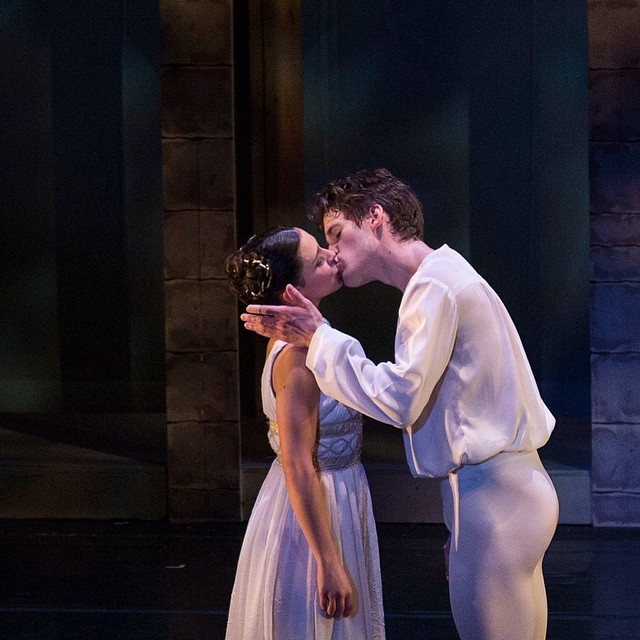
Lucia Rogers & me performing Romeo & Juliet at Fort Wayne Ballet (Photo: Jeffrey Crane)
As a freelancer, you are constantly meeting new people and developing fresh relationships throughout gigs and networking that leads to work. While a shy dancer may take their time to develop relationships once they feel comfortable within a group, a freelancer doesn't always have this luxury. A freelance artist needs to be adept at adapting quickly in the studio, as well as within the culture of the group with whom they are working. For instance, when I was brought in to dance with Fort Wayne Ballet, I had less than two weeks to prepare the role of Romeo. Due to the short period of time to prepare this full-length classic, Juliet and I were already kissing in rehearsal by the second day. If you have issues getting comfortable with your colleagues quickly, you may have challenges adapting to the constant environmental and social changes that are a major part of a freelance career.

Does self-promotion come easily to me and/or am I willing to work to build that?

A popular Instagram post creating choreography at my gym
There are few dancers that are naturally good at promoting themselves for employment. Most of us were taught to speak with our bodies and technique, not our mouths or keyboards. Can you find effective ways to market yourself and the quality of performer you are without appearing that you are an egotistical maniac of a dancer? Do you love or hate social media? Even if you don't enjoy it, you need to be willing to put daily effort into (at least) Facebook and Instagram to keep your face and product on the minds of those in your career field.

Can you stand up for yourself in the studio? What about when it comes to contract negotiations and pay?

Are you a compulsive pushover? Most people don't like pushing too hard when it comes to accepting terms of work. We all want to be working, so we will all be pushovers at a certain point. What I am talking about is speaking up when you are not comfortable with the compromise (or lack thereof) given. It is important that you know how to stand your ground in contract negotiations or how to approach an employer when certain work places issues arise. It is never comfortable speaking up to protect yourself or telling an employer that you aren't comfortable with certain items. As a freelancer, you are responsible for your physical, emotional, and financial health. If you don't think you can handle this type of pressure, you may need to seek work with a company that offers a union contract or an advocate for its dancers.

Are you ready to wear more hats than the word "dancer" implies?

One of the biggest shocks I had after entering my freelance career was the multitude of duties I had to take on in order to become successful in my field. While dancing for a company, all I had to worry about was showing up for class, rehearsing repertoire, and taking care of my body. The last few years I danced with Pacific Northwest Ballet, I added university classes to achieve my Associates of the Arts degree and union delegate duties as a liaison between company dancers and management.

Playing the role of Businessman
Luckily, these activities outside of my role as a dancer began to prepare me for the life of a freelancer. Once I began working as an independent contractor, my focus had no choice but to spread over a vast amount tasks that are necessary to build and maintain this style of career.  Now, instead of having the luxury to completely focus on fine-tuning my technique and preparing for performances, I found myself maintaining this blog and taking on work in my own marketing, research, managing, negotiating, cross-training, physical maintenance, teaching, promotion, and more. A few years into my travels, there was a point when I really missed the luxury of company life that allows dancers to focus solely on their work in the studio and on the stage. While this was quite an adjustment, I am very grateful for the vast education and experience I have received from having to wear so many hats.

Are you truly passionate about dance or is it just something that you've always done?

One thing that really strikes me about freelance work is how revealing the stresses of this career-style are to an artist. Dancers are greatly unique, but especially so in the sense that almost all of us started our path to professional as children. Some of us asked our parents to take dance classes. Others were put into ballet by our parents who thought we needed to burn energy. And there are certainly some dancers who were forced into the studio by overbearing dance parents hoping to live out their unrealized dreams through their children. Due to the range of reasons dancers begin training, many are only dancing because they were good at it and have never known anything else. Like other artists who have been honing their craft since early childhood, a handful of professionals find that they really aren't passionate when the going gets tough. I can almost assure you that there will be intense challenges at some point in your freelance career. If you know nothing but an easy path, you may not realize that you don't have the passion to push through intense difficulties. I have experienced firings, injuries, famines, transitions, losses, more injuries, burnt bridges, burn out, and much more. But I am still here and I can't imagine doing anything else. How about you?

2.27.2017

The Ultimate Sacrifice

Throughout the wildly political 2016 calendar year, social media became all sorts of heated platforms. Long gone were the days of respectful conversation and friendly debate. This new age of irresistible public posting with resistant, closed-mindedness permeated my feed as I tried to stifle the stress of possibly losing my rights and watching the positive progress of 8 years disappear with the ding of voting machine buttons. Nonetheless, I did everything in my power to avoid arguments on social media while staying a part of important conversations. And this is how I continue to treat social media while the remnants of this election cycle still have people on an argumentative edge. Now this is where this post swings from political to dance. The other day I was sifting through my feed to find a former professional dancer I was acquainted with through Pacific Northwest Ballet's school (who is now retired) reposting the article I shared in my most recent blog post about dance potentially causing psychological harm. Now a mother, her sharing of this article was accompanied by a statement that her daughter would never be a part of the art form to which she once gave her full self. I felt the need to turn this public thought into a caring conversation, and luckily she responded with the same sentiment. And from that respectful chat this post was borne.

A local Philly sculpture - "Freedom" by Zenos Frudakis
There is just something about being a former professional dancer. I can speak to this from both perspectives, as I am out of my performance career, but still maintain dance as every aspect of my career and self. While there are short-lived, wildly euphoric highs involved in the life of performing artists such as dancers, there are also desperately painful lows. These lows are often accompanied with physical pain that can drive a dancer into the ground before they fully blossom. Most professional dancers don't stop dancing because they have consciously tied up all ends of their performing careers and feel like they have accomplished what they set out to do. More often, they retire due to complication from injuries, disappointment in casting and organizational progression, and beyond. This array of painful endings has more dancers leaving our career feeling bitter than sweet (not even bittersweet). So, why even try to be a part of this career?

What it comes down to is that a career in dance is the ultimate sacrifice. It is the sacrifice of one's body, mind, will, and lifestyle. A dancer may come off as selfish in their full-out ambition to have a stage career. But the truth is that a dance career can't be selfish, as it is submitting oneself over fully to the art form. Perhaps, the art should instead be deemed selfish. And all of the stepping stones to get a dancer to the point of performance in a professional setting prove that they are willing to submit themselves, even if they aren't aware of it.

One of my biggest challenges as an educator in dance involves getting through to parents, children, pre-professional students, and open class students that I am not coming into the studio with any intention but to prepare them for a lifestyle in dance. Whether that means you are striving to have a career or you only intend to take open classes for health, fun, and fitness, I will enter the classroom to impart my knowledge and share our art form to better you along whatever path you wish to take. Initially, I have found this is often met with resistance and confusion. A few examples of this include an open class student telling me they come to class to have fun and I make them think too much. Or a young student taking my contemporary class once and her mother pulling her from subsequent classes because of my approach to instruction, only to return 3 months later because the other student's parents who gave me a chance had so much positive to say about my teaching methods. The struggle as an educator is real. And it is especially difficult in our field because young dancers don't understand that there are many challenges a dancer must face in order to know whether they can be one of the few who can sacrifice certain aspects of their lives to be a dancer. A life in dance is a life of sacrifice. And these sacrifices aren't common or comfortable.

There are many points in a dancer's education that can be considered stepping stones towards testing out the waters of a career. Your first recital. The first time you feel the pain of pointe. That point when you realize more of your friends have quit dance than remained. The first time your teacher is unusually critical of your dancing. The days you have too much homework, but you still refuse to miss class. The time when you choose to move away from your family before you are even your own legal guardian. The first time you get that rejection at an audition. The first time your company doesn't cast you in a ballet. The first time you suffer a career-threatening injury. The first time somebody mentions your weight. The first time your friend is unkind to you because they are jealous of your casting. The first time you don't want to wake up to take class because you are so exhausted. The first time you consider your life without dance. Most dancers don't get past point three in this paragraph. But those who do are commonly accepting each subsequent sacrifice as a necessary step towards living out their dreams to become one of us rare human super-humans called a professional dancer.

Nicholas Rio, Ali Block, & dancers of Columbia Ballet Collaborative sacrificing their Sunday night to dance my new work
While a dance artist can perform seemingly supernatural feats with their bodies, they are also doing the same with their minds. I remember the first time I had a stone bruise on the heel of my foot around the age of 14. I was quite convinced that I wouldn't be able to dance for a week, let alone walk. But I learned that day that, while I felt the pain, I could ignore it enough to continue. Eventually, I forgot about it. This evolved into handling being so sore day after day and still attending class and rehearsing for 8 hours without realizing that most people would completely shut down under the same circumstances. But then there is also the ability of a dancer to stifle emotional trauma and still perform at a high level. For all of the effort put in by most dancers day in and day out, they may still find themselves in the 2nd cast of a ballet. Or, perhaps, they were learning a new role for weeks and the director chooses not to put them onstage for the production. Even under these circumstances, dancers keep trucking on and perform their job to the best of their abilities. But what about all of the hard work they put in? What about the extra time they spent at home after their 8 hour dance day watching footage of the role and marking the steps in their living room? Don't they deserve a chance for all of their effort? Perhaps, they even put in more effort than the person who got to perform that role. 

With all of these different ideas colliding into one, what most dancers are forced to reconcile, but rarely see, is that dance never owed them anything. Just because you walk into a studio and work every ounce of your being off doesn't mean you deserve to step on a stage and enjoy the bliss of performance. And most people don't ever recognize that, even after their career is over. Dance is always a gift and rarely a straightforward response to all of the effort you put into it. Due to the lack of open dialogue about this harsh reality of the life of a dancer, there is an epidemic of bitter, jaded dancers expressing how dance victimizes its participants and leaves them broken with little to show for it. This is often an inner dialogue of their perceived failure of expectation. An expectation that dance promises no one. This reality isn't talked about enough during the training stages of a dance career.

Shira Lanyi & Allen Abrams in my work, Distinct Perceptions (Photo: Dave Friedman)
When this naivety is broken for a dancer, which is often caused by a case of physical or emotional injury, dance often turns from a personal passion into a personal vendetta. How can a dancer submit themselves to an art, then claim hatred for something that is so ingrained as a part of them? It could be the fact that they had expectations and weren't aware of what they were signing up for when they fell in love with dance while still aged in the single digits of life. But the way I see it is this. When you fall in love with somebody, you open up a more vulnerable part of yourself to this person. And if things don't work out, you often feel anger towards that person, if not hatred. So many people will say the worst things about their ex-lovers, even if they were married for years and years. My assumption here is that the brokenhearted must create negative feelings towards their ex-lover, otherwise they may find themselves still in love with them, even if they aren't a good fit today. For example, if they don't hate them for this, they may remember that they were the most generous of people. Or if they don't speak negatively of that, they may realize that nobody ever made them feel more empowered to reach for their dreams. In this vein, ending a career in dance that wasn't fully realized to one's expectations may lead a person to project negativity and bitterness towards dance to help them detach from something that they used to love more than most anything else. I've seen this happen among more retired dancers than you can imagine.

This is a lot of information to take in here. But what it comes down to is that we all fell in love with dance for a reason. Whether it was fascination with the super-human aspect of it, getting out of the house during your parent's dirty divorce, the only place you felt you fit in, or some other situation, dance doesn't owe you anything. It can offer you some otherworldly experiences. It can introduce you to the most diverse cast of friends. It can keep you fit, disciplined, and eager to enjoy a lifetime of progress and growth. But it doesn't owe you that Odette/Odile. It doesn't owe you a body that can withstand the wear-and-tear of near-contortionism. It doesn't owe you that meteoric rise to Principal. It doesn't owe you that final curtain call with audience members yelling bravo and tossing roses at your feet.

Many people look up to dance artists because they feel that they are ethereal creatures. Dancers look at their careers the same way. Infinite progress is the ethereal creature they seek to capture. But at a certain point, nearly all of us will hit our peak, as infinite is unattainable. And instead of looking up at the next tallest mountain with bitterness and disdain for its unattainable height, we should instead look down from the impressive heights we have climbed and enjoy the breathtaking view that lay before us.

Looking over Lake Eklutna in Anchorage, AK

2.16.2017

Protecting Your Mental Health


Don't Lose Your Mind!!!!
Dance is an extremely difficult career field. From competition to personal aesthetic and emotional perfectionism, dancers encounter more stressors than nearly any other career that doesn't involve risking one's life or saving/protecting others. Dance Magazine's Jennifer Stahl recently wrote an article about a Portuguese study that suggests that dance training may actually cause psychological harm in the form of depression, anxiety, eating disorders, and unwarranted stress under certain circumstances. I think that the study noted in the article could probably use more study (and I've talked about emotional health in training on here before), but I do feel that certain methods of training can instill certain traits that could disrupt a dancers mental state. At the same time, in order to become a true artist, dancers often have to dig deeper and more personally into their psyche and physicality than most others in any other field. Perhaps, this also causes those consequences. Nonetheless, freelance artists often find themselves under greater stress and anxiety than company artists because of how closely tied together their art, livelihood, and careers are to their ability to find and sustain regular work. For this reason, I have developed a short list of valuable ways that I think can help protect dancer's mental health to ensure that they can handle the great amount of stress and anxiety that comes with a dance career.

1. Plan a Day Off in Advance - Many freelance artists will keep on taking work until it dries up. Often, this is out of fear that work will soon cease to appear. In reality, while not getting a day off may temporarily cushion your bank account with a little extra cash, you could possibly be bringing yourself that much closer to burn out. If this happens, you may find that you can't even bring yourself to continue working, which defeats the purpose. If you want to sustain a long-term career in dance, teaching, and more, one day off each week is probably more valuable than a short-lived career.

2. Find Ways to Take "Me-Time" - With all of my media work added on top of teaching and choreography, life can easily turn into never-ending periods of working for everybody except myself. Due to the fact that people are constantly reaching out to me for work, advice, and more, it is necessary for me to find a little bit of time every few days to do something completely for myself (without any guilt for work that has been left aside during that time). Some of my favorite guiltless "me-time" activities include sitting at a cozy coffee shop (preferably one with couches) and sipping a latte with a fresh baked soft cookie, taking a bath with candles and Pandora's "Chill Out" station playing, going for skyscraper walks around whatever city I'm in, and watching aimless videos on YouTube. When I take some time for myself, I don't feel as stressed or anxious about giving so much time to others and find I'm actually more generous with helping people out because I've already taken care of my own needs.
An image from one of my skyscraper walks
3. Develop Friendships with Non-Dancers That Don't Mind Discussing Dance - This one is pretty straightforward. It can become way too easy to only hang out with friends in your dance bubble. Most dancers go through phases where they start seeking friends who have nothing to do with the dance world. For many of those friends, one thing that is shocking for them is the amount of attention, thought, and dedication that goes into a dancer's evolution from student to performance career and beyond. Most don't realize how completely consuming this can be and are confused how dance is always on the tip of a dancer's tongue. I've had friends who were quite turned off by the regularity that conversations on dance become regular topics of discussion. Though, I am lucky to have cultivated a handful of very special friends who don't mind, if not enjoy, sitting around, learning about, and discussing our fascinating world. These friends are definitely keepers, especially for the benefit of having an outside opinion to balance out stressful experiences and internal politics with a perspective different than your colleagues. It is extremely valuable to develop friendships with non-dancers who don't mind, or even enjoy, talking shop. This can offer valid insights and a healthy perspective for looking at certain work-related stressors.

Non-Dance Friends are Important
4. Avoid All-or-Nothing Situations - For dancers, it tends to be all-or-nothing. For instance, if a dancer is trying to lose or maintain weight, they may completely avoid eating anything that they enjoy. Or if a dancer is told that they aren't improving fast enough, they may stop doing outside activities that bring great joy to their lives and enhance their human experience. Approaching situations in this way can lead a dancer to go overboard when they finally reintroduce certain things into their lives or, even, push a dancer into burn out or self-harm if they never indulge themselves. We only get one life to live. And while a dancer does need to make sacrifices to enjoy a dance career, they don't have to give up all things that make them happy in order to be the best dancer possible. A healthy dancer is a person who is balanced and knows how to use moderation to find that balance.

I always treat myself to a chocolate croissant when I've had a bad bus ride from Philly to NYC
5. See a Counselor - If all else fails and you find yourself in an impossible-to-get-out-of rut, do seek outside assistance from a mental health professional. After spending 4 lonely years on the road as a self-touring guest artist, I developed such severe anxiety that I could no longer handle simple stresses in life. I also wasn't aware how burnt out I had become. After a mild panic attack in Lincoln Center before watching a New York City Ballet performance, I realized I needed to talk to somebody about getting my anxiety back under control. I am so proud to be an advocate for people, especially dancers, to find ways to take the best care of their mental health. Many dancers leave home as teens and handle stress that few people experience in their career (let alone at such young, impressionable ages). There is no shame in seeking counseling to help improve your mental health. If you are wondering how to find a therapist, read this recent article, that explains how to find somebody that works for you and how to afford therapy if you don't have coverage.

2.03.2017

Knowing When to Say "No"

As dancers, we are always taught to be YES people. Do you want to do the combination again? YES! Do you want to try that lift again? YES! Do you want this job? YES! It is ingrained in a dancer's mind at a very young age that you should nearly always say YES during your dance career. For, if we say no, we may actually remember that the human body has certain limitations and we may miss out on career-boosting opportunities. At the same time, it is also considered poor etiquette to say NO to an instructor, choreographer, or director. But there will be a time in every dancer's career, especially as a freelance artist, when they are suddenly struck with an instance where they may need to say NO. When is it appropriate or, perhaps, even necessary for a dancer to break the expectation for them to remain submissive and say NO?

1. Since this blog is about freelancing, let's start with an example for any dancer that works as an independent contractor. It can be very exciting to have an employer reach out to you for an opportunity to dance with their organization. Though, there are a few reasons that you should say NO to a potential job for reasons beyond timing and logistics.

If a director want you to travel for a period of time to work with them, but doesn't want to provide travel, housing, or sufficient weekly pay to cover your bills, this is absolutely a time that you should say NO. Take it from me. My last major performance gig didn't provide housing, which led to me living like a homeless person going from couch to couch at pure strangers homes for 5 weeks. I ended up severely injured and traumatized for months after (imagine random crying fits out of nowhere). Beyond that, if you are away from your normal connections and you aren't being paid enough to cover your monthly expenses, it will be nearly impossible for you to recover your lost income in time to meet your bills. Be sure to know what you are committing to before signing that contract.

2. As you mature as a dancer, you get a better idea of what works for your body and what doesn't. Also, you may end up dealing with some nagging injuries that prevent you from performing certain steps. For me, when my lower back started to reject certain partnering choreography, I would have to step up and tell a choreographer that I couldn't perform certain lifts from a flat-back position. While this wasn't always met with the happiest response, I was able to continue dancing without injuring myself for quite some time. It is important that a dancer is completely sure that specific movements are off the table before claiming that they can't perform those maneuvers. Also, be sure to understand that saying NO to certain movements may end up reflecting upon you in certain ways and you may find yourself limited in casting.

If you are a freelancer, this is one of the most important things, as you don't want to injure yourself to impress an employer that is only hiring you for one production and may never use you again.

At a certain point, this lift was off the table for me - "Not a Cry" by Amy Seiwert (Photo: Alexander Izaliev)
3. During my time working for the American Guild of Musical Artists (AGMA), I learned that there has been research conducted that shows dancers are much more likely to become injured during the 4th consecutive hour of rehearsal. Beyond that, there is an increased likelihood of injury in rehearsals that extend beyond one hour. When I worked for Pacific Northwest Ballet, we had a 5-minute break every hour of rehearsal and no dancer was allowed to work beyond 3 hours without a 1-hour break before starting back up again. I understand there is sometimes a need to break one of these rehearsal rules, as stopping a choreographer mid-thought could be detrimental to their process or holding an emergency rehearsal on a performance day may only be available during that 4th hour. But, generally, a dancer should do their best to avoid saying YES to rehearsing for endless periods of time without appropriate breaks. Your body is your instrument and, if your employer isn't going to take that into consideration, it is your job to protect it.

4. While it may be great experience for a dancer to take on additional non-dancing work for a company (social media, marketing, admin, etc.), a dancer shouldn't be required to perform work outside of their job description. Working as additional stage crew to load-in, load-out, or perform duties of a stagehand should not be an expectation of a dancer, as well. Heavy lifting and moving could put dancers at risk. If an employer has these expectations of dancers, this should be expressed to them before they are given the choice to say YES to accepting a contract.

Networking at an event (Photo: Patrick Mackin)
5. One expectation of many dancers is to attend general public and fundraising events for an organization. While this is not always mandatory, it is good for dancers to attend these events. It helps the company promote its' mission, it lets donors and potential sponsors feel like they are a part of the organization, and it humanizes our often untouchable-feeling art form. While these events are often lots of fun, there are times when an attendee has too much to drink or is attending with less than favorable intentions. Just because a major donor or a potential sponsor is looking to give money to the organization does not mean that they can treat a dancer inappropriately. If you are uncomfortable with the direction a conversation is going, absolutely do say NO to any advances that are clearly inappropriate. And, if worse comes to worse, excuse yourself to use the restroom, refill your drink, or grab a friend to help pull you out of the situation.

6. I have a major rule that I never pay to work for an employer. If there are any items that an employer asks for you to pay for, you should say NO to that job. This includes paying for unpaid tickets that you were expected to sell (I don't think this should ever be a dancer's expected responsibility), shoes for performances (especially if you are required to dye them), travel, hotels, costuming, housing, etc.

7. The rehearsal studio is an extremely unique workplace. There are many things that if put in any other work environment could easily be considered crude, inappropriate, or sexual harassment. This is a difficult item, as dancing requires touching each other's bodies in otherwise inappropriate places for partnering or to tell the story. If you are a young, hopeful dancer who is shy, prude, or extremely religious, then you may want to consider looking into a different career option.

Now, there is a time when certain types of touch are inappropriate in the studio. If your partner or a choreographer are touching in places that are unwelcome for you or don't make sense to express the storyline, do express that it feels uncomfortable immediately. Usually, if everybody is working appropriately, this should resolve the issue. If certain types of touching continue beyond rehearsing the actual part, it is necessary for you to say NO or to reach out to the company's Human Resources department to address the issue. If there is no Human Resources department, you need to reach out to the ballet master or director.

In an office environment, this would be sexual harassment - Romeo & Juliet w/Fort Wayne Ballet (Photo: Jeffrey Crane)

1.21.2017

Ballet Techniques Uncovered

I know that this is generally a blog about freelance work as a dancer, but every once in awhile I like to include some content that I feel is extremely valuable to my readers. And this post falls right in the realm of content that is fully appropriate (and helpful) for all of you who come here for valuable information on dance.

Students at the Vaganova Ballet Academy
Over the past few weeks, I have been working my ballet-toned rear-end off to create this immense resource for anybody that is curious about the art form of ballet. On my podcast, Pas de Chรกt: Talking Dance, on the Premier Dance Network, I researched and interviewed experts on 7 international training methodologies in ballet technique to provide accessible information explaining the background and execution of these methods. Our contributors include the Artistic Director of New York Theatre Ballet, Principal of Ballet West Academy, Faculty at the School of American Ballet, American Ballet Theatre's JKO School, and Houston Ballet Academy, and more! Additionally, I have crossover-collaborated with Pirouettes from the Past host, Dr. Melissa Klapper, as a part of this episode series. On Dr. Klapper's channel, she talks about the history behind a few of the techniques mentioned.

So, if you are interested in learning about Vaganova, Royal Academy of Dance (RAD), Cecchetti, French (Paris Opera Ballet), Balanchine, Bournonville, or Cuban training methods, please feel free to click the links below and give these episodes a listen! Enjoy!

Ballet Techniques Uncovered (Part 1)
Ballet Techniques Uncovered (Part 2)
History of "Ballet Techniques" - Pirouettes from the Past

1.12.2017

Reframing Your Thinking

Overexposed and ringing in the new year with great friends
Whew! This new year has been a complete and utter whirlwind. I have had mostly major ups and a few minor downs (that include a business I will no longer support - Megabus - avoid this company at ALL costs). But I honestly can’t complain about anything at this point, other than the fact that I need a few more hours in my bed every night. Since the new year, I have taught master classes in both Ballet and Contemporary techniques for the pre-professional class at the School of Pennsylvania Ballet. There was even a sprinkling of company members who joined me for class. Additionally, I will be teaching Contemporary classes for the Second Avenue Dance Company in February. This is a performing group at New York University’s Tisch school comprised of graduating BFA and MFA students. With even more news to share, I have been selected to choreograph for Columbia University’s performing group, Columbia Ballet Collaborative, for their 10th anniversary performances in April. All of this coupled with my 7-week Advanced Beginner Ballet series at Broadway Dance Center (Fridays at 6 pm through February), choreographing student solos for Youth America Grand Prix, and teaching elsewhere has me feeling extremely grateful to be sought out in my art form.

Pre-professional division students at the School of Pennsylvania Ballet (Photo: Alexander Izaliev)
It’s funny, though, because while I am so lucky to have all of this interest in my work, there is a certain degree of anxiety that comes along with it. The concept behind this may require a bit of explanation. Just this weekend, I got news about 5 positive choreographic and teaching offers. While it seems that I should only be feeling excitement here, there is a certain type of stress that comes with positive news. I noticed today that I was experiencing a bit of my former anxiety that I used to get when I was traveling a bunch during my performance career. I would find myself attempting to focus on the work in front of my face, while feeling distracted by setting up what was next (one of the hazards of working as a freelancer). The impossibility of only focusing on the task at hand would make me feel overwhelmed and I now recognize that it contributed to my burn out that I have discussed in this blog already. As a freelance artist, your work stops when the jobs stop. In the process of working to set up continuity within my career, I never took a moment to recognize that I was actually having my career. Instead, I constantly felt like I was working on reaching a certain level of success in my career and didn’t realize that I was actually living it until it was over. There was very little in the moment for me because I was only living in the future.  And while that aspect of my career ended over 2 years ago, I only recognized this today.

So, just a little background. With all of this wonderful news that I’ve gotten in the last week, I had two horrible experiences with Megabus. If you don’t read this regularly, I commute from Philadelphia to New York City multiple times a week to teach at Steps on Broadway, Broadway Dance Center, and Greenwich Ballet Academy. Early on Friday morning, in freezing cold temperatures, our bus never showed up. And, shortly after, on Tuesday night, there were a series of fiascos that prevented our bus from arriving in Philadelphia until 4 am in the morning. I had to teach for the School of Pennsylvania Ballet at 9:30 am that same morning. I was put off by this organization both times and they refused to acknowledge their issues or compensate me for their poor practices/lack of service. This stress, coupled with exhaustion and the flood of positive news somehow threw me back into the throws of anxiety that I experienced previously. I found myself negatively fixated on my exhaustion and the challenges of having limited time in any one place. And I found that I was again telling myself that things will get better when I actually make it into a certain realm of success. Then, this afternoon, out of nowhere, I had a realization. I realized I needed to reframe my thinking because I want to take in all of the amazing experiences that I am having and be as in the moment as I possibly can.

We are very lucky as human beings that we have intellect and the ability to analyze things that are happening in our lives. I firmly believe that one of the best analytical qualities that we share is the ability to reframe life experiences in order to make a dialogue fit in better with our story. Sometimes, this works to our benefit. While, at other times, it can be very detrimental and lead a person to spiral into dark, dark places. But if we can take control of how we frame our life and career experiences in our minds, we can benefit greatly from this. Of course, this is as long as we are being honest with ourselves about where we are and how things are going.

In my current situation, it was almost a bit too natural for me to look at recent happenings and tell myself that things are difficult because I haven’t yet succeeded in reaching my end career goals. Mind you, this is ridiculous to consider at the age of 33. Additionally, I was digesting more stress from the challenges of dealing with the negligent Megabus company and the added exhaustion those issues brought on. I found myself walking to the gym before I jumped on the Bolt Bus to teach at Steps on Broadway tonight telling myself that everything will be glorious when I actually make it big someday. And then right then and there, almost as if I had been hit by a bus, I realized that I wasn’t looking at the situation from any rational perspective. I needed to reframe my thinking.

That moment at 3:34 am, when your Megabus driver gets off the bus to ask a homeless person for directions :-/
At that very moment, I reversed the natural stream of thoughts that roll through my head and chose to look at things differently. I told myself, “No. I am not in any bad situation, at all. And while there are always new dreams and achievements that I want to attain, I am actually living my dream right now. I’m not putting in the work to get to my dream. I’m putting in the work that one does while they live it and that is why I am successful. Yes, my success can get greater. Yes, I have greater goals in mind. But I am not putting in all of this work to get somewhere. I am there and, as long as I keep positively moving forward, it can only get better from here.”

So, now as I sit here on the Bolt Bus (goodbye Megabus ๐Ÿ˜‚ have I made my point?) heading to Steps to teach, I realize that I should be proud of my success. And that my success sometimes puts me in situations that require me to travel a lot, to lose sleep, and to spend time away from my loved ones. This isn’t a greatly negative thing. It is an aspect of becoming successful. And if I can’t come to grips with that in this stage of my career, I may find myself in the same type of burn out situation that I was in at the end of my performance career. And, I don’t want to go through that again.

If you can use my exploration of the idea of reframing thinking to have a more positive outlook on your own life and career goals, I feel that you can benefit from this, as well. Dancers are naturally overachieving spirits. We are always looking to reach the next level of success in many areas of our lives. Whether it is casting, rank promotion, technique, health, or anything else, we tend to be extremely critical of ourselves. When you start to feel out of sorts, if you can reframe your thinking you may recognize that you have already achieved what you are seeking and that you just haven’t taken note that it is happening or already has happened.