Showing posts with label Kathryn Morgan. Show all posts

5.27.2016

Life of a Dance Podcast Host

I feel like I'm on the verge of something big. I don't know what, but I feel like my voice is being heard and recognized in new ways throughout our beautiful dance world. And, even more important to me, I feel like I'm making a difference. As you all know, I began hosting my own podcast, Pas de Chat: Talking Dance, on the Premier Dance Network nearly two months ago. In that amount of time, I've been contacted to write articles, I was asked for an interview to offer insight for a dance book, I've been sought to teach and choreograph, and for general advice. The press keeps coming out as my producer continues adding exciting new hosts to our network. From former New York City Ballet Soloist Kathryn Morgan (who was recently featured here on LOFD) to Ballet West & Breaking Pointe star Allison Debona, American Ballet Theatre Principal James Whiteside, and new Miami City Ballet Soloist Lauren Fadeley, it is very exciting to be a part of this revolution of dance artists finding their voices!

An old pic in Huntington Beach, CA back in 2006 right after we met
I'm getting married to the love of my life on Sunday, then heading off to Alaska for my summer intensive next Thursday. While I take some time to enjoy these events, I thought I would leave you with a list of my first set of podcasts that have been released. It's a holiday weekend coming up, so be sure to download these onto your phone for easy listening while you have a relaxing lay on the beach. If you enjoy, please be sure to share, rate, and review. Happy Memorial Day Weekend!

1. Let's Meet Your Host - Just a little introduction and what Pas de Chat: Talking Dance is all about

2. Determining Your Value - An exploration on whether professional value is determined by our own feelings of worth or the influence of outside factors like rank, company, salary, etc. Listen in as I chat about looking inward at your own value and how others perception of your worth can change dependent upon multiple factors.

3. How to Choose a Show to Go See - Many potential dance-lovers find themselves nervous to purchase tickets to local dance productions, touring musicals, and more. In this episode, I discuss the best ways to go about choosing which performances may be a best fit for you.

4. Emotional Training - In this episode, I discuss the importance of developing and integrating emotional training into the world of dance. While much of a dancer's training focuses on building physicality, most programs leave out cultivating these young professional's psyche.

5. Getting Fired - In this episode, I talk about my experience getting fired from a small contemporary ballet company in Philadelphia. Listen in as I discuss this experience and chat about coming to terms with being fired from this job.

6. What Does a Choreographer Do - Many people believe that the work of a choreographer only takes place in a dance studio. While much of a dance maker's product comes to fruition in the studio, there is a great deal of effort that must take place outside of this environment to complete a true work of art. In this episode I talk about my career as a choreographer and explains the many aspects of a dance maker's job that takes place outside of the studio.

7. Education for Leadership - In this episode, I discuss the track of most incumbent directors into ballet companies in the U.S. and their lack of formal education on the administrative side of the Artistic Director spectrum. Included in this discussion are details on the recent expose in the Philadelphia Inquirer on Artistic Director Angel Corella, comparison of leaders in the ballet world to those in the business world, and conversation on education versus starpower.

8. Explaining Company Ranking Systems - In this episode, I discuss the function and purpose behind the strict structure of most dance companies and their ranking systems.

9. The Challenges of Success - It is ingrained in our culture to praise talented youth and their successes. As we have seen in popular culture, young talent rises quickly and often falls just as fast. Dance is one of few professions that is largely comprised of ultra-talented teenage and 20-something professionals working in the highest levels of their field. Success is thrilling, but difficult to maintain. Listen in as I discuss the challenges of gaining success and how it becomes exponentially more difficult to maintain with each additional achievement.

10. Rating National Ballet Companies - In this episode, I offer a break down of most ballet companies in the United States and how they compare to one another in both quality and public opinion. Sharing research on information ranging from budget, roster size, repertoire, visibility in press, and more, listen in as I explain this fluid 3-tier system of national, regional, and local dance companies.

11. Contemporary Dance Training in the US - In this episode, I discuss how contemporary dance has evolved over the past decade from both classical ballet and modern dance forms. I also share my pick of the best training and degree programs in the U.S. for anybody interested in pursuing a career or education in this hard-to-define genre of dance.

3.18.2016

Freelancing from a Woman's Perspective

Alright, let’s be honest here. Nearly everything in the dance world is easier if you are a man. Not to say that those of us at the top of our professional game haven’t worked our butts off to get to where we are. But it is easier for boys to get scholarships, there are fewer guys at most auditions, and males are often given a bit more leeway in a professional work environment. Although this is a grand generalization, women definitely have more difficulty finding work due to a larger pool of competition. The challenge of finding work as a female dancer can be magnified when starting up a career as a freelance dancer.

Since all of my posts clearly come from my experience as a man in the freelancing world, I want to offer my viewers a chance to hear what it is like from a female perspective. I reached out to my friends Kathryn Morgan, Allynne Noelle, and Miriam Ernest to offer their experiences, thoughts, and advice for any woman trying to break into or sustain a freelance career. Enjoy!

The Freelance Artists:

Kathryn Morgan (New York-based): Former Soloist w/New York City Ballet. Youtuber. Writer of popular monthly advice column, Dear Katie, in Dance Spirit.

Allynne Noelle (Los Angeles-based):  Former Principal w/Los Angeles Ballet & Soloist w/Miami City Ballet.

Miriam Ernest (New York-based): Former dancer w/Grand Rapids Ballet.

The Interviews:

What type of freelance work have you performed?

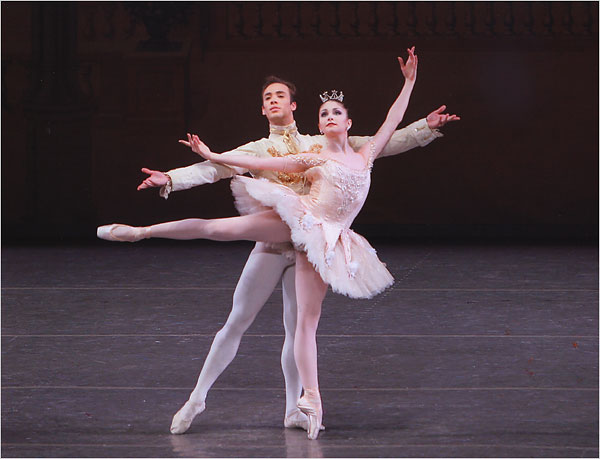
Kathryn Morgan in Sleeping Beauty w/Tyler Angle (Photo: Paul Kolnik)
KM: Freelancing has been quite a new experience for me. At first I was just trying to get well from my illness, so performing wasn’t the main focus. But it actually helped me heal, and I rediscovered my love for ballet. Since leaving NYCB, I have gotten to do some really great performances. I have danced Odette/Odile in Swan Lake, guested in various Nutcrackers as the Sugarplum Plum Fairy, and performed in the world premiere of Snow White in the ballet's title role with Mobile Ballet. I also put on An Evening with Kathryn Morgan in Cleveland, where I shared my most personal experiences in an intimate performance.

AN: I currently dance with The Suzanne Farrell Ballet. Suzanne and her company are everything I have ever wanted in my professional life. Being a part of her company led me to make the decision to leave Los Angeles Ballet and supplement the rest of my year with freelancing. In the past, I have worked as a principal guest artist with Sacramento Ballet, State Street Ballet, and Inland Pacific Ballet. I have also guested for numerous schools and pre-professional companies.

ME: I have danced with The Suzanne Farrell Ballet for four seasons. In addition to this, I have freelanced with Emery LeCrone Dance, New Chamber Ballet, Ballet NY, Kathryn Posin Dance Company, Les Grands Ballets Canadiens de Montréal, and Texture Contemporary Ballet.

How did you get into freelancing?

Photo shoot (Photo: Rachel Neville)
ME: Each season with The Suzanne Farrell Ballet is short, usually about a month or so per year. My first season with Ms. Farrell was so wonderful and inspiring that I knew I wanted to keep returning. I realized I needed to find a place to continue growing as an artist, generate income, and stay in shape while TSFB was out of season. Freelancing was the natural choice.

Being new to freelancing, what have been your biggest challenges?

AN: The idea of freelancing sounds relatively simple when you think about it with the security of a full year contract. During my time under contract with Los Angeles Ballet, I was approached to guest with Sacramento Ballet, Inland Pacific Ballet, and Imagine Ballet Theatre (plus various Nutcrackers). I had to request time off during rehearsal weeks in order to accept outside work. I performed at the annual Dizzy Feet Gala performance one summer in LA, which fell conveniently during a layoff period. It all seemed simple and fluid. It's very different when you look at freelance work as a full-time job, requiring a full income to live, as opposed to when you see it as bonus or supplement to an already existing contract and income. I'm a planner and I like to know things far in advance. That really isn't something that comes with the freelance/guest artist life. I think when you're in a company, especially at the top end of the ranks, you're naturally relevant. When you no longer have that company affiliation to your name, unless you're working and performing you aren't really relevant at all. You're only on the radar when you're busy. It's like you disappear in between work. I was never big on social media, but I have found that it is an essential tool to keep people apprised of what I'm doing currently, my past contributions I have made to the art form, what lies ahead, etc.

Do you think that company credentials are necessary or helpful to work as a freelance artist?

ME: Yes and no. I think company credentials help a lot. I also think staying in shape and being your best self in class and interactions with choreographers/directors are just as important. I’ve seen men and women with impressive company credentials get fired because they were unpleasant to work with in the studio.
 
Allynne Noelle (Photo: J. McMerty)
AN: I don't think more or less marketable would be how I would look at it, so much as the degree of ease I previously thought I would experience marketing myself. I know my value set, my work ethic, and my talent. When you're in a full-time company, all that information is known and speaks for itself. When you freelance, you have to remind the ballet world of all you are as a dancer and person, and advocate for the strengths you can offer any institution.
 
Have you had any difficulty finding freelance work?
 
KM: Thankfully, most of my work has been offered to me at this point. I have been very fortunate in that. And when I was ill. I wasn’t interested in doing a ton of guesting anyway. So up until now, it has been a perfect amount. 
 
ME: I don’t necessarily find it difficult to find work. I do find it more difficult to find work that I am genuinely interested in and that pays well. While I am appreciative of every offer, I have learned to be selective to ensure safe working conditions and adequate pay. I babysit on the side to supplement income. It is something I love doing that isn’t too strenuous for my body.
 
How has your perspective changed since you started freelancing?
 
AN: I definitely realize now that the act of obtaining freelance work is very much a job in itself. Under a full season contract, freelance offers came occasionally and were always a bonus. I assumed that simply having an open calendar and being more readily available for freelance work would directly boost the number of offers I received. You absolutely need to seek the work for it to come to you. People show interest in me and seek me out based on my resume. Also, previous relationships and connections work in my favor. But, I still have to remind others of my availability. 
 
How do you promote yourself/find work?
 
Kathryn Morgan in Balanchine's Nutcracker (Photo: Paul Kolnik)
KM: I promote myself through social media, my website, and YouTube. I actually probably need to do a better job promoting myself to actual employers. I do find it difficult posting about myself all the time or reaching out to people basically saying “Hire me!” I have never been good at that, but I am working on it. While I was still sick, I started watching YouTube videos as a distraction. It suddenly occurred to me that for the thousands of beauty gurus online, there were no ballet dancers on YouTube. I wasn’t under a company contract at the time, so I thought I would make a few videos and see what happened. I never expected it to turn into what it has!
 
AN: I quickly realized that I wasn't very accessible or search-able to those I don't already know. I was never much for social media. I quickly realized the importance of branding myself and creating a solid social media presence. So, I have been working on that, as well as my website (which will launch very soon). I signed with a ballet agent based in New York City, and hopefully he will bring work that I wouldn't otherwise find for myself. A lot of this career is networking. I am a believer in cold-emails; introducing myself to companies who might need a principal female. I think it's hard for most dancers to become their own agent and advocate for themselves. We are trained from such a young age to do as we are told and deliver what's asked of us. My dancing has always spoken for itself. All I have ever had to do is dance in front of someone to get the job, the role, etc. Now, as a freelance ballerina, I have to speak out! I have learned to advocate for myself.

Tell me about freelancing in New York City.

Miriam Ernest (Photo: Joerg Didlap)
ME: I knew New York had a huge dance scene and several of my friends were already freelancing there. New York has plenty of places to take quality dance classes during and in between gigs, which can be difficult to find elsewhere. Most of my work is in the city, although I do travel to and from Washington, DC at least once a year to dance with TSFB.
 
What is your ideal job?
 
AN: My ideal jobs are mostly those I have been fortunate enough to do thus far. Short stints with professional companies in need of a principal female. My hope is to build a lasting relationship with these companies and return for future programs. I love the nature of guesting/freelance work. It's exciting, and also extremely beneficial as an artist to be constantly exposed to different dancers, new partners, and fresh eyes for coaching. I also really enjoy guesting for youth and pre-professional companies. I find it extremely gratifying to interact with dancers approaching that time where they may potentially make this art form a career. I can inspire them and offer any helpful insight I can!

ME: For me, an ideal gig is dancing for someone who believes in me and trusts me as an artist, and whom I respect in return. It includes getting paid an appropriate amount and provision of or reimbursement for pointe shoes and physical therapy.

What are the best/worst things about freelancing?

ME: The best thing is the freedom to pursue whatever movement and choreographers interest me. The worst thing is not having a constant income and having to pay for physical therapy, daily ballet classes, and pointe shoes on my own.
 
Do you have any advice for women that are interested in freelancing?
 
KM: I think the advice I would give to women who are freelancing is the same advice I need to hear. Don’t be afraid to put yourself out there! People need to be able to find you and see your work. You can still be kind and not pushy, so go for it!
 
Allynne Noelle in Agon w/Ulrik Birkkjaer (Photo: Reed Hutchinson)
AN: I'm still learning myself! But thus far,  I would say a most important piece of advice is to always be prepared. Work can come when you least expect it, and you want to be ready. You want to feel good about yourself and your dancing and put your best self forward. First impressions are important in any career, especially ballet. Stay in class and stay focused, even if you're frustrated. I like to spend my downtime taking class and supplementing it with barre, Pilates, or yoga and time at the gym.
 
ME: Don’t be afraid to inquire about pay and politely decline offers if gigs don’t make sense for you financially or interest you artistically. Use time between projects to cross-train, network, and market yourself. Be kind to everyone you meet. You never know who someone is, especially in an open class. Freelancing is challenging, but can be artistically and personally rewarding.
 
What upcoming gigs are you looking forward to?
 
KM: An organization called Ballet in the City is presenting me at the Kennedy Center in Washington, DC, sponsored by Bloch dancewear. It is an entire evening about my life and career. I will be dancing a wide variety of pieces; some classical, some Balanchine, and a few new things. Performances are on March 29 & 30th at 7pm. I will also be teaching master classes at Washington Ballet on March 31. Here is the link for tickets: https://www.kennedy-center.org/calendar/event/RQXBN 
 
AN: I will be performing with Sacramento Ballet all month in their Bach to Now and Beyond program (March 17-April 2). I will be featured in a workshop performance, premiering excerpts of a new ballet by Melissa Barak, in New York City (May 2) and then working with Barak Ballet after that in Los Angeles. 
 
ME: Currently, I am looking forward to performing with Emery LeCrone Dance at Jacob's Pillow on June 23.

If you would like to check out more information about these lovely freelancing women or contact them for work, check out their information below.

Kathryn Morgan
Website: http://kathrynmorganonline.com/
Youtube Channel: https://www.youtube.com/user/Tutugirlkem
Instagram: https://www.instagram.com/kathryn_morgan/
Twitter: https://twitter.com/Kathryn_EMorgan

Allynne Noelle:
Website: www.allynnenoelle.com (coming soon)
Email: Allynne.noelle@gmail.com
Instagram: https://www.instagram.com/allynnenoelle/

Miriam Ernest:
Website: www.miriamernest.com
Instagram: https://www.instagram.com/miriamernest/

9.30.2012

The importance of taking breaks

Driving towards downtown Los Angeles

The past year and a half has been quite challenging for me, adjusting from the structure of a big-time union company to the wildly changeable life of a freelance dancer. I began auditioning for companies while still working at PNB, often on weekends. I would finish my workweek, take a cab to the airport, fly across the country, audition, and then fly back to begin a new workweek (sometimes flying back early Monday morning and going straight to work). Following this extravaganza, I finished out my last season with the company, moved across the country, danced job after job after job, and taught master classes/subbed whenever possible. It was shocking to my system and I was very clearly running full speed ahead towards burnout. About six weeks ago, my partner made me take a day retreat to assess why I had started developing extreme stress and anxiety symptoms in even the most minor situations. My assessment: I hadn’t even realized that I had been dancing, working, teaching, and stressing about so many life changes for 18 months without taking more than a few days for myself. My plan? Take a month off from dance and dance work, teach minimally, travel somewhere that isn’t in the Philadelphia region, and dye my hair some fun color that I could never sport onstage.
Purple and Blue

Working full-time for a company has many great perks. Aside from rep, finances, touring, and benefits, you are also given structure. PNB had a great contract that provided forty weeks of work a year. This meant that we were laid off for 12 weeks every year. Of course, you could continue dancing during these weeks, but you were afforded the opportunity to take a break if you wanted or needed. As a freelancer, you aren’t governed by an official calendar. If work pops up, chances are you will take it. Freelancers, often living in constant fear of financial disaster, tend to book their schedules dancing with “this” company and teaching at “that” school and “that other” school. My summer included me dancing two gigs in Philadelphia that rehearsed on completely different sides of town and teaching at six different schools, some of which were more than an hour commute each way. On top of all of this, I was taking ballet class in the mornings, going to the gym daily, choreographing a solo that I performed in the Philly Fringe Festival, keeping up this blog, looking for new work, and so much more. I was literally running from place to place. As in, I would dash down the street running to get to my next job. I didn’t have time for anything. My bills were paid, but I wasn’t even aware until my retreat that I couldn’t keep it up much longer. I clearly needed a break.

One of the hardest things to figure out is exactly when one should be taking a break. There are two ways that you can figure this out. The first way is to look at your calendar and determine how long you can practically dance before giving your body a rest. Some dancers need time off after a couple months, while others can go up to six months. One thing that I am sure of is that no dancer can keep their body in peak physical condition 52 weeks a year. You can put time off into your calendar, blocking out one or a few weeks. Of course, these dates can be flexible in the event that a great opportunity presents itself. But you should really try to commit to this time off. The other way to determine when to take a break is impractical and dangerous. Many freelancers beat themselves into the ground until they burn out or become injured. I learned this lesson the hard way, but I figured things out just in time. The hard part was that I didn’t even realize that I was approaching burn out.

In my mind, I was convinced that I had absolutely no choice but to hustle around the city like a prostitute de ballet. At times, I didn’t have a choice. But once I got in the flow of that constant rush and panic, I couldn’t break the pattern. I was rushed and panicked about everything from making ends meet to food shopping. How can you tell if you are approaching burn out? There is no real answer to this question, as I feel that everybody handles stress and workload differently. For me, I first noticed it in my breath. My partner turned to me after I had reacted with unnecessary abrasiveness when he was trying to help me accomplish a task and said, “I haven’t seen you take a full breath in at least two weeks.” I was anxious about the simplest things. At times, I couldn’t even handle our cats meowing when we prepared to feed them, like they do every night. I had begun to lose my ability to cope with normal, everyday stressors. This was my first sign. The second sign that I was running myself into the ground was when I started to question whether I should continue in my profession. Anybody that knows me personally is well aware that I am quite the “bunhead.” I live for dance and try to immerse myself in the art as much as possible. So, it was odd when I started thinking about what my life would be like without dance in it. I knew that I was lying to myself, but I also couldn’t stop playing with the idea. It was almost as if I was teasing myself to take the bait. When burn out is approaching, it is almost like being addicted to a drug. You start ingesting unhealthy thoughts. Though you are quite aware that this kind of thinking is bad for you, you keep going back to that negative thinking. If one gets to this point, it is necessary to take some time off. Essentially, burn out can be a career-threatening injury.

When a dancer has determined that they need to take a break, how do they prepare to take time off? Obviously, the most ideal way is to create some type of savings. This way you can pay your bills and maybe even travel while you are giving your body and mind a rest. With scattered or sometimes low paying work, it can be difficult to create a savings. If you are unable to save enough money to take an extended break, I suggest finding some way to make money while avoiding dancing. Teaching is an option. But, if the plan is to stay away from dance altogether, teaching may not be the best option. If you need to continue bringing in income, perhaps, look for other work that isn’t dance related. Not only will this give your body a chance to recover, but it will hopefully give you time to miss dancing. I think it is important to miss dancing every once in awhile. It builds a greater appreciation for and want to dance. Doing other jobs also gives you a greater range of work experience that will benefit you when you retire from dancing. One could look for desk work at a dance/non-dance institution. If one is looking for short-term work, they could check out Craigslist or ask around. I know some friends that even mention that they are looking for short-term work on Facebook. No matter the avenue, just make sure that you feel comfortable with the situation and that you trust they will compensate as agreed upon prior to doing the job.

Corona Del Mar in Orange County, CA
The best way to take a break is to get out of your working environment for a bit. It was hard for me to stop working, even when I committed to taking some time away from the studio. Because I work from home when I’m not in the studio, it is impossible for me to 100% get my mind off work in my house. To achieve this, my partner and I traveled across the country to Los Angeles for a week. We had a bit of money saved up, but we didn’t have the funds to do a luxurious vacation. We decided that the best way to do this would be to visit my partner’s hometown. He has tons of family and friends in LA, so this seemed like a great option. We both have a credit card directly linked to an airline, so we were able to use a voucher to greatly reduce the price of flying. Essentially, we paid for one round-trip ticket and split the cost. Then, once we arrived in LA, we either stayed with friends or family. This cut the cost of hotels. The only expenses that we needed to afford were food and renting a car. My suggestion if you want to get out of your home-base is to find a location where you can stay with a friend or family and make it work. If that isn’t a possibility because you need to stay home to work, I would suggest, at least, taking a weekend get-away. Take a train/bus/drive to another town or city nearby. If you can afford one night at a hotel, go for it. If not, go on Groupon or Livingsocial and look for deals or adventures that will get you out of the house and offer a fun or new experience. Whatever you do, be sure that you are giving yourself a chance to enjoy yourself. Freelancing is stressful and requires time to decompress and get your mind off work. 
I began this blog en route to Los Angeles and am finishing the post a day after arriving back home. I didn’t touch it the entire week I was taking a break, even though I was tempted. Lynne Goldberg (link in my friends of freelancers column) is a life-coach for many great dancers in our community, including Edwaard Liang, Maria Kowrowski, and Kathryn Morgan. We were having a conversation a couple of months ago where she mentioned that repeated thoughts create wiring in the brain. Once you have created that wired connection, it is hard to break the pattern of thought. I really agree with this concept. I spent a large part of my vacation struggling with guilt that I was getting out of shape, falling behind in work, and losing valuable opportunities that I should be seeking. Even with these thoughts, I did not work. The emails and phone calls came in and I responded that I wouldn’t be available until the following week. I feel that the reason I struggled so much to relax was because I have wired my brain to be in a constant state of staying in shape, looking for work, and stress for the last 18 months. I still need to work on relaxing and taking time for myself, but this vacation was a good first step. I am positive that taking short breaks more often will help me find a healthier balance, physically and mentally. In this difficult career, not only do we have to enjoy our work, but we need to find time away so that we remain healthy and passionate about our artform.

Driving into the sunset (and palm trees) in Long Beach