Showing posts with label festival ballet providence. Show all posts

6.09.2016

Adapting to Differing Company Practices

I'm currently in Alaska running my annual summer intensive for pre-professional track students. The sun sets a few minutes before midnight and rises around 4 am, but it never gets fully dark. I started this intensive to help enhance these Alaskan student's local training after my tenure as Interim Artistic Director of Alaska Dance Theatre. One of my favorite things about getting to run this program is that I am in complete control of what happens in the studio. If I feel that a student needs to be pushed, I can push them to their limit. If the time has come to pull a student back for their own safety, I do that because I answer to myself. Working like this was a rarity when I held a full-time schedule of performances with multiple companies as a freelance dancer. I was often a slave to company practices, which could mean that I was adjusting to 8-10 different ways of running rehearsals each year. So, getting to make strategic decisions in the studio is a luxury that I really appreciate.

AK-BK Students in Contemporary Technique Class
It can become quite easy to get stuck in one's ways when you have been dancing with a company for any time greater than a year. You wake up in the morning with a general idea of what to expect throughout your day. There may only be cause for concern if a new choreographer or stager is creating/teaching a new work. And, even in these situations, you usually have the protections of an extensively negotiated contract to make sure that there are at least a handful of regular studio practices in place. Some of these luxuries can include a 5-minute break during each hour that you rehearse, an hour for lunch in the middle of the day, a non-mandatory hour-and-a-half warm up class, major issues taken up in private meetings, and more. No matter how functional or dysfunctional a company may be, one often finds a certain level of comfort and expectation in working for one organization. You know what you are getting into from day to day and week to week.

Unfortunately, for freelancers, the above case of comfort and expectation just doesn't exist. I learned this the hard way after dancing with Pacific Northwest Ballet for 7 seasons. After experiencing this company's very functional way of running, I found myself struggling to adjust (and sometimes handle) to the multitude of environments in which I was dancing. For instance, the first time I was brought in to dance with Festival Ballet Providence for their production of Swan Lake, I was at a loss for words when I walked into my first rehearsal. I was standing in the middle of the studio preparing to learn the waltz in the first act of the ballet. Due to circumstances, I was only able to enter the studio after most of the company had already learned this piece of the ballet. My assumption, based off of previous experience, was that teaching me the choreography and filling in the gaps would be the priority of this rehearsal. Instead, I was partnered up with another dancer who already knew the choreography. Before I knew it, the music started. I stood staring at my partner, following her around for about 16 counts before I walked off the floor and raised my hand. Instead of the, "Oh, we forgot that we had to teach it to you," response I was expecting, the director told me that he would teach it to me another day and to just stand beside my partner and follow her around for the next hour. If I remember correctly, I left rehearsal and texted my husband, "I'm really concerned about what I have signed up for." This may be an extreme example of the point I am trying to make, but after asking around the studio if this was a common practice, none of the dancers were even slightly phased by what happened to me. This was not an uncommon practice for them.

Throughout most of my freelance career, I have had a different experience with each company I danced for. Fort Wayne Ballet left my Juliet and myself in the studio with a DVD to learn all of a full-length Romeo and Juliet without a ballet master. We had the freedom to make decisions and they trusted that we would make the right ones. Company C Contemporary Ballet wanted to rehearse a 20-minute one-act ballet that I had learned in a flash almost immediately. Other companies I worked with rehearsed 3 hours a day (instead of the 6 hours I was accustomed to at PNB), docked your pay if you missed company class, and even requested dancers perform on public transportation. Instead of experiencing the restricted choices of a unionized company contract, I found myself panicking that these practices were going to injure me or take away from the integrity of my work that I felt I had built during my years dancing in Seattle.

Performing Romeo & Juliet w/ Fort Wayne Ballet - Dancer: Lucia Rogers (Photo: Jeffrey Crane)
I'm not sure if I ever fully adjusted to the malleability that is necessary to function in the freelance world. But I can tell you that I have many friends and colleagues who have learned to just go with the flow and hold no company to any expectations. While some of these dancers have come from major companies, what I have found is that most of these more fluid dancers have never danced in a union company. In this situation, I feel that it can be very beneficial to lack the experience of working for an organization that is structured by a strong contract. It is kind of like eating candy. If you have never eaten candy, you are a lot less likely to crave it. But if you have ever tasted the sweetness of chocolate (or for me gummy bears), and it is kept from you, you will be much more likely to crave that chocolate. In the case of a dancer, if you have ever rehearsed in a more efficient way, it can become stressful to lower your standards to a less efficient approach. Even, if in some cases, that approach is more efficient, but you only want to rehearse the way you are used to.

My greatest suggestion to any dancer that finds themselves struggling with working in differing company cultures is to remember that there is no perfect way to run a rehearsal, treat a dancer, or lead an organization. Of course, there are things that should not be done; like treating dancers poorly, changing rehearsal hours without care or additional pay, etc. But keep in mind that all directors and ballet masters/mistresses have come from a different background and a have had different experiences in and out of the studio. If you were put in the same position to lead the dancers standing beside you, you may find that they dislike how you approach running rehearsals. Yes, there are more and less efficient approaches to teaching. But until you are in a position of leadership, it is actually your job to remain mostly submissive.

Now, if there is a point where you feel that you or your peers are being put in legitimate danger, it is your responsibility to speak up. But, in order to maintain a professional relationship, you may want to wait to speak to whomever is leading rehearsal until after that rehearsal has ended. If you feel that you are being put in immediate danger, of course, you must speak up. But it isn't extremely common to find yourself in a situation where something needs to be addressed at that exact moment in the studio.

One of the most beautiful parts of our dance world is that no company is alike. There are differing reps, a plethora of dance artists, and a range of styles. In the same way, there are many ways that a company can choose to function. Do your best to remain submissive and lead through example. If you become a leader in this way, you may actually be asked to help influence a clearer rehearsal process. Stay true to yourself and speak up if absolutely necessary, but keep in mind that it is leaderships choice how to run a company and its rehearsals. Think of it this way. The first time you learn a role in a ballet, dancers often feel that this is the correct way to perform this piece. If someone comes in a few years later and asks for steps to be executed on different counts or in a different style, the dancers who have already performed the work will say that what is being taught is wrong. But in reality, it is only a different viewpoint of what the work was before. There is no right or wrong, unless it is endangering one's safety or health.

5.13.2013

Returning to Providence

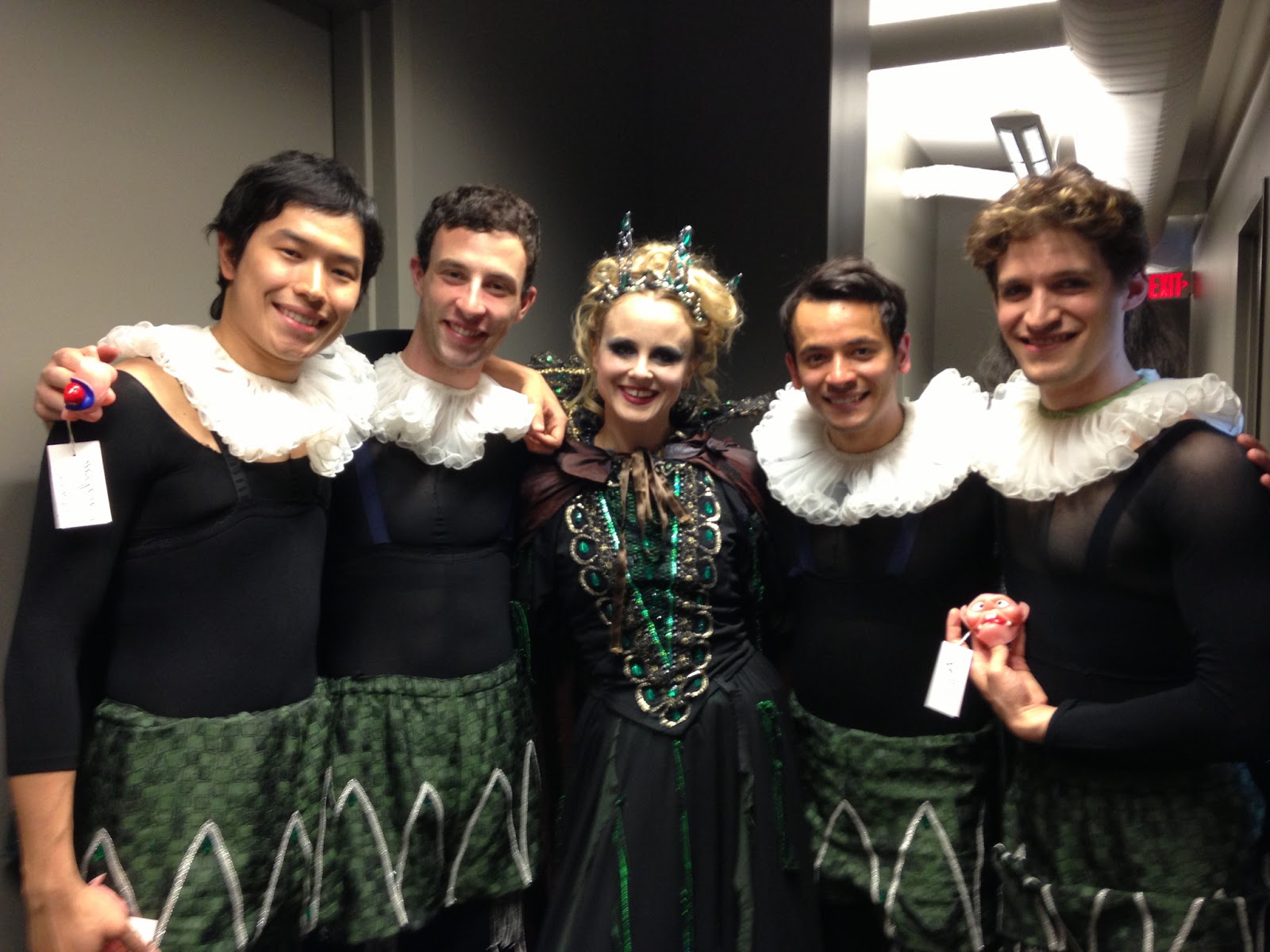
Sleeping Beauty rehearsal - Shura Baryshnikov as Carabosse & Emily Loscocco as the Lilac Fairy (Photo: A. Cemal Ekin)
Almost one year ago to the day, I was sitting on an Amtrak train writing a blog about my wonderful host family that I had spent a month living with in Providence, Rhode Island while guesting with Festival Ballet Providence. Although, I had some experience freelancing before that gig, it was my first as a full-time freelance artist. I am experiencing a bit of de ja vu since I am currently on a train heading home to Philly after saying goodbye to the same host family. Three weeks ago, I was brought back to the Ocean State to dance with FBP in their season closing production of Sleeping Beauty. It was due to the relationship that we had cultivated last year that I was asked to come back and dance with the company again.

A few weeks before I left Alaska, I contacted the director of Festival to see if he needed any guest artists for his production of Sleeping Beauty. Since the company is comprised of about 25 artists, it is not uncommon for them to hire guest artists to supplement their productions of these large scale classical ballets. At the time of contact, the company was in the theatre working on a different production and they weren't able to let me know if they needed me. I only found out that I was hired a little less than a week prior to my leaving. I had just arrived home from Anchorage when they let me know they needed me. After spending 3 months in Alaska, I only had 5 days at home before I hopped aboard a train to begin rehearsing. Sometimes, that is how work happens. I have learned to be prepared to travel at a moment's notice.
Providence is beautiful in the springtime

Although I do prefer a bit more warning, I was happy to return to Providence for many reasons. The moment that I was hired, I jokingly told the director that I wouldn't take the job if I couldn't stay with the host family I was with last year. He already knew that I would make this request and within an hour I had received a text from my host mother letting me know, "Of course you'll stay with us. I'll start cooking!" I was very happy to reconnect with the fam and to catch up on happenings of the past year.

I was also excited, surprisingly, to take class with the company again. Last year, I dreaded returning to the achingly slow classes that were founded by Agrippina Vaganova. Strict Russian-style classes are hard as can be. After training at the Kirov Academy of Ballet for a year, I was reluctant to return to that training, especially after cultivating myself into a Balanchine dancer with Pacific Northwest Ballet. What I wasn't expecting was how much strength I would gain from the technique during my time with FBP last season. This time around, I was excited to benefit from these classes. At times, I just couldn't make it through the painstakingly slow adagios that are often given. But I definitely felt that my technique got stronger over the last few weeks. I even had a mind-blowing revelation during one of the classes. Well, I didn't quite have this revelation, but the teacher explained one thing that had always irked me about Russian training. After giving a particularly hard combination, the ballet master, Cosmin Marculetiu, let the dancers in on a little secret about Vaganova training. He stated, "This combination wasn't created to make you feel good. It was made to make you fail." This statement validated all of my feelings about this style of training since I left KAB. I always felt like I was a horrible dancer in Russian classes. I didn't realize that this was exactly the point. Although, I don't prefer to feel like I am failing each day, I can now better appreciate this technique. It was developed to challenge you beyond your threshold, so that one can handle difficult choreography with ease.

One thing that I really appreciated upon my return to the company was how welcomed I felt by the dancers and staff. There has been a lot of turnover in the company since last season, so there were many new faces. Although there were new dancers, from the moment I walked into the studio I felt that people were genuinely happy to see me. There was only a rumor that I might be returning, so most of the dancers weren't expecting to see me when I arrived. I was embraced with warm smiles, hugs, and chatty catching up. Those that didn't know me quickly warmed up to me and, within a day or two, I felt almost as if I had met them the season prior. Being a freelancer, I am constantly faced with the discomfort of breaking into each company's unique bubble, which is commonly tight knit and competitive. It was nice to walk into the studio knowing that I didn't have to prove myself or awkwardly engage people until someone befriended me. I appreciate this more than one would probably think due to the fact that my work forces me to exist in a constant state outside of my comfort zone.

Taking this job was not a career boosting opportunity for me. I didn't return to Festival to be a star. The director didn't hire me to dance in place of his dancers. He already has beautiful, quality dancers who are more than qualified to dance their repertoire's leading roles. When I take work, I usually prefer to be the Prince or some other leading character. But if I am going to take a job where I am only needed to supplement corps roles, especially roles I most often performed during my apprenticeship/1st year in the corps, I would prefer for it to be in an environment that I enjoy. During the past three weeks, I was so happy to reconnect with old friends, make new friends, take quality classes, and perform with little stress in my roles. Last year, I felt like I was returning to my roots in Providence. This year, I felt like I was returning to see an old friend.

Carabosse & her crew of gargoyles

9.01.2012

Meet your link to getting hired - Lauren Menger

Often, when you are sending out emails, marketing yourself as a valuable freelance dancer to different companies, your emails are not going straight to the artistic director. If you are sending your info to a larger company, you will most likely be communicating with the company manager or the assistant to the artistic director. This is not typically the case, though, with smaller sized organizations. I have found that smaller companies who utilize freelance dancers don't typically have the finances to hire a massive network of administrators to handle everyday business. What often happens is one very respected and responsible dancer takes on a more administrative role and helps the company out with certain tasks. Taking on this responsibility can be very valuable, as it offers some great work experience outside of dancing and it saves the company some money. I have had a few great experiences working directly with a dancer while I am setting up work. The best part of this interaction is that you are already developing a direct relationship with somebody that you will eventually be dancing with before you arrive. Recently, prior to signing a contract to dance with Festival Ballet Providence in their production of Swan Lake, I communicated with a dancer about everything from contracts to housing and travel. Meet Lauren Menger.

Lauren in Balanchine's Apollo (Photo: Gene Schiavone)

The professional dance world is very small. And when I say small, I mean really, really small. I was performing in a festival with Seiskaya Ballet while solidifying work with Festival Ballet Providence. I mentioned, in passing, that I was communicating with a woman by the name of Lauren Menger during a conversation with the directors and fellow guest artist, Boston Ballet's Boyko Dossev, when all of their eyes lit up. Lauren was raised at Seiskaya Ballet. I knew that we were connecting through our email conversations, but this new connection really helped seal the deal. I find that I always end up befriending dancers that take a greater position in companies beyond their role as a dancer. This is not only because they are an integral part in me getting hired. I find that these dancers are intelligent, ambitious, interested in the greater picture of the organization beyond their own status, and proactive in creating work experience that may help them when their dance career ends. I have great respect for that. Needless to say, Lauren and I became great friends and supporters of each other during my five weeks in Providence. I pulled her aside and asked if she would be willing to speak about her dual role as a dancer and liason to the artistic director for my audience and, to our benefit, she agreed.
Lauren performing Swan Lake (photo: Gene Schiavone)

What is your position with the company and how long have you been doing this/these jobs?
 

I am a Company Dancer here at Festival Ballet Providence and have been dancing full time here for the past seven years. We do not have official ranks. In addition to my role as a company dancer, I am called Production Manager in the playbill, but in all actuality it is more like an Assistant to the Director position. I have been in this position for the last five years.

How did you fall into your current position as an assistant?


Towards the end of my second year as an apprentice here, the company became short staffed in the office. Mihailo (Misha) Djuric, our artistic director, needed help with a few odds and ends. He didn't want to hire another person because he felt a colleague of mine and I were capable of the job and could split the duties. That year we were each assigned specific jobs. We were given an hourly rate and it was a nice small addition to our income. The following year my colleague was preparing to retire, so I incurred her duties. The next few years were big transition years for the company. We lost an executive director, who was incredible at her job, our production manager, two marketing people, and a slew of other administrative workers. I had a business minor from my time at Indiana University and had no problem picking up odds and ends that needed to be taken care of. This company has always been extremely loyal to the dancers and has never cut our pay. They have had to sacrifice office workers for the good of the dancers. Since this is the case, I help Misha out, filling in these gaps whenever possible.

What specific responsibilities do you have outside of being a dancer with your company?
 

Outside of the company my responsibilities include, but are not limited to: ordering, budgeting and distributing company dancers' shoes, answering all auditioner correspondence, coordinating truck rentals for load in and load out of the theatre (this includes my husband, fellow dancer Roger Fonnegra, driving them on occasion), assisting with all dancer/staff relations, communicating important information with the dancers whenever needed, communicating and helping out new hires, assisting with travel arrangements for guests, and assisting Misha whenever he needs help. I have also created and organized fundraisers, contributed to a blog, and helped sell tickets/ads.

What do you do to help dancers that are coming in as guest artists?
 

I try to make their transition as seamless as possible. I fill them in on the odds and ends of dancing with Festival. I have offered up my house as a place to stay when we can, assist with driving them places, answer all their emails/questions, take care of their shoe needs, and keep them updated with all company info.

What is the most rewarding part of your job as an assistant?


At times, my job as assistant can be time consuming, but in the end it is actually very rewarding. One thing that the director and I have always shared is our desire for the arts and more importantly our company in Rhode Island to succeed. One doesn't really realize how much work it takes to put on a production until you really are behind the scenes of it. This company has so many talented artists and dancers. It gives me great pleasure to know that I was part of the hard work that went into getting them on stage. My work often goes unrewarded externally, but personally it makes me feel good knowing that I can put forth my efforts into something larger and more meaningful than just myself.

What advice would you give to dancers who are looking for guest work? How about once they arrive to dance with a company like Festival?


My advice to dancers looking for guest work would be to make it evident from the get-go what type of work you are looking for. I would also say to not be shy about sending your materials out, even if companies are not necessarily seeking guests. I usually keep an e-file of dancers who send me their info to go through when we need them. When they arrive to work, I would say that being flexible is the best quality to have; and not necessarily the ballet type. ;) Be ready to give up some of what you are used to, either stylistically or personality wise, to mesh well with the staff and company. Also, be open; companies like ours really enjoy having other people come and perform with us, and being friendly can't ever hurt.


Lauren was one of the most positive aspects of my time in Providence. Companies are very lucky to have certain people that are willing to give as much to the organization as they do to their art. After finishing her 7th season with Festival, Lauren and her husband Roger decided to take a great leap across the country to join Ballet Idaho, where they will both dance. Lauren is also taking on a major role teaching in the school, all while finishing up a Master's degree in Elementary Education.