 |
| An image from my work, Glass House - Dancers Toby Lewellen & Amanda Sewell |
There are many situations that may be better to leave unaddressed, but there are also a handful of topics that I strongly feel need to be touched upon. To offer all of my readers and those working dancers out there that don't have the luxury of turning to a union to deal with workplace issues, please read below to see my thoughts on how to best approach certain issues that may present themselves while on the job. With three years behind me working as a union delegate for Pacific Northwest Ballet and 5 years guiding my own career as a freelancer, I feel that I have a ton of valid experience to lend you some sound advice on how to respectfully respond to workplace issues.
Pay:
This is one area in which I have actually had relatively few issues throughout my freelance career. Of course, there is always that uncomfortable period when you are negotiating pay. But for the most part, employers respectfully follow through with paying dancers what they agreed, when they agreed to do it. Still though, every once in awhile I have heard of dancers that have had issues of non-payment.
When I have had an underpayment in the past, I have contacted my employer and casually mentioned it to them under the assumption that it was an honest mistake. This can be easier to discuss via email (and is more ideal for documentation purposes) because money is always a touchy topic to bring up. After an initial conversation, any errors or issues are usually resolved immediately (and with apologies).
I do remember an instance where an entire company of dancers wasn't paid for their work. After scrolling through angry, public Facebook outcries posted against the organization, I wondered how it could have been handled better. When a contract is being violated, it can be difficult to understand the correct route of execution to resolve complicated issues. For this reason, I hold legal insurance. This inexpensive assistance offers me access to talk directly to lawyers about any issues that I have free of charge beyond the $10 monthly rate. If their advice doesn't help you resolve your issue, they are also available to write letters to try to create an open path of communication. I strongly suggest stepping away from Facebook to announce any decrees against a company. While it may make you feel better, it could actually be used against you by the company, future employers, or cause issue if legal action needs to take place.
In the end, if there is no way to resolve the issue, you will need to determine if it is necessary for you to take legal action to reclaim your losses. I always suggest that you do everything in your power possible to avoid this. But a dancer should never feel like they can't protect themselves by accessing the power of the law.
Studio Conditions:
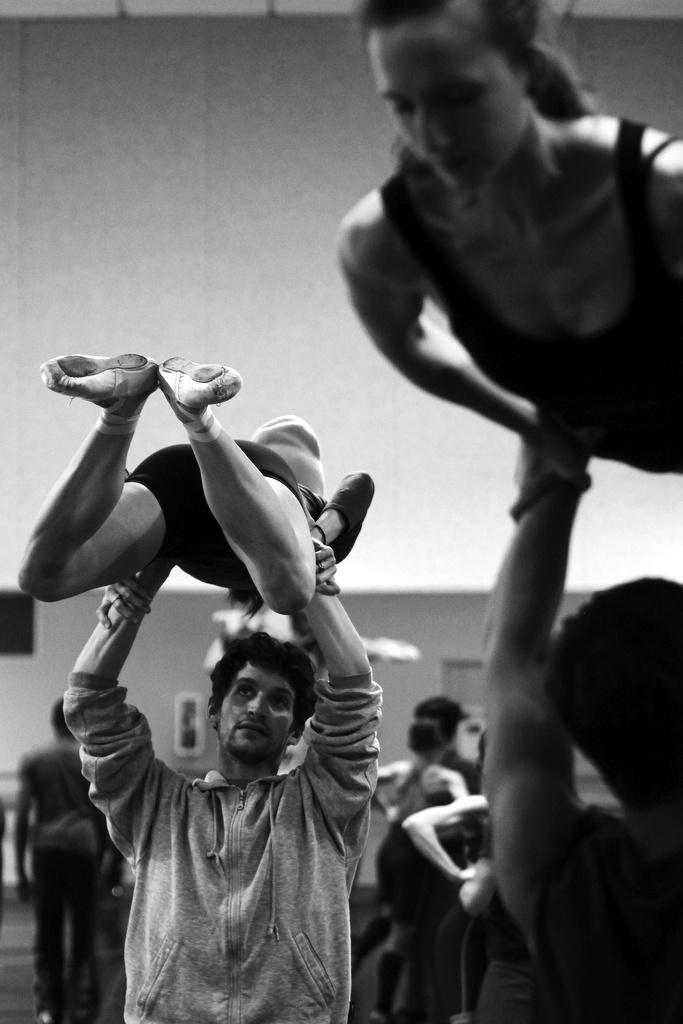 |
| Rehearsing w/Oakland Ballet in 2014 |
After a few days of not jumping in class, the director pulled me aside and stated that he wanted me participating until the end of class. I wasn't too pleased with his request, as it showed me that he didn't understand the inadequacies of the facility and why commonplace items like a sprung floor are important to have for dancers performing at a professional caliber. In response to him, I calmly stated that I was concerned that I was going to injure myself due to the lack of spring in the floor. He acknowledged my concern, but still requested that I continue jumping. At that point, I responded, "I understand where you are coming from, but I am concerned that I am going to become injured. And while I would like to follow through to please you, you are not providing workers compensation in the event that I do get injured. So, I do feel it is necessary for me to continue working in the capacity that I am." He calmly agreed, though, I don't think he was very pleased with my response.
The best route of action to deal with studio conditions is to approach these issues earlier than later. If you have been dancing on a floor that is frighteningly slippery for a month and you finally reach your maximum threshold, it may be confusing to a director if it was never brought up before. Be sure to approach issues sooner than later. The way in which I interacted with the director may not appropriate for all dancers. I was lucky enough that I was more senior and had experience with talking to management about issues. If you feel that certain conditions may be endangering your body, but don't feel comfortable to approach management about the issues, I would suggest reaching out to a more senior dancer or somebody who seems to be on a more friendly level with the director. There is always a pathway to communication, even if it isn't direct.
Rehearsal Conditions:
Some of you may look at the above section about studio conditions and assume that I am talking about the same thing. Let me differentiate this for you. Studio conditions involve the physical condition of the studio; like sprung floors, slippery floors, temperature, size, ceiling height, etc. Rehearsal conditions are the way that you are treated by whomever is running the rehearsal. Issues like this may include not being given appropriate breaks, demoralizing remarks, proper rehearsal structure, etc.
Back when I was dancing with another company in the Bay Area of San Francisco, I had an issue with rehearsal conditions. At the time, I had been flown in with one day's notice to replace an injured dancer in two difficult ballets. Within the time frame of 2 rehearsal days, I learned these two 20 minute ballets. This was an extremely difficult task, but my ability to retain quickly meant that we had more time to rehearse the ballets before they were put onstage. On the 3rd day of rehearsal, I was told by the ballet mistress that we would be running the 2nd ballet that I had just learned. We had hours of rehearsals and four more rehearsal days until we were in the theatre, so there was still some time left. I was concerned that running this fresh work full-out could possibly injure myself or cause me to injure my partner due to the lack of freshness in my mind. Instead of following common rehearsal procedures of breaking the work down into sections and rehearsing the sections separately before putting the whole ballet together, they wanted to skip to the final step.
As with the last section about studio conditions, it is important that you set up a pathway for communication. Make sure you say something before rehearsal gets underway. And if you aren't comfortable speaking up for yourself, don't be shy to ask for assistance. This should be approached in the same way as I mentioned above. You are responsible for your own health and career. And nobody knows what your body needs more than yourself.
Housing Issues:
 |
| Sometimes, people live differently...with ants all over their kitchen |
First things first, when you start to feel uncomfortable with your housing, take a step back and out of yourself. Are you particularly uncomfortable only because you are out of your comfort zone? This is normal. Maybe the host doesn't like to turn on the heat until it is well past cold. Or, perhaps, your host smokes marijuana and you prefer to keep your distance from such substances. There are many situations that can feel frightening when you are trying to find your own comfort outside of your home. I always remind myself that there are many ways to live. My way of living is only one way, not the only way.
If there really is an issue with something, kindly ask to discuss the issue with your host, if you are comfortable. Most of the time, these people are housing you because they love artists and want to make you feel at home. I have had host families go way out of their way to accommodate my comfort. It is always best to have a personal conversation first because things can get awkward if you have to go through certain channels to relay a point. If worse comes to worse and you need to have somebody outside of the housing address it, it is not improper to ask your employer to change your housing situation. In the end, you are on-site to deliver your product, which is your dancing. If you can't relax, rest, and properly recoup at the end of your work days, you are more likely to get injured, less valuable to your employer, and less likely to return to a gig again.
Issues with Fellow Dancers:
It was the first day of a job and the choreographer had asked us to pair up with a peer. We were asked to improvise a duet together based off of a certain concept. By the time we had finished up, the choreographer had really latched on to the phrase that my partner and I had created. After sharing our choreography with all of the dancers, we were asked to do this again. I'm not sure what happened between the first and second exercise, but my peers mood quickly turned from camaraderie to anger. We were trained in different styles of dance, therefore we had different approaches to creating movement. The place we were working from previously was mutual, but once we hit a roadblock all of this dancer's communication skills broke down.
My first reaction to this breakdown was to try to resolve it myself. I apologized to the dancer for the miscommunication and asked if he would be a little clearer in what he was asking. At that point, the dancer turned to me and told me that they would figure it out on their own and I should figure it out on my own, then we could just dance our separate solos like a duet beside each other. I was in my 30's by this point and wasn't really interested in having a tense, dramatic in-studio experience.
I was really proud of how I approached this situation. I didn't make a big fuss out of it. I raised my hand and waved the choreographer over to speak to us. Instead of laying the blame on my fellow dancer for the anger that he was displaying towards me, I calmly mentioned that we seemed to be having a misunderstanding and some miscommunication and needed assistance to get back on track. The dancer snapped back in defense of his actions. Instead of trying to rat this dancer out, I continued to keep my calm and said, "I'm not trying to cause any issues, I just feel that we need help communicating and I'm hoping that he can assist us with that." The choreographer saw what I was trying to do and did a really great job of calming the other dancer down and getting us back to a good place.
So, if you find yourself in a similar situation, please follow my lead and seek out assistance to create a dialogue versus assigning blame. Blaming your fellow dancer will only cause immediate and, likely, future issue. Dance is very competitive and dancers almost always want to be seen in the best light possible. If a dancer feels like you are trying to make them look bad for your own personal gain, you will never resolve any situation.
Injury:
When most people think of an injury, they imagine those scenes in movies when a dancer goes down screaming in pain and hugging an ankle or extremity. While these dramatic injuries do happen, there is also a range of problems that don't always manifest as immediate or cringe-inducing traumas. Back in 2014, when I suffered the injury that took me out of dancing with Oakland Ballet, I landed a Horton-based jump that required me to drop out of the air in a contraction over one leg. I didn't feel or hear any pop. And I didn't feel any dramatic event immediately after execution either. In fact, I didn't notice it until after we finished running this difficult Molissa Fenley work. At the completion of the run, I noticed that my back was becoming mildly tight, but it didn't present itself as anything more than a bit of overwork. It took me nearly an hour outside of rehearsal to notice that something had went wrong and about 3 hours to know that something had gone severely wrong. As my back continued to seize up to the point that I almost had to call an ambulance to get out of bed the next morning, it became quite clear that it was unlikely that I was going to be able to make it to rehearsal that day, let alone the performance 8 days from then.
This is how I approached the situation. If you have a dramatic, clear take you out kind of injury, there really isn't much conversation to be had. You know you will be recovering for awhile and need to address whether you have the right to workers compensation or not. But if you have an injury like the one that I had in Oakland or a slowly building stress injury (stress reaction or stress fracture), it may be harder to assess if you need to be replaced or if you can muster up the strength to move on without causing further harm.
If you find yourself dealing with an injury that may resolve in time for a show or that you can continue dancing on without causing irreparable damage, you need to assess where you are today, if it is feasible to make it until the end of the show, and what type of physical therapy you can get to help cope with pain, swelling, or immobility. Once I assessed my injury and considered the amount of time it could take for me to get back to a functional place, I used my fastest path of communication to talk to the director. He had given me his phone number, so I texted him that I was injured and needed to have a conversation. If you don't have such direct access, an email should suffice. I wasn't quite ready yet to take myself out of the program. So, I sought medical assistance and started to take the powerful steroid Prednisone. Once that kicked in and the muscles around my spine started to calm down, it became clear to me that I was in pain beyond the immobility caused by muscular spasm to protect my injured spine. At this point, I had to make a decision between selfishly holding on to my roles in the performance (under the assumption that I probably wouldn't make it through the show) or to humble myself and request to be replaced in the performance.
I chose to relieve the company from the stress over whether I would make it through to the end and take myself out of the performance. While this was a difficult conversation to have with the director, it was necessary for me to give him time to figure out how to handle replacing me. Some directors take this news well, and some do not. So, be prepared to have an honest conversation based on reality. If you are concerned that the director doesn't believe your injury is bad enough or that they may feel that you should push through your pain, perhaps consider getting your doctor involved in the conversation. As dancers we are taught to do whatever it takes to please our bosses. But I urge all dancers to take care of themselves and prevent making an already bad injury worse. It is not worth living in pain beyond your dancing years to make it through one program of performances.
Inappropriate Conduct:
 |
| Dance is no ordinary workplace (Photo: Jeffrey Crane) |
The first time that poor conduct occurs, one may not be completely aware of whether it was intentional or not. This doesn't matter. If you are uncomfortable with something that happened, I'd first suggest talking to your partner, ballet master, or whomever committed the act that was beyond your comfort zone. If everybody's intentions were good, a simply put, "Please don't touch me there when it isn't a part of the choreography" or "When you talk to me like that, it makes me uncomfortable," will likely lead to an immediate apology and acknowledgement of error (whether intentional or not). This will usually resolve any issue.
If you find that bringing up your discomfort doesn't yield a successful result, it is time that you bring this misconduct to the attention of somebody in power. First, assess whether you are overreacting to a norm in choreography. If you come from a more conservative background and aren't used to the requirements of partnering, perhaps ask a friend what they think.
Now that you've determined that what is happening is truly inappropriate, reach out. Always, always, always reach out to the Human Resources (HR) department first. This area of most organizations is responsible for dealing with any concerns or work place issues. In smaller organizations, though, these companies can't always afford to create an HR department or hire one employee devoted to HR. If this is the case, consider who would be best to talk to. A director isn't always the best person to chat with considering they often have a great deal of stress to work around. Additionally, you don't want to soil somebody's image if you mistook their intentions. If your dance partner or coworker is being inappropriate, talk to the person in charge of rehearsal privately. Do not do this in public, as there is nothing worse than embarrassing a colleague, especially if they didn't understand that what they were doing was inappropriate.
If the issue you have is with a Ballet Master or Rehearsal Director, you may need to approach the Artistic Director. Make sure that you know how you want to approach the director first. If you come off as overly emotional or aren't completely clear on what resolution you would like, they may see you as being dramatic and out of touch. You want them to take you seriously, so be clear and try to remain relatively calm.
If you have an issue with your director, there is no HR department available, and you have discussed your concern directly with them, you may need to reach out to somebody who the director respects. Be aware that if you reach out to a lawyer for advice and you have them contact the director, your relationship will change dramatically. And whether you want to keep your job or not, it will certainly end your time with that organization in the near future (whether on your terms or not). If you encounter this rare, unfortunate situation, be extremely sensitive, have clear examples, and try to stick to the facts. The moment that tears or yelling get involved, your voice is a lot less likely to be heard.


